
Stop Doing the Same Report Twice: What AI Agents Actually Save Swiss SMEs
Every Monday you chase overdue invoices, every morning you check the same three dashboards. AI Agents do it for you automatically — here's what that's really worth in hours and francs.
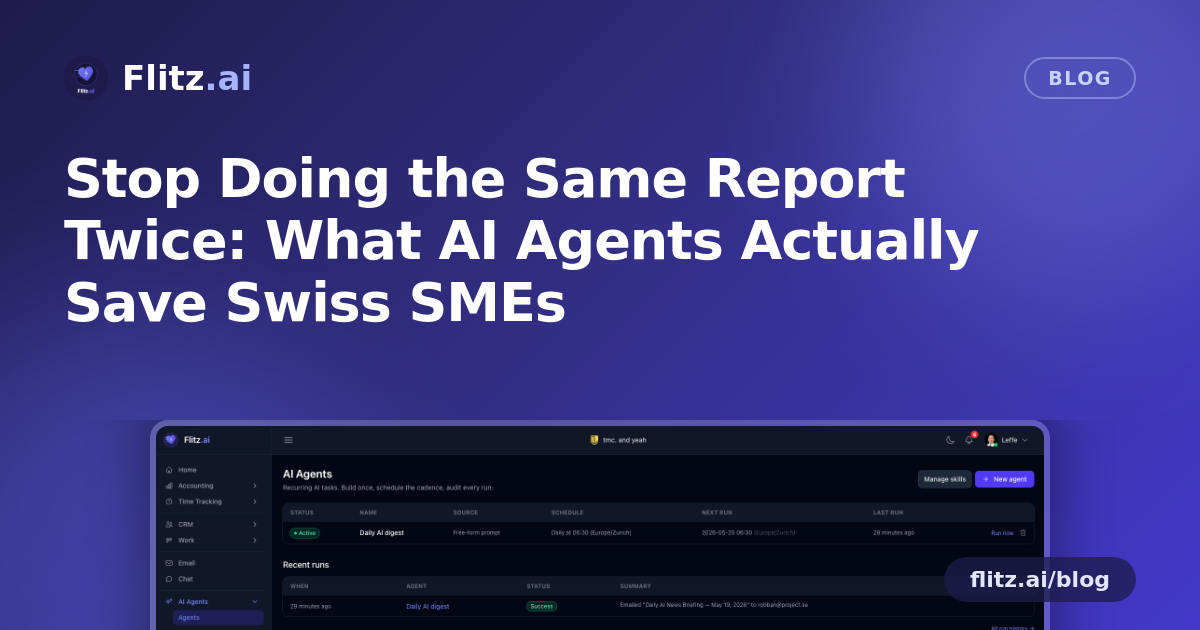
Think about your Monday morning. Before you've had your first coffee, you're probably already doing some version of the same ritual: opening the accounting software to check overdue invoices, scrolling through last week's support tickets, pulling numbers into a spreadsheet for a KPI overview, maybe forwarding a summary to a business partner. None of this is difficult work. It's just repetitive, and it eats time you don't get back.
For a small team, that "quick check" rarely takes five minutes. Between switching tools, re-running the same filters, copying figures into an email, and double-checking you didn't miss anything, a realistic estimate is 30 to 60 minutes a day for basic monitoring tasks alone — more if you're also compiling weekly or monthly reports for a fiduciary, a co-founder, or the bank. Multiply that across a five-day week and you're easily looking at 3 to 5 hours of manual, low-value work every single week, done by someone whose time is worth far more spent on customers, sales, or product.
The real cost of "I'll just do it manually"
At a loaded cost of even CHF 60–90 per hour for an owner-operator or office manager, 4 hours a week of manual reporting and monitoring adds up to roughly CHF 250–370 per week — or CHF 1,000 to 1,500 a month — spent on tasks that follow the exact same steps every time. Many SMEs try to solve this with a patchwork of Zapier, n8n, and spreadsheets, or by hiring a part-time analyst to keep the numbers flowing. Both come with their own overhead: automation platforms need to be built and maintained, and a part-time hire needs onboarding, context, and management time.
AI Agents in Flitz are built to remove that overhead entirely. Instead of a one-shot AI chat where you ask a question and get a single answer, an Agent is a Skill you define once — "email me a daily KPI digest," "list overdue invoices every Monday," "summarise last week's tickets" — that then runs on its own, on schedule, for as long as you need it.
How it actually works
Each Agent runs on the cadence you choose: hourly, daily, weekly, or monthly, in your own timezone, with control over the exact day of the week or month. When it runs, it doesn't guess — it pulls live data straight from your tenant using the same SQL toolkit that powers the Flitz AI Assistant, can search the public web if the task requires outside context, and can email the finished result directly to your inbox or anyone else's.
You don't need to write a technical workflow to get started. The Skills library ships with five ready-made system skills, and if none of them fit, you can describe what you want in a single sentence — the AI drafts the prompt, selects the right tools, and sets the output type for you. If you already have a useful AI Gallery artifact or a time-anchored prompt in the AI Assistant, the "Schedule this" button turns it into a recurring Agent in one click, no rebuilding required.
Why this beats a bigger stack
Chaining Zapier and n8n together to replicate this typically means paying for multiple subscriptions, maintaining brittle integrations, and still needing someone to interpret the output. A part-time analyst solves the interpretation problem but adds a fixed monthly cost regardless of workload. AI Agents fold both roles — the automation plumbing and the analysis — into a capability that's already included in your Flitz plan, working off the same live data as the rest of your business tools.
That matters because the value of AI isn't really in a clever one-off answer. It's in recurring leverage: the same useful check, done reliably, every day or every week, without you remembering to run it. Five well-chosen Agents can realistically replace an hour of manual monitoring every single morning — which, over a month, is the equivalent of reclaiming two to three full working days for a small team.
Nothing runs in a black box
A fair concern with "set it and forget it" automation is trust — what if the agent does something wrong, or emails the wrong person? Every run in Flitz is logged with its full output and recipient list, kept for 30 days and pruned automatically afterward. If an agent's output looks off, you can open the run history and see exactly what data it pulled, what it produced, and who received it. Nothing runs silently; you always have an audit trail to check against.
Where to start
- Pick one recurring task you already do manually every week — overdue invoice checks are a common starting point
- Use a system skill or describe it in a sentence and let the AI draft it
- Set the cadence and let it run for a week before adding a second agent
- Check the run history once to confirm the output matches what you'd have produced yourself
You can explore the full capability, including the Skills library and scheduling options, on the AI Agents feature page. For most small teams, the honest math is simple: a handful of scheduled agents cost nothing extra on top of your plan, and they buy back hours every week that were previously spent on work a computer was always better suited to do.