
Spreadsheets, Zapier, and a Standing Email Chain vs. One AI Agent That Just Does the Job
Swiss SMEs still stitch together spreadsheets, Zapier, and manual email chains for recurring tasks. Here's an honest comparison with AI Agents that do the work on their own.
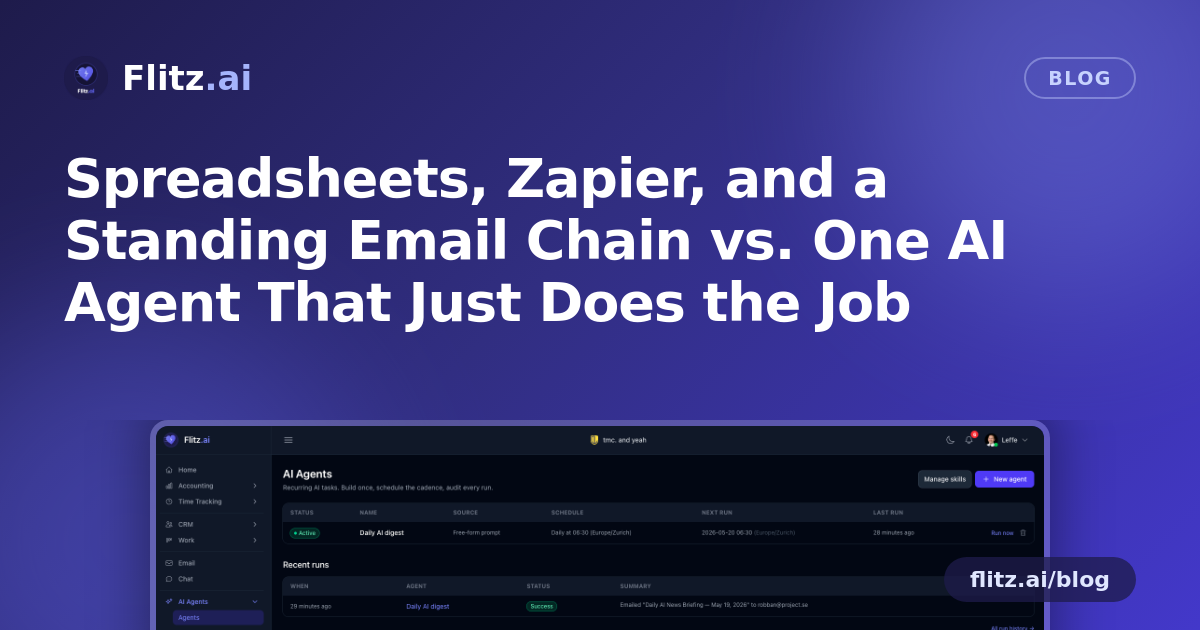
Every Swiss SME has a version of the same Monday morning ritual: someone opens a spreadsheet to check overdue invoices, someone else scrolls through support tickets to summarise last week, and a KPI number gets typed into an email and sent around "for visibility." It works. It also quietly eats an hour of someone's day, every single day, forever.
This is worth examining honestly, because the old way isn't stupid — it's just expensive in a way that's easy to ignore.
The old way: spreadsheets, Zapier, and point tools
Most SMEs end up with some combination of three things:
- Spreadsheets that someone updates manually, pulling numbers from the accounting system, the CRM, and a banking export, then formatting them for the boss.
- Zapier or n8n to connect apps that weren't built to talk to each other — triggering an email when a row changes, or pushing a CRM update into a Slack channel.
- A part-time analyst or office manager whose actual job, underneath the job title, is running the same five reports every week and emailing them to the right people.
These tools are genuinely useful on their own merits. Spreadsheets are flexible. Zapier and n8n are powerful once configured. A sharp analyst catches things automation misses. The trade-off is integration: every one of these pieces lives in its own silo, needs its own login, its own maintenance, and its own point of failure. When the automation breaks — an API key expires, a column gets renamed, a trigger silently stops firing — nobody notices until a report doesn't show up, and then nobody remembers how it was built.
What actually breaks down at scale
The honest problems with the old approach aren't about capability — Zapier can do a lot. They're about ownership and trust:
- No audit trail. If an automation sends the wrong number to the wrong person, good luck reconstructing what happened and why.
- Stale by design. A spreadsheet is a snapshot. The moment it's emailed, it's already out of date.
- Fragile glue. Connecting accounting, CRM, banking, and email through third-party automation means three vendors' worth of outages and breaking changes to manage.
- Knowledge walks out the door. When the one person who understands the Zapier chain leaves, the automation becomes a black box nobody wants to touch.
The integrated approach: AI Agents on your own data
AI Agents in Flitz start from a different premise: your accounting, invoicing, banking, CRM, and HR data already live in one system, so the AI doing the recurring work doesn't need brittle connectors — it reads live tenant data through the same SQL toolkit as the AI Assistant, can check the public web, and can email results directly from your account.
You define a Skill once — "email me a daily KPI digest," "list overdue invoices every Monday," "summarise last week's support tickets" — using a library of reusable templates with {{variable}} placeholders. Five system skills ship out of the box, and you can write your own. If you'd rather not write a prompt at all, you can describe the task in one sentence and the AI drafts the skill itself, filling in the prompt, the tools it needs, and the output format.
Then you schedule it: hourly, daily, weekly, or monthly, in your own timezone, with control over which day of the week or month it runs. From there it just happens, without anyone opening the app.
Trust, but verify: the audit trail
This is the part that matters most for finance and compliance-minded teams. Every run is logged — full output and full recipient list — and kept for 30 days before automatic pruning. If an agent sends a surprising number on a Tuesday, you can open the run history and see exactly what query it ran, what data it pulled, and who received it. That's a level of accountability most Zapier chains never had in the first place.
Beyond scheduled reports: Apps built from your own data
The same engine powers Apps: describe a small tool — "open invoices by age," "hours by project this month" — and the AI builds a self-contained HTML app from your live data. Unlike a spreadsheet, an app registers named read-only queries that Flitz re-runs every time it's opened, so a card pinned to your dashboard always shows today's numbers, not the numbers from the day it was built.
Pin an app to your own dashboard, or publish it to the Intranet Gallery so the whole team can use it. And anything — an app or a time-anchored AI Assistant prompt — can be turned into a scheduled agent in one click via "Schedule this."
Where this leaves the trade-off
Spreadsheets will always be more flexible for true one-off analysis. Zapier and n8n will always have broader third-party reach for niche apps outside your business platform. There's no pretending otherwise. But for the recurring work that defines most SME operations — the daily digest, the weekly overdue list, the monthly hours report — the value isn't flexibility, it's leverage you don't have to maintain. Five agents running quietly in the background replace an hour of manual work every single morning, with a full audit trail and zero integration risk, because the data never left the system.
You can see how the Skills library, scheduling, and Apps fit together on the AI Agents feature page.