
Quarter-End Without the Chaos: How an AI Copilot Handles Swiss SME Questions
A look at how Flitz's AI Assistant turns quarter-end scrambles, MWST checks, and new-hire questions into quick, plain-language answers.
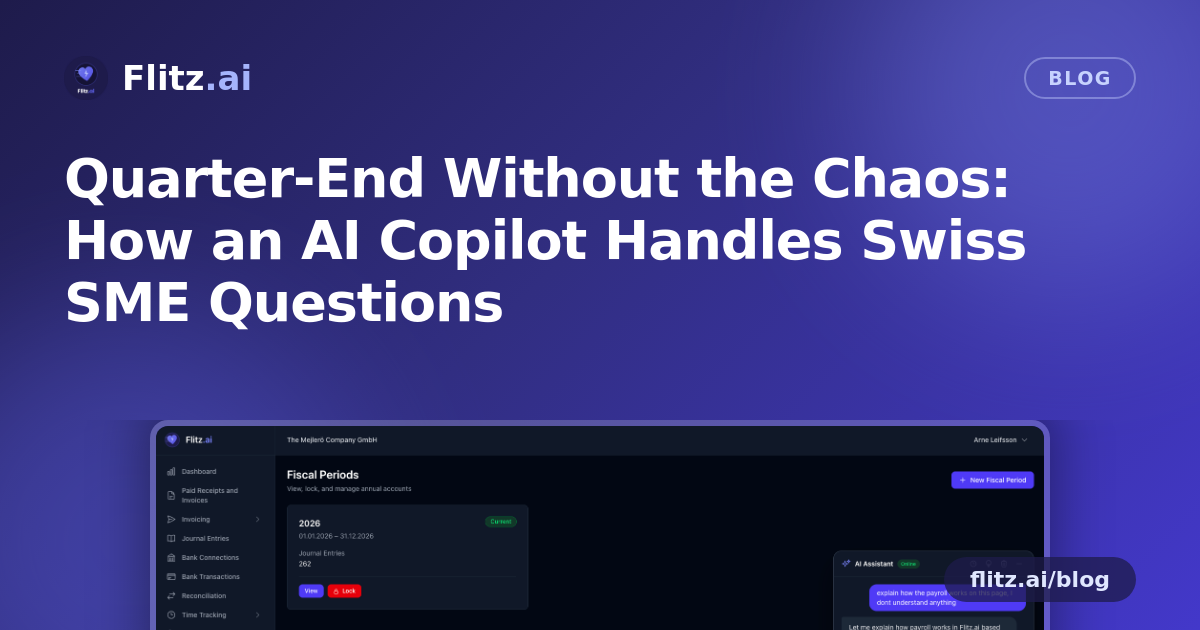
It's the last week of the quarter. Somewhere in a Swiss office — could be a small architecture firm, a physio practice, or a five-person e-commerce team — someone is trying to close the books, answer a client's invoice question, and figure out why a new employee's absence didn't sync to payroll. All before Friday.
This is a familiar scenario for many Swiss SMEs, and it's a good way to illustrate what actually changes when you have a conversational AI assistant sitting inside your business platform instead of scattered across spreadsheets, email threads, and separate tools.
The Setup: A Quarter-End Crunch
Let's imagine a small consulting company preparing its quarterly MWST (VAT) statement. The office manager needs three things fast: a clean list of outstanding invoices, confirmation that transactions are coded correctly under the Kontenrahmen KMU, and a quick sanity check on a client conversation that happened weeks ago about a disputed payment.
Normally, that means opening the accounting software, scrolling through transaction lists, searching old emails or chat threads, and maybe pinging a colleague who "remembers something about that invoice." Multiply this by every quarter-end, and the hours add up — hours that could go toward client work instead.
Where the AI Assistant Changes the Workflow
With the AI Assistant available as a floating panel on every page of Flitz, the office manager doesn't need to switch context. She simply asks, in plain language: "Show me all unpaid invoices from this quarter over CHF 500." The assistant queries the accounting data directly and returns the list — no manual filtering required.
Next, she wants to confirm a transaction was booked to the right account under Swiss accounting rules. Instead of cross-checking the Kontenrahmen KMU manually, she asks the assistant to review the entry. Because the AI Assistant understands OR (Swiss Code of Obligations) requirements, MWST logic, and the standard Kontenrahmen KMU structure, it can flag entries that look off — a real time-saver during a period when accuracy matters most.
Resolving the Client Dispute
The disputed invoice is trickier — it involves a conversation that happened across chat, not just a line in the ledger. Rather than digging through old messages, she asks the assistant to search chat history for mentions of the client's name and the invoice number. Because the assistant has access to conversations across channels, it surfaces the relevant thread in seconds, including the exact message where a payment extension was agreed upon. That context alone can resolve what would otherwise become a lengthy back-and-forth.
A New Hire Joins Mid-Quarter
Now add a second, equally common situation: a new employee started three weeks ago, and HR needs to check whether their time entries and absences are logging correctly before payroll runs. Instead of opening a separate HR module and manually cross-referencing dates, the manager asks the assistant directly: "How many hours has [the new hire] logged this month, and are there any recorded absences?"
The AI Assistant pulls this straight from time entries and project hours, giving an immediate, accurate answer. For a small team without a dedicated HR department, this kind of instant check reduces the risk of payroll errors slipping through during onboarding — a period when details are easy to miss.
Preparing for an Audit
Quarter-end often overlaps with the kind of scrutiny that makes business owners nervous: an external audit, a bank review, or simply a fiduciary partner asking for documentation. In this illustrative scenario, imagine the company's fiduciary calling to ask for a summary of account balances and recent transactions before a review meeting.
Instead of exporting reports or compiling numbers manually, the office manager can ask the assistant directly for account balances and a transaction summary for the period in question. Because the data lives inside the same platform used for daily bookkeeping, the answer reflects the actual state of the books — not a snapshot that's already a few days stale.
Why Plain-Language Access Matters
None of these tasks — checking invoices, verifying account codes, searching chat, reviewing hours, pulling balances — are unusual for a Swiss SME. What's different is how they get done. Instead of jumping between accounting software, a separate chat tool, and an HR system, the same conversational interface handles all of it, because it's connected to accounting data, chat history, and time entries at once.
For smaller teams without a full back-office department, this matters. It's not about replacing bookkeeping judgment or a fiduciary's expertise — it's about removing the friction of finding information that already exists somewhere in the system. The AI Assistant doesn't need a dedicated report or export; it answers the question that was actually asked, in the moment it was asked.
The Takeaway
Quarter-end, audits, and onboarding all share the same underlying challenge: someone needs a fast, accurate answer pulled from data spread across different parts of the business. An AI Assistant built specifically to understand Swiss accounting rules — and connected directly to your invoices, conversations, and time tracking — turns that scramble into a quick question and answer.
For Swiss SMEs juggling accounting, HR, and client communication with limited staff, that's less about novelty and more about getting a few real hours back every quarter.