
Spreadsheets vs. AI Copilot: Rethinking How Swiss SMEs Find Answers
Swiss SMEs still lose hours a week hunting for numbers across spreadsheets, email chains, and disconnected tools. Here's an honest look at that old way versus an AI assistant built into your business platform.
Ask any Swiss SME owner how they find a simple answer — "How much did we invoice Client X last quarter?" or "Who's been off sick this month?" — and you'll likely hear a sigh before the answer. It usually involves opening three different tools, scrolling through an inbox, or waiting for someone else to check a spreadsheet and get back to you.
This is the quiet tax that disconnected systems place on small businesses: not catastrophic, but constant. Let's look honestly at both approaches.
The Old Way: Spreadsheets, Email Chains, and Point Tools
For decades, this has been the default stack for Swiss SMEs:
- Spreadsheets for tracking balances, project hours, or client data — manually updated, easy to misplace a formula, and rarely a single source of truth.
- Email chains as the de facto archive for decisions, quotes, and client questions — searchable only if you remember the right keyword and the right inbox.
- Point tools — one app for accounting, another for time tracking, a third for chat or CRM — each with its own login, its own export format, and no shared memory between them.
To be fair, this approach isn't without merits. Spreadsheets are flexible and familiar. Dedicated point tools can be excellent at their one job. For a very small operation with simple needs, this patchwork can work — for a while.
But as a business grows, the cracks show. Information lives in silos. Answering a question that touches accounting, time tracking, and client communication — "Did we bill the hours we actually worked on this project, and did the client reply to our invoice email?" — means manually stitching together data from three places. That stitching is where errors creep in, where MWST figures get miscopied, and where hours get lost just searching instead of working.
The Hidden Costs of Disconnection
The real cost of the old way isn't any single tool — it's the gaps between them:
- Time lost context-switching between apps just to answer one question.
- Stale or duplicated data when the same number lives in two spreadsheets that drifted apart.
- Knowledge trapped with one person — if only the office manager knows which folder has the latest hours report, the business depends on them being reachable.
- Swiss-specific complexity — OR requirements, MWST rates, and the Kontenrahmen KMU structure don't map themselves onto a generic spreadsheet template. Getting it right takes expertise or a careful template someone built once and hopes nobody breaks.
The Integrated Approach: One Conversation, Every Answer
An AI assistant built directly into your business platform works differently because it isn't a separate tool bolted on — it's connected to the data that's already there: your accounting records, your chat history, your time entries.
Instead of opening five tabs, you simply ask, in plain language:
- "What's our current account balance?"
- "Show me unpaid invoices from last month."
- "Find my conversation with a client about their order last week."
- "How many hours did the team log on this project, and who's currently on leave?"
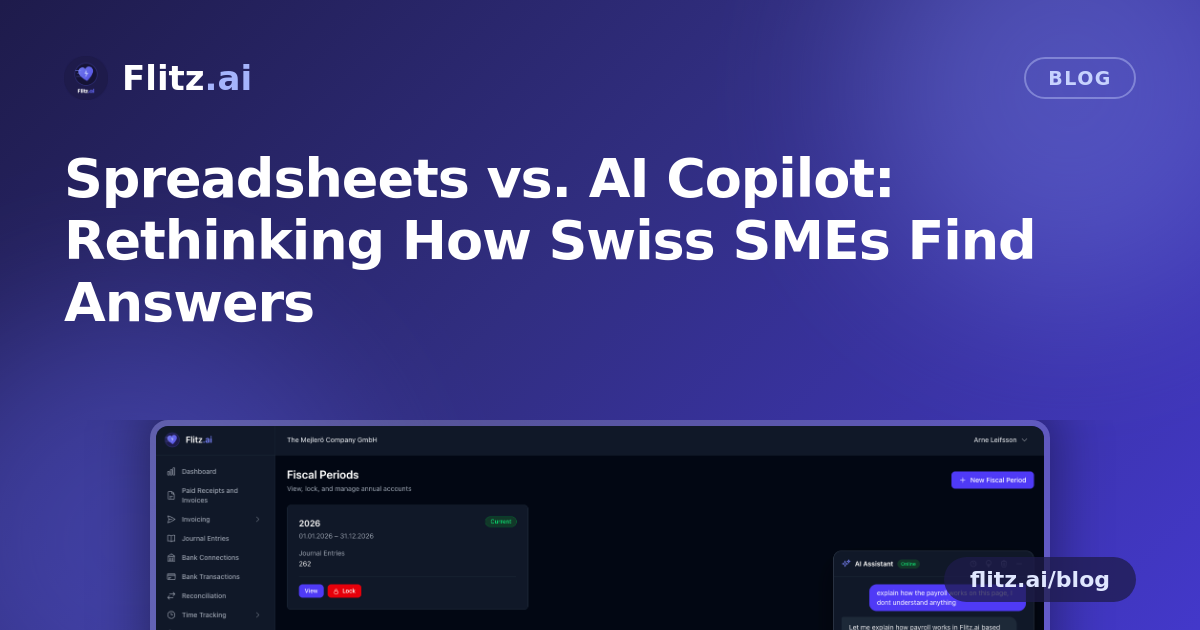
Because the assistant sits across accounting data, chat history, and time entries at once, it can answer questions that would otherwise require manually cross-referencing multiple systems. And because it's available everywhere as a floating panel on every page, you don't need to navigate to a specific module first — the answer comes to you, wherever you're working.
Built for Swiss Accounting, Not Retrofitted
A generic AI chatbot bolted onto a spreadsheet won't know what MWST treatment applies, or how the Kontenrahmen KMU is structured. An assistant designed for this context understands Swiss accounting rules natively — OR requirements, MWST, and the standard chart of accounts — so the answers it gives are grounded in the framework your fiduciary actually expects, not a generic approximation.
Weighing the Trade-offs Honestly
Consolidation isn't free of trade-offs. Moving away from familiar spreadsheets or a point tool you've used for years takes some adjustment. Teams need a short period to build the habit of asking instead of searching. And an AI assistant is only as good as the data connected to it — if your accounting entries are incomplete, the answers will reflect that.
But these trade-offs are front-loaded and temporary, while the costs of staying disconnected — lost time, duplicated effort, single points of failure — compound every week a business keeps operating that way.
Why Consolidation Wins for SMEs
Small and mid-sized businesses rarely have a dedicated analyst to reconcile spreadsheets or an IT team to maintain integrations between five tools. What they need is a way to get a trustworthy answer fast, without becoming an expert in each underlying system.
That's the real value of a conversational AI assistant connected to your entire platform: it collapses the time between "I have a question" and "I have an answer" — whether that question is about a balance, an invoice, a chat thread, or who's away this week. For Swiss SMEs juggling day-to-day operations with compliance obligations, that's not a convenience feature. It's time and clarity given back to the people actually running the business.