
Audit-Ready by Default: How AI Booking Keeps Swiss SMEs Compliant with OR and MWST Rules
Swiss bookkeeping law leaves little room for error. See how an AI Booking Agent applies Kontenrahmen KMU and correct MWST rates automatically, keeping every entry audit-ready from day one.
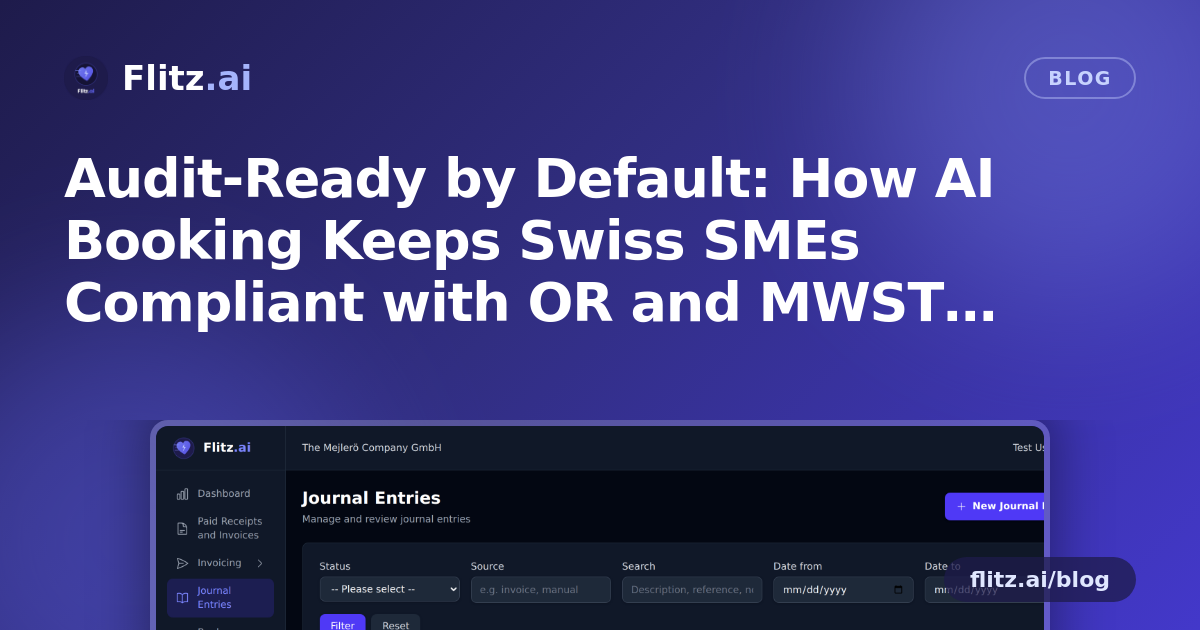
Swiss bookkeeping law is not a suggestion. Under the Code of Obligations (OR), every company — regardless of size — must keep books that are complete, accurate, and traceable. The Swiss VAT Act (MWSTG) adds another layer: correct tax rates, correct account allocation, and documentation that stands up if the Federal Tax Administration comes knocking. For most small and medium-sized businesses, this is where manual bookkeeping starts to creak.
What the law actually expects
Article 957 OR requires bookkeeping that follows recognized accounting principles: transactions must be recorded in the order they occur, supported by a receipt, and structured so that a third party (an auditor, a tax official, a fiduciary) can reconstruct the business situation without guesswork. This is the principle of Nachvollziehbarkeit — traceability. It's not enough to have the right numbers; you need a clear, unbroken chain from invoice to journal entry to financial statement.
On top of that, MWST rules require the correct rate to be applied to each transaction — currently 8.1% standard, 2.6% reduced, 3.8% for accommodation, or 0% where exempt. Misclassifying a single recurring expense at the wrong rate can compound into a real liability by the time of the annual VAT reconciliation.
Where manual processes create risk
Most compliance gaps don't come from negligence — they come from volume. An office manager processing dozens of supplier invoices a week, switching between PDF attachments, email, and accounting software, is bound to make small classification errors: booking a software subscription to the wrong expense account, applying the standard MWST rate to something that should be reduced, or simply falling behind and batch-entering invoices weeks later with no real paper trail for each decision.
Each of these is a small deviation. But under OR and MWST scrutiny, small deviations are exactly what trigger follow-up questions, corrections, and in the worst case, penalties. Fiduciaries spend a disproportionate amount of time each quarter simply cleaning up account misclassifications before they can close the books.
How the AI Booking Agent addresses this directly
The AI Booking Agent in Flitz.ai is built around the same principles the OR demands, applied automatically at the point an invoice enters the system:
- Double-entry journal entries (Soll/Haben) are generated for every invoice, matching the structural requirement of proper double-entry bookkeeping rather than a simplified single-entry log.
- Swiss Kontenrahmen KMU is used as the underlying chart of accounts, so classification follows the standard structure Swiss auditors and fiduciaries already expect — no custom account logic that needs explaining later.
- MWST rates are applied automatically — 8.1%, 2.6%, 3.8%, or 0% — based on the nature of the expense, reducing the chance that a reduced-rate purchase quietly gets booked at standard rate.
- Expense classification with 85%+ confidence triggers auto-booking, meaning routine, clearly identifiable invoices move straight into the books without waiting on manual review.
- Every entry is audited before it reaches your books, so lower-confidence cases are flagged rather than silently guessed — keeping human judgment in the loop exactly where it adds value.
Traceability as a by-product, not an afterthought
The compliance value here isn't just about getting the number right once. It's about producing a consistent, structured record — invoice, classification, MWST rate, journal entry — that a fiduciary or auditor can follow without reconstructing intent after the fact. That is precisely the traceability OR 957 is asking for, and it's far harder to guarantee when bookkeeping is done invoice-by-invoice under time pressure.
It also changes the rhythm of quarter-end and year-end closing. Instead of a fiduciary sifting through months of entries to find misclassifications before a VAT return or annual statement, the bulk of routine transactions are already correctly booked. Review time shifts toward the genuinely ambiguous cases — which is where accounting expertise should be spent in the first place.
What this means in practice
For an SME owner, this doesn't remove the need to understand your own numbers — it removes the risk that a mundane invoice gets booked incorrectly simply because someone was moving quickly on a Friday afternoon. For a fiduciary managing several client mandates, it means the books arriving for review are already structured to Kontenrahmen KMU standards, with MWST already applied at the correct rate, rather than needing to be untangled from scratch.
Swiss compliance requirements aren't going to get simpler. Kontenrahmen KMU, MWST rate distinctions, and OR traceability rules exist because financial records need to hold up to scrutiny — from tax authorities, auditors, or your own year-end review. Automating the mechanical part of that process, while keeping every entry auditable, is less about convenience and more about reducing the everyday risk that manual bookkeeping quietly carries.