
Year-End Close, Swiss Style: Spreadsheets vs. an Integrated Jahresabschluss
Comparing the old spreadsheet-and-email approach to closing the books with a fully integrated annual statement workflow — and why most Swiss SMEs are better off consolidating.
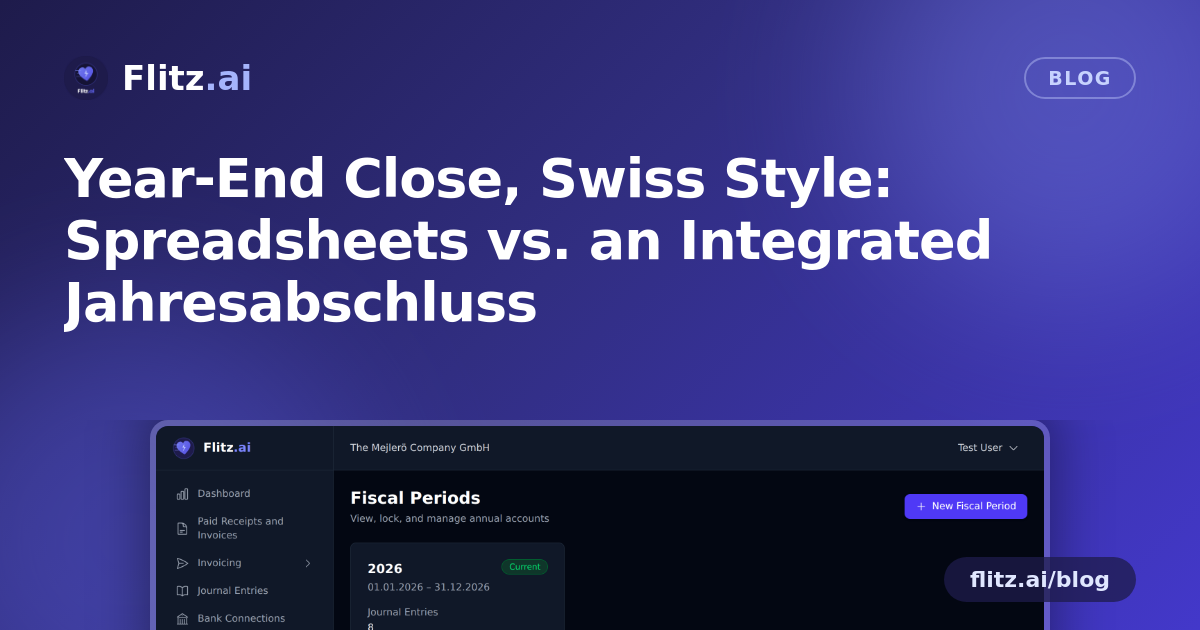
Every Swiss company, from the smallest sole proprietorship to a growing GmbH, faces the same annual ritual: closing the books and producing a Jahresabschluss that satisfies Art. 957ff OR. The requirements are clear — balance sheet, profit & loss statement, and, depending on size, notes. But the way SMEs get there varies wildly, and the method matters more than most business owners realize.
The Old Way: Spreadsheets, Exports, and Email Chains
For many small businesses and even some fiduciaries, year-end still looks like this: export the general ledger from the accounting tool, paste it into a spreadsheet, manually build the Bilanz and Erfolgsrechnung, then email drafts back and forth with the external accountant until the numbers agree.
This approach has one genuine advantage: flexibility. A spreadsheet can be formatted however you like, and anyone with basic Excel skills can adjust it on the fly. For a very small operation with few transactions, that flexibility can feel like enough.
But the trade-offs add up quickly:
- Manual transcription errors. Every copy-paste from the ledger to the spreadsheet is a chance to mistype a balance or miss an account.
- No single source of truth. Once the trial balance is exported, it's disconnected from the live bookkeeping. If a transaction gets corrected afterward, someone has to remember to update the spreadsheet too.
- Version chaos. "Final_v3_reviewed_FINAL.xlsx" sent over email is a familiar story for most Swiss office managers. Tracking which version is actually correct becomes its own project.
- No period locking. Nothing stops someone from accidentally editing a transaction in a period that's supposedly already closed, which can silently break a statement that was already signed off.
- Compliance risk. OR Art. 957ff has specific formatting and completeness expectations. A hand-built spreadsheet doesn't enforce that structure — it's on you to know and replicate it correctly every single year.
Disconnected Point Tools: A Step Up, But Still Fragmented
Some businesses graduate to dedicated accounting software that generates a balance sheet and P&L directly. This is a real improvement — the numbers come straight from the ledger, reducing transcription risk. But if that tool sits apart from invoicing, banking reconciliation, and general bookkeeping, you're still stitching data together from multiple systems, and any gap between them (a missed invoice, an unreconciled bank transaction) can throw off the trial balance before you even start the close.
Point tools also rarely offer proper fiscal period locking tied to the rest of your operations — so a payroll entry or a late invoice booked in HR or CRM modules might not even reach the accounting side until someone remembers to sync it manually.
The Integrated Approach: One Ledger, One Source of Truth
The alternative is generating your annual financial statements directly from the same bookkeeping data that already runs your invoicing, banking, and daily transactions — no export, no re-entry, no reconciliation between systems. That's the core idea behind the Annual Financial Statements feature in Flitz.
Because everything lives in one platform, the balance sheet, profit & loss statement, and trial balance (Saldenliste) are simply views generated from your existing entries — not a separate document someone has to build and maintain. This removes most of the manual-error risk that comes with spreadsheets and closes the gap that point tools leave open.
What This Looks Like in Practice
- Balance sheet and P&L on demand. Generated directly from your books, always reflecting the current state of your ledger.
- Trial balance included. The Saldenliste your fiduciary needs for review is available without a separate export.
- Fiscal period locking. Once a period is closed, it's locked — protecting the integrity of a statement that's already been reviewed or filed.
- OR Art. 957ff compliance built in. The structure follows Swiss statutory requirements, so you're not reverse-engineering formatting rules from scratch each year.
Weighing the Trade-Off Honestly
Spreadsheets remain genuinely more flexible for one-off, highly custom analysis. If your business has an unusual reporting need outside standard statutory statements, a spreadsheet can still be a useful companion tool. Nobody should pretend an integrated system replaces every ad-hoc need.
But for the core job — producing an accurate, compliant Jahresabschluss every year without recreating the wheel — the trade-off tips heavily toward consolidation. Fewer exports mean fewer chances for numbers to drift apart. Fiscal period locking means fewer nasty surprises after the fact. And because the statements come from the same data your team already uses daily for invoicing and banking, there's no reconciliation step just to get the year-end numbers to agree with reality.
What This Means for Swiss SMEs and Fiduciaries
For an SME owner, the appeal is time and peace of mind: less back-and-forth at year-end, and confidence that the statement reflects what actually happened in the business. For fiduciaries managing multiple clients, it means less time spent chasing spreadsheet versions and more time on actual review and advisory work.
Year-end closing isn't going away, and OR requirements aren't getting simpler. But the process of getting there doesn't have to involve spreadsheets, exports, and email chains. Keeping bookkeeping, invoicing, banking, and annual statements in one connected system is, for most Swiss SMEs, simply the less error-prone way to close the books.