
Bank Reconciliation, Reinvented: Spreadsheets vs. Smart Matching for Swiss SMEs
Manual bank reconciliation costs Swiss SMEs hours every month. Here's an honest look at spreadsheets vs. connected point tools vs. automated matching.
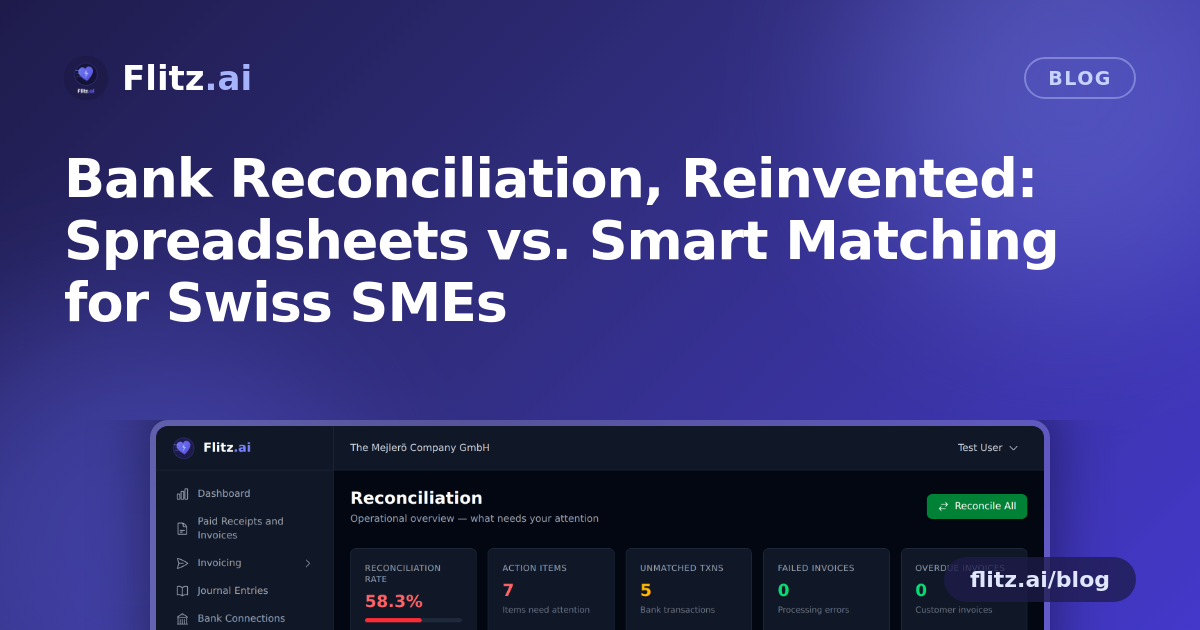
Ask any Swiss bookkeeper what eats up their month-end, and bank reconciliation is almost always near the top of the list. Matching incoming payments to outstanding invoices sounds simple in theory. In practice, it means downloading statements, opening a spreadsheet, cross-referencing payment references by eye, and chasing down the odd transaction that just does not fit the pattern.
Before looking at how automation changes this, it is worth being honest about the alternatives SMEs actually use today — because each one has real trade-offs.
The spreadsheet approach
For many small businesses, reconciliation still happens in Excel. A finance team exports a CSV from the bank, exports open invoices from accounting software, and manually eyeballs which payments match which invoices.
What works: It is flexible, requires no new software, and everyone already knows how to use it.
Where it breaks down: Spreadsheets do not scale with transaction volume. A single missed decimal, a truncated reference number, or a customer who pays a slightly different amount than invoiced (rounding, partial payment, bank fees) can throw off an entire reconciliation. Every month, someone has to redo the manual matching from scratch, and errors tend to surface only when the books do not balance — often weeks later.
The disconnected point-tool approach
Some SMEs try to solve this with a dedicated reconciliation tool that sits alongside their accounting and invoicing software. This is a step up: dedicated matching logic, some automation, maybe a nicer interface.
What works: Better than spreadsheets for volume, and purpose-built matching can catch things manual review misses.
Where it breaks down: The tool still needs to talk to your invoicing system and your bank exports, usually via manual CSV upload or brittle integrations. You end up maintaining yet another login, another export/import routine, and another place where data can go out of sync with the rest of your books. Email chains between bookkeeper, owner, and fiduciary to confirm "was this payment for invoice 1042 or 1043?" do not disappear — they just move around a different piece of software.
The integrated approach
An all-in-one platform that combines banking, invoicing, and accounting in one place removes the handoff points entirely. This is where Flitz's bank reconciliation feature is built to work differently.
Flitz connects directly to your bank in two ways: through the PostFinance Open Banking API for live transaction feeds, or via CSV import for any other Swiss bank. It also supports ISO 20022 (camt.053) statement files, the standard format increasingly used across Swiss banking infrastructure — so you are not locked out if your bank does not offer a direct API connection.
Three matching strategies instead of one
The core problem with basic reconciliation tools is that they rely on a single matching rule, which fails the moment a reference is missing or an amount is slightly off. Flitz uses three strategies together:
- QR reference matching — using the QR-bill reference number, the most reliable identifier when present.
- IBAN + amount matching — matching by sender account and payment amount when no reference is available.
- Fuzzy matching — catching near-matches where amounts or names are close but not exact, such as partial payments or minor rounding differences.
When confidence in a match reaches 90% or higher, Flitz reconciles it automatically. Lower-confidence matches are flagged for a quick manual review instead of forcing you to check everything by hand.
Weighing the trade-off honestly
Automated matching is not magic — it works best when invoices carry a QR reference and when bank data flows in consistently, which is exactly the environment Swiss QR-bill and camt.053 standards are designed to support. There will still be edge cases: cash deposits, unusual third-party payments, or manually entered references with typos. The difference is that these become the exception you review, not the rule you process for every single transaction.
Why consolidation wins for SMEs
The real cost of spreadsheets and disconnected tools is not any single mismatch — it is the recurring time spent on manual cross-checking, the risk of an error slipping into your MWST filing, and the mental overhead of maintaining multiple disconnected systems. When bank connections, invoicing, and reconciliation logic live in the same platform, a payment that comes in gets matched against the right invoice without anyone exporting a single CSV file.
For Swiss SMEs and the fiduciaries who support them, that means month-end closes faster, fewer emails asking "did this get paid?", and more confidence that the books are accurate before they are ever reviewed.