
The End of Manual Bank Reconciliation: How Swiss SMEs Can Reclaim Their Month-End
Matching bank statements to invoices line by line eats hours every month. See how automated bank reconciliation gives Swiss SMEs that time back.
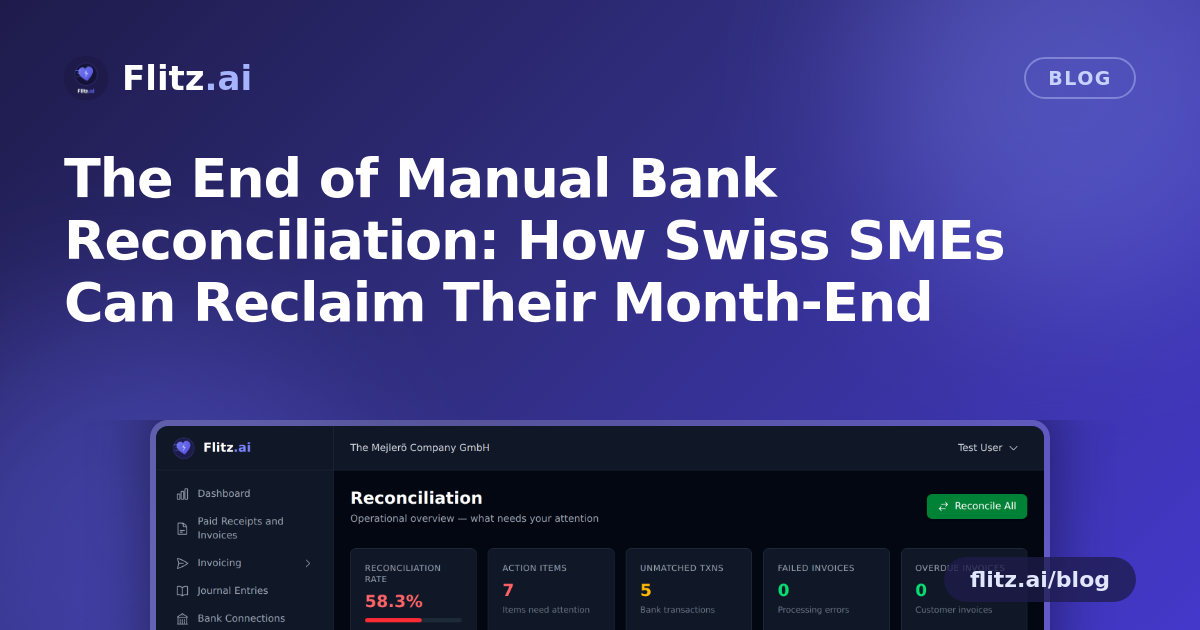
It's the last Friday of the month. Your bank statement has fifty new lines. Your invoicing tool has forty open invoices. And somewhere between the two, you have to figure out which payment belongs to which invoice — squinting at reference numbers, guessing at rounded amounts, and cross-checking names that never quite match what's printed on the invoice.
If you run a small or medium business in Switzerland, this scene probably feels familiar. Bank reconciliation is one of those tasks that sounds simple in theory — "just match the payments to the invoices" — but in practice turns into an hour-long (or longer) exercise of copy-pasting, searching, and double-checking. Miss a payment and a client gets an unnecessary reminder. Mismatch one and your books are wrong at year-end. Multiply that by every account, every month, every year, and it's easy to see why reconciliation quietly becomes one of the most time-consuming parts of running a business.
Why This Task Is Harder Than It Should Be
Part of the problem is fragmentation. Some clients pay with a QR reference, others just type your company name — sometimes misspelled. Some banks give you a clean camt.053 file, others hand you a CSV with columns in a different order every export. If you're a fiduciary or office manager handling multiple accounts or multiple clients, you're doing this dance repeatedly, with slightly different rules each time.
None of this is due to carelessness on your part. It's simply that payment data isn't standardized enough, and matching it to your accounting records by eye is slow and error-prone by nature — no matter how organized you are.
How Flitz.ai Removes the Manual Work
Flitz.ai's bank reconciliation feature is built specifically to close this gap between "money arrived" and "invoice marked as paid" — automatically, and in a way that respects how Swiss banking actually works.
Connect once, or import as needed
You can link your account directly through the PostFinance Open Banking API for a live, continuous feed of transactions. If your bank isn't connected via API, you can simply upload a CSV export — Flitz.ai supports CSV files from any Swiss bank, so you're not locked out if your institution works differently. On top of that, Flitz.ai reads ISO 20022 camt.053 statements, the standard format most Swiss banks can generate, giving you a structured, reliable alternative to CSV whenever you need it.
Three ways to match a payment, not just one
This is where the real accuracy comes from. Instead of relying on a single matching rule that breaks the moment a client does something slightly unusual, Flitz.ai applies three strategies together:
- QR reference matching — the most precise method, using the unique reference number tied to a specific invoice.
- IBAN and amount matching — pairing a known sender account with the exact invoice amount when no QR reference is present.
- Fuzzy matching — catching the messier cases, such as slightly different amounts, partial payments, or company names typed with typos or abbreviations.
When Flitz.ai reaches 90%+ confidence that a transaction belongs to a specific invoice, it reconciles it automatically — no clicking required. Anything below that threshold is flagged for a quick manual check, so you keep full control without having to review every single line.
What This Actually Changes for Your Month-End
The practical effect is straightforward: the majority of your incoming payments get matched and marked as paid without you touching them. Your accounts receivable stay accurate in near real time, which means fewer awkward reminder emails to clients who already paid, and a much clearer picture of who actually still owes you money.
For office managers juggling this across several bank accounts, or fiduciaries reconciling on behalf of multiple clients, the time saved compounds quickly. What used to be a recurring block of manual, error-prone work becomes a short review of the few edge cases the system wasn't fully confident about.
Less Guessing, More Certainty
Bank reconciliation will probably never disappear entirely as a concept — money still needs to be matched to invoices. But it doesn't need to be a manual, line-by-line chore that eats into time better spent running your business. With direct bank connectivity, flexible import options, and three complementary matching strategies working together, Flitz.ai handles the repetitive matching so you can spend your month-end reviewing exceptions, not chasing every single payment by hand.