
5 Common Swiss VAT Reporting Mistakes — and How to Stop Making Them
MWST filing trips up even experienced Swiss SMEs. Here are the five most common VAT reporting mistakes, why they happen, and how automation prevents them.
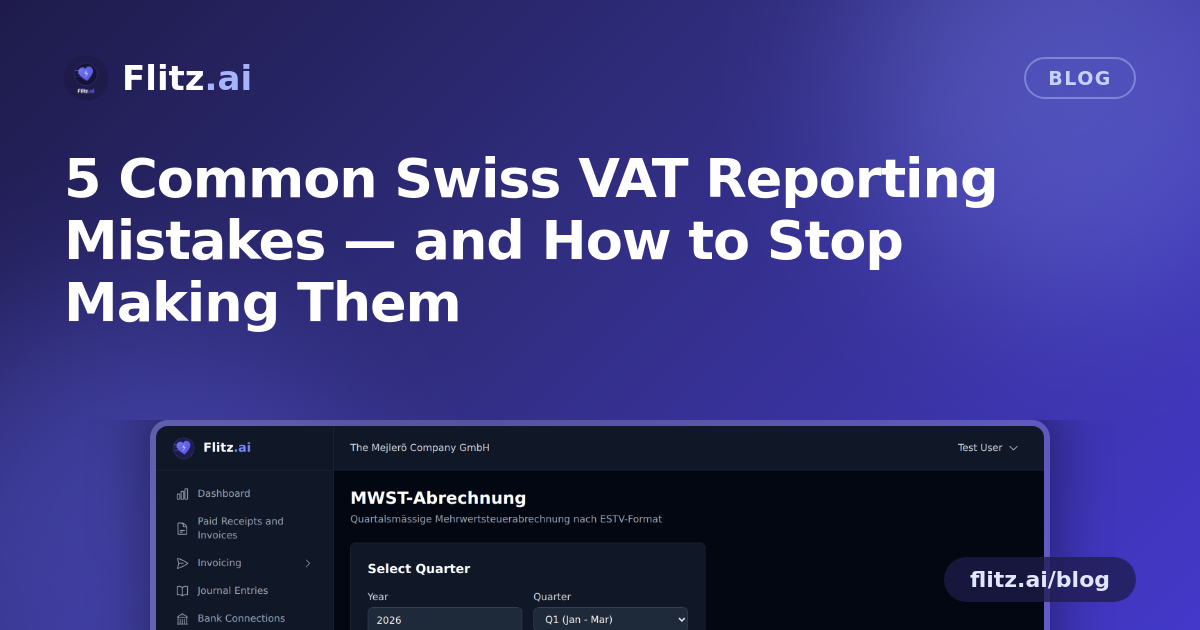
Filing MWST returns is one of those recurring tasks that feels routine — until it isn't. A wrong rate here, a missed deadline there, and suddenly a small bookkeeping slip turns into a correction letter from the Steuerverwaltung. Most Swiss SMEs don't make these mistakes because they're careless. They make them because manual VAT compilation leaves too many opportunities for something to slip through.
Here are the five mistakes we see most often, why they keep happening, and how the right setup avoids them entirely.
1. Applying the wrong VAT rate
Switzerland currently runs four MWST rates: 8.1%, 3.8%, 2.6%, and 0%. Depending on the industry, a business might issue invoices that mix several of these in a single month — standard goods at 8.1%, accommodation services at 3.8%, groceries or books at 2.6%, and exports or exempt services at 0%.
The mistake happens when someone manually types a rate into an invoice or journal entry and picks the wrong one, or applies last year's rate out of habit after a rate change. It's an easy typo, and it's rarely caught until the quarterly total looks off — or worse, until an audit.
The fix: automatic VAT code assignment per transaction removes the guesswork. Each transaction is tagged correctly against the applicable rate at the point of booking, not reconstructed later from memory.
2. Manually compiling figures from multiple sources
Many businesses still pull numbers from invoicing software, a separate accounting tool, and a spreadsheet of bank transactions, then merge them by hand into the report format the tax authority expects. Every manual transfer between systems is a chance to double-count, miss a line, or copy a figure into the wrong box.
The fix: when your bookkeeping, invoicing, and banking data live in one place, there's nothing to compile. The report is generated directly from the same ledger that produced your invoices and recorded your payments — with one-click generation instead of a spreadsheet marathon.
3. Missing the monthly-vs-quarterly deadline pattern
Some businesses report quarterly, others — often those with regular refund positions — report monthly. The mistake is treating the reporting rhythm as an afterthought rather than a setting: deadlines get missed because nobody adjusted the calendar after switching methods, or a monthly filer keeps preparing figures on a quarterly cadence out of habit.
The fix: choose your reporting period once — monthly or quarterly — and let the system generate reports on that cadence automatically. No recalculating the schedule every time.
4. Formatting the report incorrectly for filing
Even when the underlying numbers are correct, the Steuerverwaltung expects figures presented in a specific structure. A report that's accurate but poorly formatted can still cause delays, rejected submissions, or back-and-forth correspondence to clarify line items.
The fix: a report that's formatted exactly as required for filing from the start removes this friction entirely. There's no reformatting step between "our numbers" and "what the tax authority needs to see."
5. Reconciling VAT codes after the fact
A subtler mistake: entering transactions without VAT coding at all, then trying to go back at quarter-end and assign codes retroactively. By then, context is lost — was that supplier invoice for goods or services? Was that expense reimbursable or subject to input tax? Reconstructing this after weeks or months almost guarantees errors.
The fix: code transactions automatically as they're booked, not in a rushed cleanup before the deadline. This is the difference between VAT reporting being a real-time byproduct of bookkeeping versus a stressful end-of-period project.
What these mistakes actually cost
None of these errors are dramatic on their own. But together they cost time — hours spent reconciling, chasing figures, and reformatting — and they carry real risk: incorrect filings can trigger queries from the Steuerverwaltung, corrections, or in the worst case, penalties for consistently inaccurate reporting. For a fiduciary managing VAT across several client mandates, the same mistakes multiplied across clients become a serious drag on capacity.
Reporting that reflects reality, not reconstruction
The common thread across all five mistakes is the same: they happen when VAT reporting is treated as a separate task performed after bookkeeping is done, using data pulled together from different places. When VAT codes are assigned automatically at the point of transaction, and the report is generated directly from that same bookkeeping data — formatted correctly, on the schedule you've chosen — there's very little left to get wrong.
That's the practical value of automatic MWST report generation: not just saving time, but removing the specific steps where these five mistakes tend to creep in.