
5 Endpoint Security Mistakes Swiss SMEs Keep Making (And How to Stop)
From forgotten laptops to breach notifications that arrive weeks too late — here are the endpoint security mistakes that cost Swiss SMEs the most, and how to fix them.
Most Swiss small and medium businesses don't get breached because they lack awareness. They get breached because endpoint security is scattered across half-remembered tools, manual checklists, and a vague hope that "the antivirus is doing something." Here are the mistakes we see most often — and what they actually cost.
Mistake 1: Not knowing what devices even exist
It's astonishingly common for a company to have no accurate list of which Macs and PCs are active in the business. Someone's old laptop is still logging into the VPN. A contractor's machine from last year was never wiped. Nobody can say for certain how many endpoints need protecting, let alone whether they're protected.
This happens because device inventory and security tooling usually live in different systems — if they live anywhere at all. The cost is simple: you cannot secure what you cannot see. An unknown device is an unmonitored device, and unmonitored devices are where incidents start and go unnoticed the longest.
The fix is structural, not procedural: every endpoint should automatically link to its asset record by MAC address or serial number the moment the protection agent is installed. No spreadsheet to maintain, no onboarding step to forget. One list, always current.
Mistake 2: Treating antivirus as a "set and forget" checkbox
Many SMEs install antivirus once, during setup, and never think about it again. Signatures go stale, scheduled scans quietly stop running, and nobody checks whether disk encryption or screen lock are actually enforced across the fleet.
This happens because traditional antivirus tools report into a dashboard nobody logs into regularly. The cost is a false sense of security — you believe you're covered, but a CIS-benchmark audit would reveal half your devices are missing basic hygiene: no disk encryption, firewall off, screen lock disabled, outdated signatures.
The fix is continuous, automated scoring rather than a one-time setup. A per-device CIS-benchmark posture score, calculated continuously, tells you in real time which machines are actually compliant — not which machines you assume are compliant.
Mistake 3: Relying on signature-based detection alone
Classic antivirus catches known malware signatures and stops there. It misses the threats that matter most to SMEs today: phishing-delivered payloads, command-and-control traffic, and indicators of compromise that security researchers have already flagged elsewhere.
This happens because many budget or legacy AV tools were never designed to cross-reference live threat intelligence. The cost is a dangerous blind spot — the malware that security communities already know about still slips through because your tool never checked.
The fix is layering detection methods: ClamAV and YARA scanning for known malware patterns, combined with abuse.ch threat-intelligence IOC matching on every endpoint. Together they catch both the textbook virus and the more current, intelligence-driven threat.
Mistake 4: No way to isolate a compromised machine quickly
When a device is flagged as compromised, the clock matters. Yet in many SMEs, isolating a machine means physically walking over to unplug a network cable, or calling an external IT provider and waiting for a callback. Meanwhile the infected machine stays connected, potentially spreading laterally or exfiltrating data.
This happens because incident response and endpoint visibility usually sit in separate tools, if response is even planned for at all. The cost compounds by the hour: more exposure, more potential data movement, more to explain later.
The fix is one-click network isolation — and release once the device is clean — straight from the fleet dashboard, without a site visit or a support ticket. Containment becomes a decision, not a logistics problem.
Mistake 5: Missing the legal clock on breach notification
Perhaps the costliest mistake: a high-severity detection happens, gets handled technically, and nobody connects it to the legal obligation to document — and in some cases report — the incident under GDPR-style breach rules. By the time someone realizes a notification deadline exists, it has often already passed.
This happens because security tooling and compliance obligations are usually managed by different people, or not managed together at all. The cost isn't just a fine risk — it's the scramble to reconstruct a timeline weeks after the fact, with incomplete logs and fading memories.
The fix is making compliance automatic at the moment of detection: high-severity alerts should open a GDPR breach record immediately, starting the clock correctly and keeping a clean, timestamped record from the start.
Bringing it together
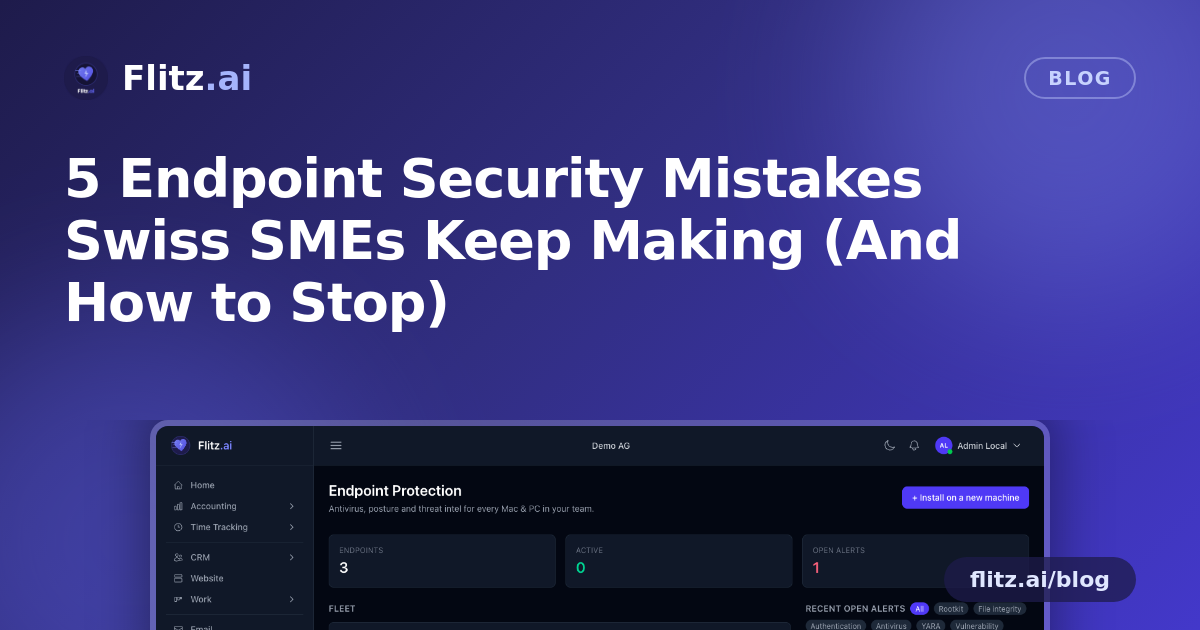
Each of these mistakes is really the same root cause wearing a different hat: endpoint security tools that don't talk to each other, don't talk to your asset inventory, and don't talk to your compliance obligations. Flitz's Antivirus & Endpoint Protection module runs ClamAV and YARA scanning, abuse.ch threat-intel matching, and CIS-benchmark posture scoring continuously on every company Mac and PC, with one-click isolation and automatic GDPR breach records on high-severity detections — all tenant-scoped, so your devices, alerts, and scans never cross paths with another company's data.
It's built to replace the likes of CrowdStrike, SentinelOne, Bitdefender GravityZone, and Jamf Protect — not as a bolted-on extra, but as a natural extension of the same platform that already runs your accounting, invoicing, and HR.
Security isn't a product you buy once. It's a process that has to be visible every day — on every device, automatically.