
Endpoint Security Without an IT Department: What It Really Costs SMEs to DIY
Chasing antivirus alerts, patch status and lost laptops across a small fleet quietly eats hours every week. Here's what that time is really worth — and how to get it back.
Ask most Swiss SME owners who is "responsible for IT security" and you'll often get a shrug, a name of someone who "is good with computers," or an outsourced contract that gets reviewed once a year. Meanwhile, every laptop and desktop in the company is quietly exposed — no antivirus running, no idea whether the disk is encrypted, no record of which device belongs to whom. Nobody is being negligent. There simply isn't a dedicated security team to keep checking.
That gap doesn't just create risk. It creates a recurring, invisible time cost that most businesses never add up.
The manual routine nobody accounts for
Without a proper security operations layer, keeping a small fleet of Macs and PCs reasonably safe usually means a patchwork of manual tasks, typically split between an office manager and whoever plays "IT person" on the side:
- Checking that antivirus software is actually installed and up to date on every machine — including the laptop the new hire brought from home
- Manually running or nagging staff to run scans after a suspicious email or USB stick
- Trying to remember which devices have disk encryption, a firewall, and a screen lock enabled
- Tracking down a laptop's serial number and owner when something goes wrong
- Figuring out, after the fact, whether an incident needs to be reported under data protection law — and by when
Individually, none of these tasks look dramatic. Added up across a fleet of 10, 20, or 40 devices, on a realistic cadence, this routine easily consumes 3 to 6 hours a week for a small business — more if there's ever an actual incident to chase down. At a blended internal cost of CHF 60–90 per hour for the person doing it, that's roughly CHF 750 to CHF 2,300 a month spent on manual security housekeeping that produces no revenue and, worse, still leaves gaps.
And that's before you look at licensing
Enterprise-grade endpoint protection tools — CrowdStrike, SentinelOne, Bitdefender GravityZone, Jamf Protect — solve the technical problem but add a separate subscription, a separate console to log into, and often a separate vendor relationship to manage. For a company running 15–30 endpoints, that's frequently another few hundred francs a month, on top of the internal hours still needed to actually watch the dashboard.
What continuous, automated protection changes
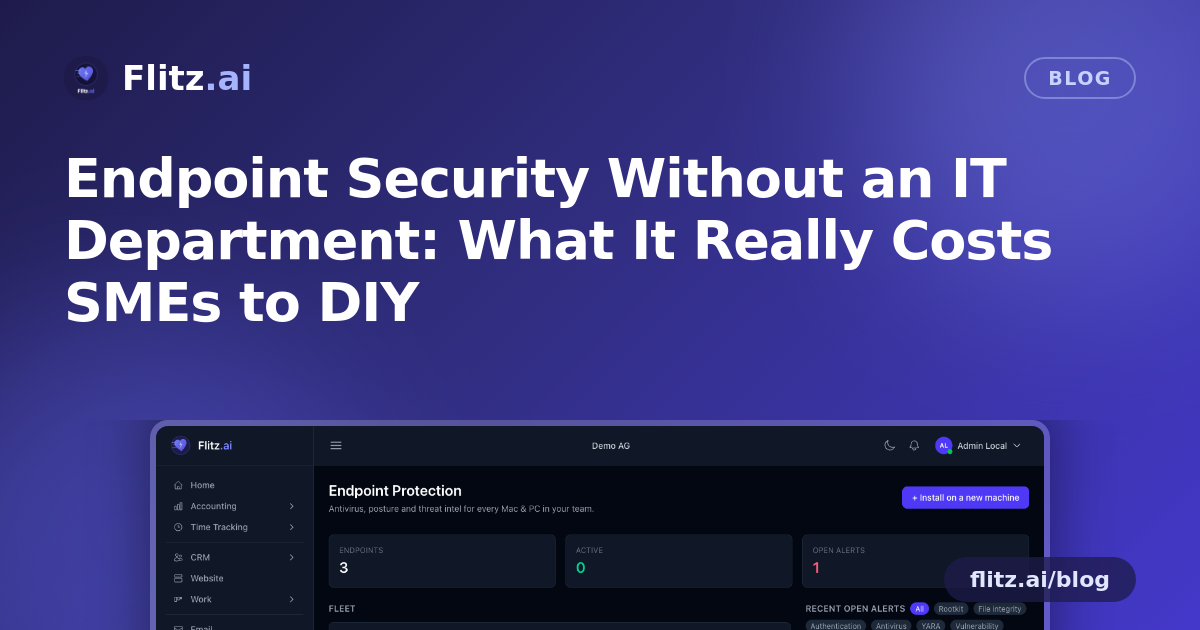
Flitz's Antivirus & Endpoint Protection module replaces that whole manual loop with a lightweight agent installed once on every company Mac and PC. From that point on, the fleet dashboard does the watching, not your team.
Continuous scanning, not "remember to run it"
ClamAV and YARA antivirus engines scan on a schedule or on demand, with abuse.ch threat-intelligence matching checking every endpoint against known indicators of compromise. Nobody has to remember to trigger a scan after a suspicious attachment — it's already running.
Posture scoring instead of guesswork
Every device gets a CIS-benchmark security-posture score covering disk encryption, firewall status, screen lock, and signature freshness. Instead of asking "do we think laptop 14 has encryption on?", you open the dashboard and see the answer.
One click instead of a phone tree
If a machine looks compromised, isolating it from the network — or releasing it once it's clean — takes one click from the fleet dashboard. No calling the user, no manually pulling network cables, no waiting for an external vendor to respond.
The compliance clock, handled automatically
High-severity detections automatically open an alert, and where required, start the GDPR breach-notification clock. That single step — often the most stressful and time-pressured part of any incident — no longer depends on someone remembering the rules under pressure.
No separate inventory to maintain
Every endpoint auto-links to its IT-Inventory asset by MAC address or serial number, so there's no second spreadsheet to keep in sync with who has which device. And because every device, alert, and scan is tenant-scoped, your data stays strictly isolated to your company — no cross-tenant exposure, even though the platform serves many SMEs.
Where the hours actually go
The real value isn't just replacing four separate security vendors with one built-in module, though that alone removes a stack of invoices and logins. It's what your team stops doing every week: no more manual scan reminders, no more guessing at encryption status, no more scrambling to find a serial number during an incident. That reclaimed time — realistically several hours a week for a small team — goes back to serving customers, closing deals, or simply going home on time.
Security software that requires constant manual attention isn't really saving you anything; it's just shifting the cost from a licence fee to your team's calendar. Built-in, continuously running endpoint protection is designed to give that time back.