
Audit Week Without the Panic: How One Swiss SME Could Handle GDPR/DSG in a Single Workspace
A fictional but realistic walkthrough of how a small Swiss company could survive an unannounced data-protection audit using one workspace for books and compliance.
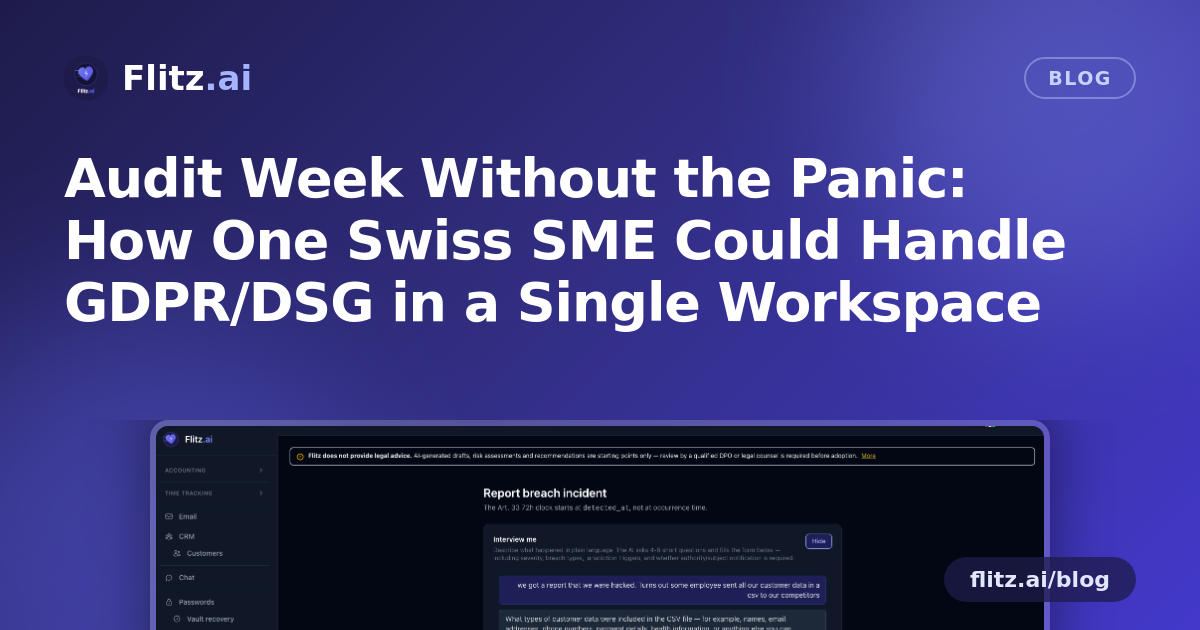
Picture a small Swiss e-commerce business with twelve employees, a handful of marketing subprocessors, and customers in both Switzerland and the EU. This is an illustrative scenario, not a real company — but it reflects a situation many Swiss SMEs recognize: a new client contract requires proof of GDPR and revFADP/DSG compliance within five working days, and nobody on the team is a full-time data-protection officer.
This is the moment where most small businesses either panic, hire an expensive external consultant for a one-off scramble, or quietly hope nobody asks again. Here is how the same week could look with a data-protection programme built into the same workspace as the company's books.
Day 1: Finding Out What You Actually Process
The first request from the prospective client's legal team is simple to ask and historically painful to answer: "Send us your Art. 30 Records of Processing Activities (ROPA)." Most SMEs have never written one down.
Instead of opening a blank spreadsheet, the office manager runs an AI interview that asks plain-language questions about what data is collected, why, how long it is kept, and who receives it. The answers pre-fill a structured ROPA entry — legal basis, retention period, recipients — without anyone needing to know the regulation by heart. Because every record in the system knows which jurisdiction it lives under, EU customer data and Swiss customer data are tracked separately from the start, which matters because the two regimes do not always align.
Day 2: The Subprocessor List Nobody Kept Updated
Next on the checklist: Art. 28 subprocessors. The email marketing tool, the cloud hosting provider, the payment gateway — all of them need a documented data processing agreement (DPA). Rather than digging through old email threads, the team uploads the PDFs they do have. The AI extracts the relevant fields — processor name, purpose, location, safeguards — straight out of the documents into structured entries. Combined with auto-discovery from the connected environment, the subprocessor register is assembled in an afternoon instead of a week.
Day 3: Does This Need a DPIA?
The client's questionnaire also asks whether a Data Protection Impact Assessment (DPIA) has been performed for any high-risk processing, such as the loyalty programme that scores customer behavior. Rather than guessing, the team runs the Art. 35 threshold assessment with one click. The AI risk analysis evaluates the processing activity against recognized risk factors and drafts a full DPIA where warranted. It is clearly marked as a draft — the built-in disclaimer on every page makes clear that Flitz does not provide legal advice and that AI-drafted material always needs review by the company's designated DPO before it is relied upon.
Day 4: Proving the Technical and Organisational Measures
Security questionnaires love asking about Technical and Organisational Measures (TOMs) under Art. 32. Instead of writing these from scratch, the TOMs baseline generator produces twelve categories of concrete, bullet-point measures tailored to the company's own tenant — access control, encryption, backup policy, and so on — giving the team a credible starting document to review and adjust rather than a blank page.
This is also when the office manager remembers that two new hires from last month never received data-protection training. Training assignments go out with email invitations and an "I have read and understood" attestation token; a reminder is queued automatically for anyone who has not confirmed within a few days.
Day 5: Packaging It for the Auditor
With the ROPA, subprocessor register, DPIA, and TOMs in reasonable shape, the final step is handing it all to the client's compliance reviewer without emailing a pile of attachments back and forth. A public auditor dossier is generated instead: password-gated, time-limited, and revocable, authenticated by token so the reviewer does not need to create an account or log in. Access can be shut off the moment the review is complete.
What Happens If a Breach Occurs Later
The same workspace keeps working after audit week ends. If an incident is ever logged, the breach clock adjusts automatically depending on jurisdiction — a strict 72-hour countdown to the authority under GDPR, or the more flexible "as soon as possible" standard under the Swiss DSG — and AI-drafted notifications for both the authority and affected individuals are prepared for review, rather than written from a blank page under time pressure.
Similarly, if a customer sends a Subject Access Request, the 30-day statutory clock starts automatically, with a one-click 60-day extension available for complex cases, and an exportable Art. 15 bundle ready to send.
The Real Benefit: Less Scrambling, More Reviewing
None of this replaces the judgment of a qualified data-protection officer, and every AI-generated document in the system carries that disclaimer deliberately. What changes is where the team's time goes: instead of building documents from zero under deadline pressure, the DPO or office manager spends their time reviewing and approving drafts that are already mostly correct. Approved documents move from a draft watermark to an approval stamp in the document library, so everyone can see at a glance what has actually been signed off.
For SMEs juggling compliance alongside bookkeeping, payroll, and actual customer work, that shift — from authoring to reviewing — is often the difference between dreading an audit and simply scheduling it. You can see how the full programme fits together on the GDPR and DSG compliance feature page.
A compliance programme that lives next to your books, not in a separate silo of spreadsheets and emailed PDFs, is one less reason to dread the word "audit."