
Why Your Google Ads Budget Keeps Leaking (and How to Plug It)
Most Swiss SMEs optimise Google Ads for clicks because that's all Google shows them. Here's what changes when you feed the algorithm real revenue instead.
Picture a small physiotherapy practice in Winterthur, three therapists, fully booked most weeks, but with a quiet gap every January when New Year's resolutions haven't yet turned into sports injuries. The office manager decides to try Google Ads for the first time to fill that gap. This is a realistic, illustrative scenario — not a real client — but it reflects a pattern we see across Swiss SMEs constantly.
She sets a modest monthly budget, writes a few ads, and after two weeks the dashboard looks great: dozens of clicks, a respectable click-through rate, cost-per-click within budget. Google's own reporting calls the campaign a success. But the appointment book tells a different story — only a handful of those clicks ever became bookings, and fewer still became paying patients. The budget is being spent. The question is on what.
The Click Is Not the Customer
This is the quiet leak in most SME paid search budgets. Google Ads optimises toward whatever signal you give it, and by default that signal is a click or, at best, a form submission. The algorithm doesn't know that a lead who filled out a contact form at 11pm on a Tuesday never answered the follow-up call, while a lead from a Saturday morning search became a loyal, paying customer. Without that distinction, Google keeps bidding for more of the cheap, low-intent traffic because, from its point of view, that traffic is "working."
Fixing this normally requires three things most small businesses don't have time for: campaign structure (ad groups, keyword lists, ad copy), a landing page that actually matches the offer instead of sending traffic to a generic homepage, and a way to tell Google which leads turned into revenue. Each of these is a specialised skill. Together, they're often why SMEs quietly give up on paid search after a disappointing quarter.
Describe the Offer, Get the Campaign
This is where Marketing AI changes the sequence of events. Instead of starting from a blank Google Ads interface, the practice's office manager would simply describe the offer — "sports physiotherapy assessment, Winterthur, January availability" — and the AI builds the ad groups, keyword lists and ad copy ready to publish directly to Google Ads. Keyword research runs the same way marketers do it manually, but faster: seed a term, and the AI expands it while pulling in Google Trends and Keyword Planner data to check real search volume and seasonality.
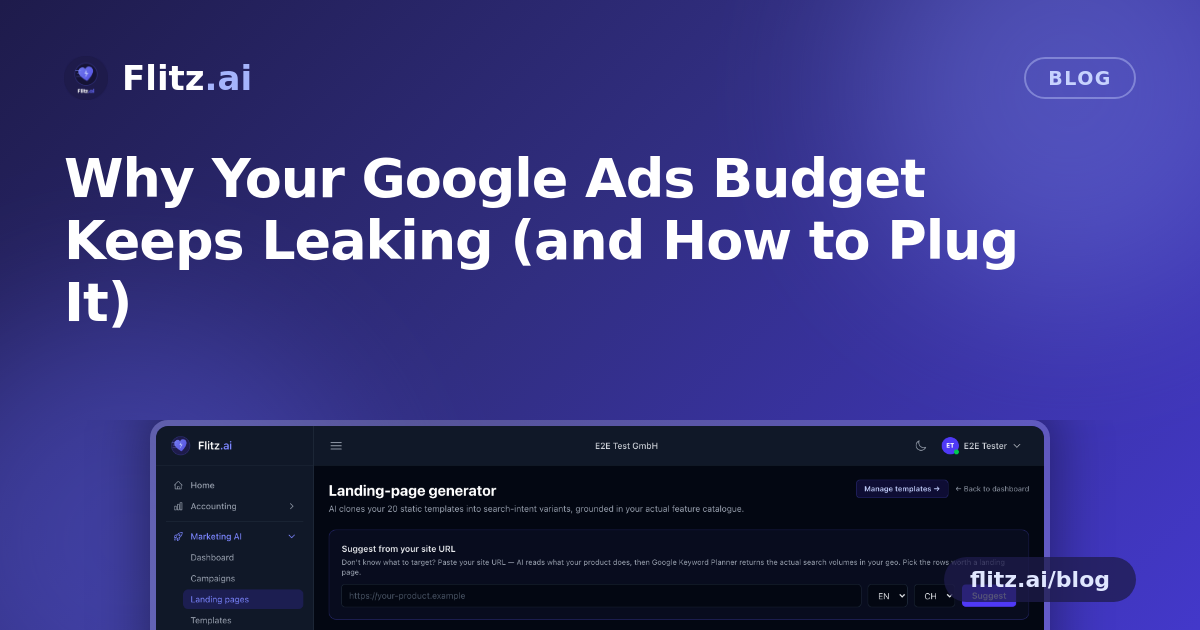
The matching landing page is generated at the same time — not a generic contact page, but one built around the specific offer, published under the business's own domain (as a /lp/ page). If there's an existing page or competitor layout worth borrowing the structure of, the tool can clone the look of any URL and let the design be tweaked from there, with a preview before anything goes live. All of this — keyword expansion, landing-page generation, template cloning — runs on the same Claude engine used across the rest of Flitz, while the actual campaign sync and performance metrics flow through the official Google Ads API.
Closing the Loop: From Click to Revenue
The part that actually fixes the leak happens after the campaign is live. When someone clicks the ad and lands on the page, Flitz captures the Google click identifier (gclid) and holds onto it for 90 days. If that lead later becomes a paying customer — books the appointment, pays the invoice, upgrades to a paid plan — the conversion is sent back to Google Ads as an offline conversion.
This is the detail that most SME campaigns are missing entirely. Google Ads can only optimise toward the signals it receives. Feed it clicks, and it buys clicks. Feed it real revenue events, and the algorithm starts shifting budget toward the keywords, times of day and audience segments that historically produced paying customers — not just curious browsers. Over a few weeks, the cost per acquisition for actual customers tends to drop, because the system stops spending equally on traffic that converts and traffic that doesn't.
Worth Sharing, Not Just Publishing
If a landing page turns out to perform well — say, the sports injury assessment page starts ranking and converting — it's often worth more than just search traffic. With LinkedIn company page and Instagram connected in one click, that same page can be shared as a social post, with the caption and card image drafted by AI. It's a small step, but it means a page built for paid search doesn't sit isolated from the rest of the business's marketing.
What This Looks Like in Practice
- Describe the offer once; get a structured campaign instead of a blank editor
- Keyword research backed by Trends and Keyword Planner data, not guesswork
- A landing page matched to the offer, live on your own domain within minutes
- Real conversions — not just clicks — fed back to Google Ads automatically
- High-performing pages reused as social content with one click
None of this requires a marketing agency retainer or a dedicated growth hire. For a Swiss SME testing paid search for the first time — or one that tried it once, got discouraged by vanity metrics, and shelved the idea — the difference isn't a bigger budget. It's making sure the budget you already have is chasing customers, not clicks.
The goal isn't more traffic. It's traffic that pays for itself — and an algorithm that knows the difference.