
Why Your Google Ads Budget Leaks Money — and the Hours It Takes to Fix It Manually
Running Google Ads properly costs a Swiss SME 6-10 hours a week in hidden admin. Marketing AI builds campaigns, landing pages and lead feedback automatically — here's what that time is actually worth.
Ask any Swiss SME owner running Google Ads how much time it takes, and the honest answer is usually "more than I think." Between keyword research, writing ad copy, building landing pages, checking Google Trends, and eyeballing which leads actually turned into customers, paid search quietly eats into a week that was supposed to be spent running the business — not marketing it.
The bigger problem isn't just the time. It's what that time is spent optimising for. Google Ads shows you clicks, impressions and cost-per-click by default. So that's what gets optimised. Nobody has three spare hours to manually cross-reference which keyword actually produced a paying customer three weeks later. The result: budgets drift toward cheap clicks and away from real revenue, and nobody notices because nobody has time to check.
What the manual process actually costs
Picture a small team — an office manager or the owner doing marketing "on the side" — running one active Google Ads account. A realistic weekly breakdown looks something like this:
- Keyword research and ad group structuring: 1.5-2 hours, done properly with search volume and trend checks
- Writing and testing ad copy: 1-2 hours per campaign refresh
- Building or updating landing pages: 2-4 hours, more if a designer or developer has to be looped in
- Manually checking which leads converted to paying customers: 1-2 hours of digging through CRM and bank records
- Posting the landing page or offer to LinkedIn and Instagram separately: 30-60 minutes
That's easily 6 to 10 hours a week — and most of that time still leaves you optimising for clicks, because tracing a lead all the way to revenue and feeding that back into Google Ads bidding is a manual reconciliation job that almost nobody actually does consistently.
At a loaded cost of CHF 60-90 per hour for the person doing this work, that's roughly CHF 400-900 every week, or CHF 1,600-3,600 a month, spent on marketing admin that still doesn't close the loop between ad spend and actual sales. And that's before counting the CHF that leaks out through campaigns Google keeps optimising toward clicks instead of customers.
What changes when the process builds itself
Marketing AI is designed to remove the manual steps, not just speed them up. You describe your offer in plain language, and the AI builds the Google Ads campaign structure — ad groups, keywords and ad copy — ready to publish. Keyword research works the same way: seed one term and get AI-expanded variations alongside real Google Trends and Keyword Planner data, instead of guessing at search volume.
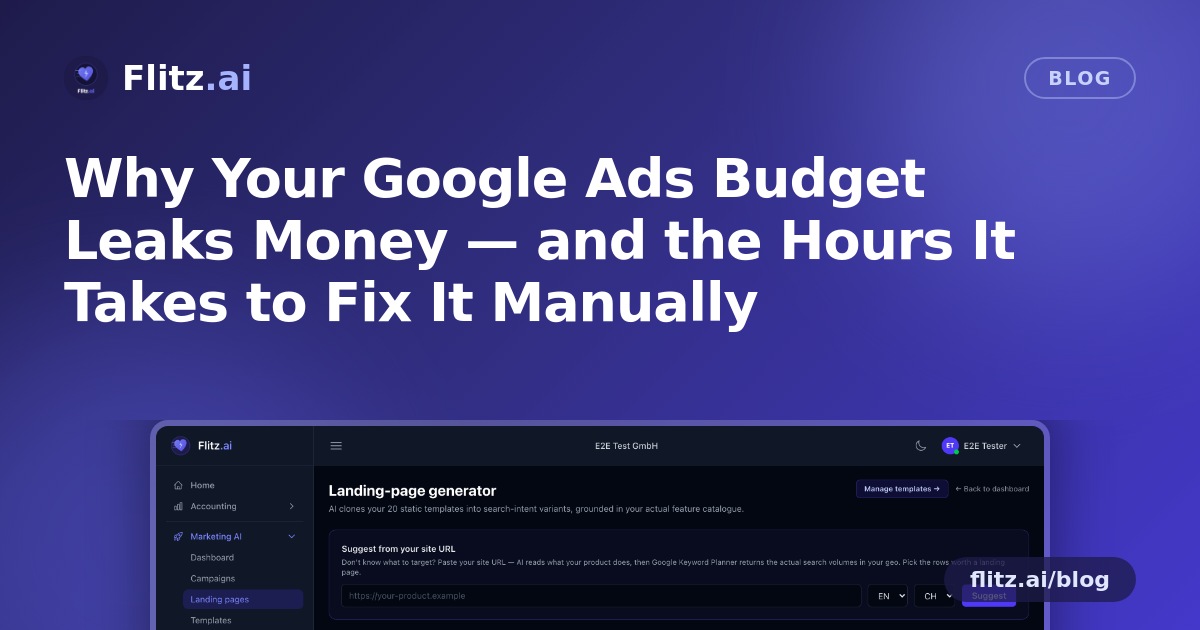
Landing pages follow the same logic. Generate a single page or a batch, or clone the look of a URL you already like, publish under your own domain at /lp/your-company, and iterate with AI before it goes live. What used to require a design brief and a few days of back-and-forth becomes an edit-and-preview cycle you can finish in minutes.
The part that actually saves the budget: closed-loop attribution
This is where the time savings turn into money savings. Flitz captures the gclid — the click identifier Google Ads attaches to every ad click — for 90 days. When a lead who arrived through that click eventually upgrades to a paid plan, the conversion is sent back to Google Ads as an offline conversion.
In practice, that means Google's bidding algorithm stops optimising toward "cheap clicks" and starts learning which keywords, ad groups and audiences actually produce paying customers. Nobody has to run the reconciliation by hand. The feedback loop that used to take hours of manual cross-referencing — or simply never happened — runs automatically in the background.
Most SMEs overpay Google because they optimise for clicks. Feeding real revenue back into the algorithm is what makes paid search profitable, not just active.
Sharing the work you've already done
Once a landing page or offer is live, there's usually a second job waiting: turning it into a LinkedIn and Instagram post. Marketing AI folds that in too — connect your LinkedIn company page and Instagram with one click, and share landing pages with AI-drafted captions and card images instead of writing a separate post from scratch. You can read more about how the whole workflow fits together on the Marketing AI feature page.
What this frees up for a small team
The keyword research, landing-page generation and template cloning all run on the same Claude engine the rest of Flitz uses, while campaign sync and metrics run on the official Google Ads API — so nothing here is a workaround or a screen-scraping trick sitting on top of Google's platform.
For a small team, the real win isn't just the hours reclaimed each week, though 6-10 hours back is meaningful on its own. It's what that time gets redirected toward: talking to customers, refining the offer itself, or simply closing the laptop at a reasonable hour. Paid search stops being a part-time job nobody signed up for, and starts being a channel that's actually optimised toward the thing that pays the bills — revenue, not clicks.