
7 Hiring Mistakes Swiss SMEs Make (And How to Fix Them)
Most SMEs hire with a spreadsheet or an enterprise ATS built for 500-person teams. Neither fits. Here are the recruiting mistakes that cost you time, candidates, and compliance — and how to avoid them.
Hiring is one of the highest-stakes activities in any small business. Get it wrong and you lose weeks of productivity, pay twice for the same role, or end up with a candidate experience so poor that good people warn others away. Yet most Swiss SMEs still run recruitment on a spreadsheet, a shared inbox, or an enterprise applicant tracking system that was designed for a recruiting team ten times their size. Both extremes create the same kinds of mistakes. Here are the most common ones — and what actually fixes them.
Mistake 1: No branded careers page, so job ads live and die on job boards
Many SMEs post openings only on third-party job boards or social media, with no permanent, professional home for their vacancies. Candidates who hear about you through word of mouth or a company website visit have nowhere to apply properly, and you lose the chance to show your employer brand at the exact moment someone is deciding whether to apply.
A public, tenant-branded careers page fixes this. Every job posting gets its own stable reference code (JOB-XXXXXX) that candidates can quote in emails or phone calls, plus optional salary range and remote-work flags — details that Swiss candidates increasingly expect before they invest time in an application.
Mistake 2: Treating every application as valid, including bots and typos
Open a shared recruiting inbox and you'll find bounced confirmation emails, duplicate submissions, and the occasional bot-generated application. Screening these out manually wastes recruiter time before real evaluation even starts.
Double opt-in applications solve this at the source: candidates must confirm via an emailed link before their application reaches the pipeline or any AI screening. Bad addresses and bot submissions simply never count, which keeps your candidate pool clean from the very first stage.
Mistake 3: Screening candidates inconsistently — or not at all
Without structured screening, the first candidate reviewed on a Monday morning gets a different level of scrutiny than the fiftieth reviewed on a Friday afternoon. Decisions become inconsistent, and strong applicants slip through simply because of when they applied.
AI candidate screening scores every confirmed application against the job description the moment it arrives, applying the same criteria every time. Just as important: if the AI call itself fails, the application is flagged for manual review rather than silently displayed as a fake zero score — a detail that matters because a silent failure looks exactly like a genuinely weak candidate.
Mistake 4: Losing track of good candidates from past roles
A strong applicant for one role often fits a different, later opening — but few SMEs have a way to search their historical candidate pool by fit rather than by keyword or memory. Good people get forgotten and re-sourced from scratch.
AI candidate search lets you describe the profile you need in plain language and get your existing pool ranked by fit, running asynchronously so it never blocks the page while you keep working.
Mistake 5: A rigid pipeline that doesn't match the role — or gets overwritten by a colleague
A generic five-stage pipeline works for some roles and badly for others; a technical role might need a take-home test stage, a retail role might not. Rigid tools force every job into the same shape. Worse, when two people manage the same pipeline, drag-and-drop changes can silently overwrite each other.
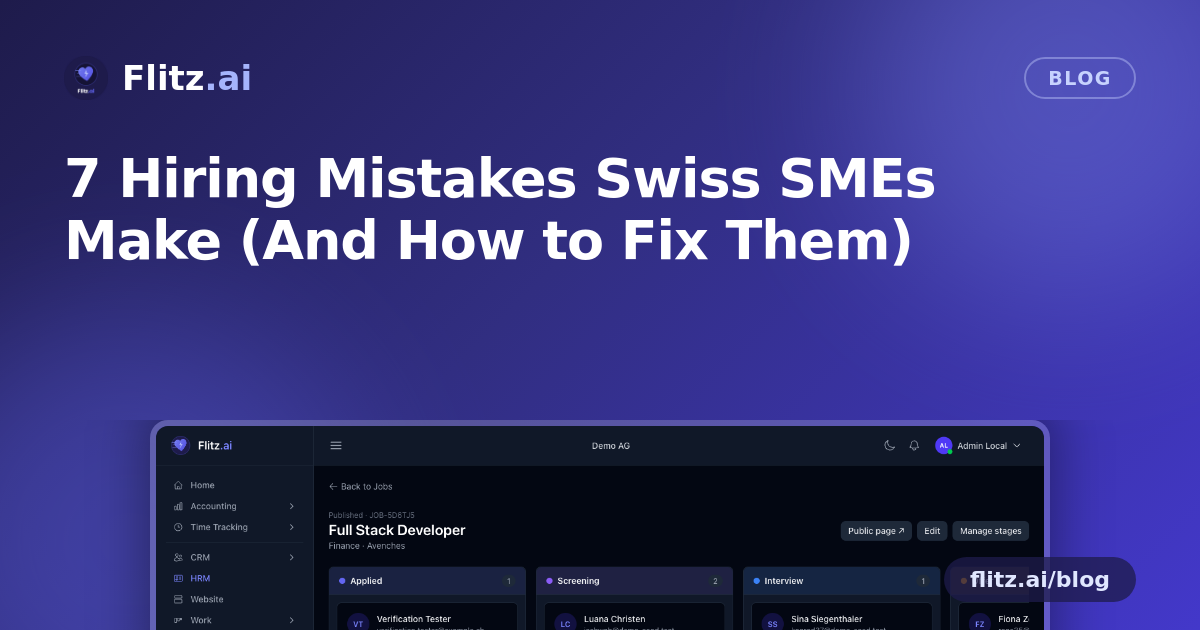
A configurable Kanban pipeline per job lets you add, rename, and reorder stages to fit the role, with conflict-checked drag-and-drop moves so two recruiters never silently clobber each other's work.
Mistake 6: Interview scheduling disconnected from candidate data
When scheduling happens in a separate calendar tool, interviewers show up without the CV or AI score in front of them, and rescheduling turns into an email chain. Interview scheduling tied to the same application record — with automatic invitations, rescheduling, and cancellation — keeps the CV and score attached to every interview, so nobody walks in unprepared.
Mistake 7: Rejections that are slow, inconsistent, or a compliance risk
Rejecting candidates well is unglamorous but consequential: slow or robotic rejections damage your employer brand, and inconsistent tone across recruiters creates unnecessary risk. On the other side, keeping rejected candidates' data indefinitely is a data protection problem few SMEs actively manage.
AI-drafted rejection emails can auto-send by default or be held for a recruiter to review and edit — your choice, per tenant. And a built-in GDPR data lifecycle automatically anonymizes rejected or withdrawn candidates after six months, while hired candidates are retained for normal HR recordkeeping. Compliance stops being a manual chore.
The right-sized alternative
None of these mistakes happen because SMEs are careless — they happen because the available tools are either too thin (a spreadsheet) or too heavy (an enterprise ATS built for a 500-person recruiting team). Flitz's recruitment module sits in between: a public careers page, AI screening and search, a configurable pipeline, tied-in interview scheduling, and a compliant data lifecycle — all in the same platform as your accounting, invoicing, and HR records, without exporting candidate data to yet another vendor.