
When Your Best Employee Quits, Does Your Company Forget Everything?
Every time a key employee leaves, Swiss SMEs relearn the same lessons from scratch. Here's how a knowledge bank that people actually use can fix that for good.
It always happens at the worst possible moment. Your office manager, the one who has handled vendor negotiations and onboarding for three years, hands in her notice. Two weeks later, you realise nobody else knows which supplier gives the early-payment discount, how the expense approval process actually works, or why a particular customer always gets a special shipping arrangement. That knowledge wasn't written down anywhere. It was just in her head.
If this sounds familiar, you're not alone. According to IDC, roughly 42% of process knowledge inside small and medium businesses exists only in employees' heads. There's no backup. No document. Nothing searchable. When someone leaves — through resignation, illness, or retirement — that knowledge leaves with them, and the rest of the team is left reconstructing it through trial and error, often repeating the same mistakes that were already solved once before.
Why Most Intranets Die Within Months
Many Swiss SMEs have tried to fix this. Someone sets up a Confluence space or a Notion workspace with good intentions. For a few weeks, people add pages. Then life gets busy, writing a proper entry takes too long, and the whole thing quietly decays into a graveyard of outdated pages nobody trusts anymore. The tool wasn't the problem — the friction was. Writing a clear, well-structured entry takes time most people don't have between client calls and invoices.
There's also a second, quieter problem: even when documentation exists, it lives somewhere disconnected from the actual work. It's in a separate app, behind a separate login, next to nothing relevant. So people stop checking it, and eventually stop contributing to it.
How an Intranet Knowledge Bank Should Actually Work
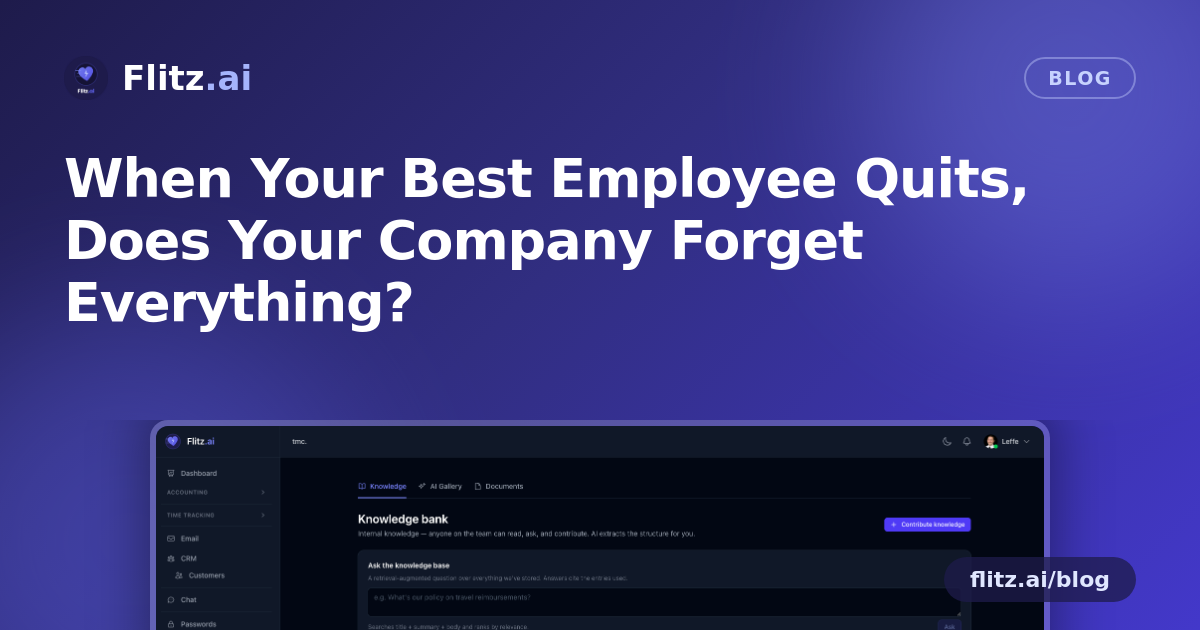
Flitz's Intranet Knowledge Bank was built around one simple observation: if writing an entry takes more than a minute, most people won't do it. So the process is reduced to almost nothing. Paste a URL or describe a topic in a single sentence, and the AI drafts a polished entry for you — title, summary, full body text, tags, and category all included. You review it, make any adjustments, and publish. What used to take twenty minutes of staring at a blank page now takes seconds.
Once entries exist, the real value shows up. Instead of searching through folders or guessing which document might contain the answer, anyone on the team can simply ask the knowledge base a question in plain language — "What's our process for onboarding a new supplier?" or "Why did we switch shipping providers last year?" — and get a direct answer, complete with citations pointing back to the original entries. This is retrieval-augmented question-answering, and it means your knowledge base behaves less like a filing cabinet and more like a colleague who remembers everything.
Built for Teams That Actually Use It
- Categories, tags and full-text search — find anything by topic, author or keyword, instead of scrolling through endless pages.
- Author attribution and view counts — every entry shows who wrote it and how many people have actually read it, so you know what's being used and what's being ignored.
- Versioned editing — anyone can update an outdated entry without erasing the history behind it, so corrections are transparent rather than silent.
Perhaps the most practical difference, though, is where this knowledge lives. Unlike Notion or Confluence, which sit entirely separate from your actual business operations, Flitz's knowledge bank lives right next to your books, your customers, and your deals. A note about a vendor's payment terms sits in the same workspace as the vendor's invoices. An onboarding checklist sits next to the HR records it applies to. Nothing is an afterthought in a different tab.
The Cheapest Insurance Policy You Can Buy
Think about what it actually costs when institutional knowledge disappears: hours spent reconstructing a process that already worked, customer relationships strained because nobody remembered a prior agreement, new hires taking months longer to get productive because there's no written onboarding trail. None of this shows up as a line item on your profit and loss statement, but it's a real, recurring cost.
A knowledge base that people genuinely use — because contributing to it takes seconds, not hours — is one of the cheapest forms of protection a Swiss SME can put in place. It doesn't require a big rollout or a training session. It just requires removing the friction that killed every intranet attempt before it.
Company memory shouldn't resign when an employee does. With the right tool, it doesn't have to.