
Spreadsheets, Email Chains, or a Living Knowledge Bank: What Actually Protects Your Swiss SME
Most Swiss SMEs store critical know-how in spreadsheets, email threads, and someone's head. Here's an honest look at why that fails — and what an integrated knowledge bank does differently.
Ask any Swiss SME owner where the company's real knowledge lives — how the biggest customer likes to be invoiced, why a vendor contract has a strange clause, what the onboarding checklist for new hires actually includes — and you'll rarely get a confident answer pointing to a document. More often it's a shrug and a name: "ask Markus, he's been here the longest."
That's not a knowledge management strategy. It's a liability with a payroll number attached.
The old way: spreadsheets, email chains, and disconnected tools
Most small businesses don't lack discipline — they lack a system that's easier to use than the alternative. So knowledge ends up scattered across a predictable set of places:
- Spreadsheets with half-updated process notes, usually named "FINAL_v3" and owned by one person who remembers where the formulas break.
- Email chains that technically contain the answer to "why did we switch suppliers in 2022," buried somewhere in a thread with forty replies.
- Standalone wikis like Notion or Confluence, set up with great enthusiasm in January and abandoned by March because writing an entry takes longer than just solving the problem again.
Each of these has a real, honest advantage: spreadsheets are flexible and familiar, email is low-friction for quick exchanges, and dedicated wiki tools offer polish and structure that general-purpose tools don't. None of them are bad ideas on their own.
The trade-off is what happens over time. Spreadsheets have no version history anyone trusts, no search beyond Ctrl+F, and no way to ask a question — you either know which tab to open or you don't. Email chains are searchable in theory but impossible to browse; you need to already know roughly what you're looking for. And standalone wikis, however well-designed, live in a separate universe from your actual business data. They're disconnected from your customers, your deals, your books — which means nobody opens them during the workday, and they quietly decay.
Why this matters more than it seems
According to IDC, an estimated 42% of process knowledge inside SMEs exists only in employees' heads. Not in a doc, not in a wiki — in memory. When that employee takes a new job, goes on long-term leave, or simply forgets the details of a decision made eighteen months ago, the knowledge doesn't degrade gracefully. It disappears, and the company re-learns the same lesson it already paid for once.
For a Swiss SME, that's not a hypothetical cost. It's onboarding taking longer than it should, the same vendor negotiation mistake repeated, or a customer promise forgotten because the person who made it left in March.
The integrated approach: knowledge that lives where work happens
The core problem with every "old way" option isn't intent — it's friction. If writing something down takes fifteen minutes and formatting effort, most people won't do it consistently, no matter how good the tool is.
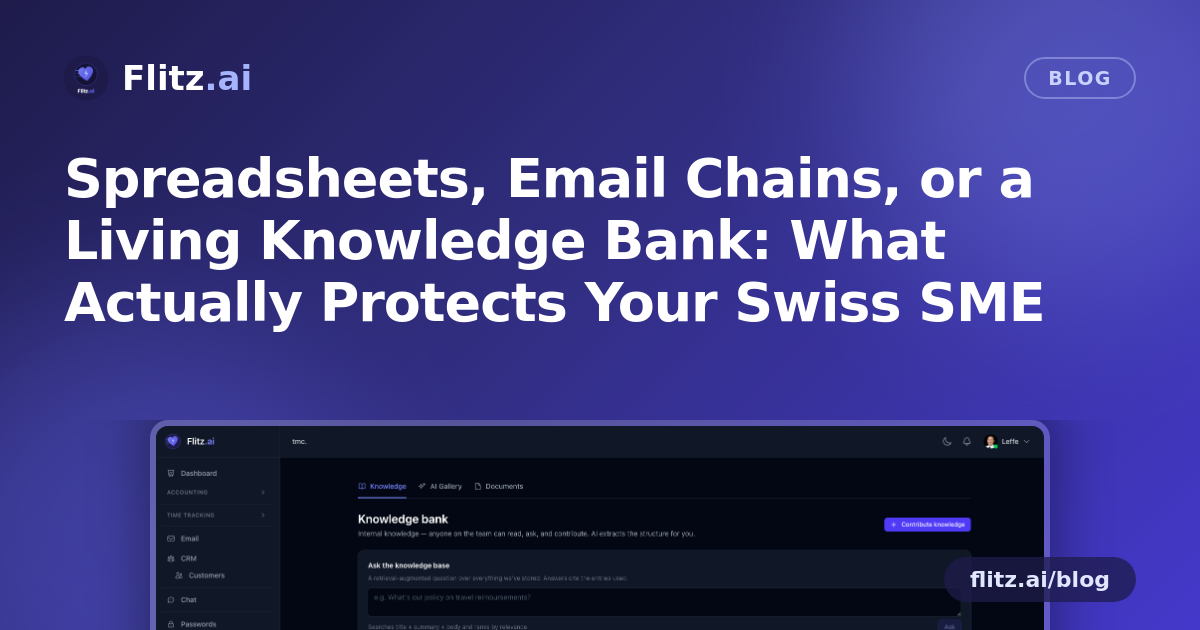
Flitz's Intranet Knowledge Bank is built around removing that friction entirely. You paste a URL or describe a topic in one sentence, and the AI drafts a polished entry — title, summary, body, tags, and category — ready for a quick review before posting. What used to be a fifteen-minute writing task becomes a thirty-second approval.
The second half of the problem — finding things again — is solved the same way the writing is: you simply ask. The knowledge base supports natural-language question-answering with citations back to the source entries, so instead of guessing which tab or thread holds the answer, you ask the question directly and get a sourced response. Categories, tags, and full-text search are still there for browsing by topic, author, or keyword, but they're a backup, not the only path in.
A few details matter more than they first appear:
- Author attribution and view counts mean entries aren't anonymous or orphaned — you know who wrote it and whether anyone is actually reading it.
- Versioned editing means knowledge can be corrected and improved over time without anyone being afraid to touch an existing entry.
- It lives next to your real data — the same workspace as your books, customers, and deals — rather than in a separate app nobody opens outside of a quarterly cleanup effort.
Weighing the trade-off honestly
An integrated knowledge bank isn't infinitely more powerful than a dedicated wiki tool on a feature-by-feature basis — Confluence and Notion have mature ecosystems and plenty of customization. What they don't have is proximity to your actual work and a low enough barrier that people actually write things down. For a Swiss SME without a dedicated knowledge manager, that proximity and ease of use is the entire game. A knowledge base nobody updates is worse than no knowledge base at all, because it gives false confidence that the information is current.
The cheapest insurance you can buy
Institutional memory isn't a nice-to-have for when the company gets bigger. It's what lets a business survive the ordinary churn of people joining, leaving, and forgetting. A knowledge bank that's actually used — because writing to it is effortless and querying it is as simple as asking a question — is about as cheap an insurance policy as an SME can buy against the slow, invisible cost of re-learning the same lessons every two years.