
Running Multiple Companies in Switzerland? Avoid These Multi-Tenant Mistakes
Many Swiss SMEs and fiduciaries managing several entities make the same costly mistakes with data separation, access control, and branding. Here is how to avoid them.
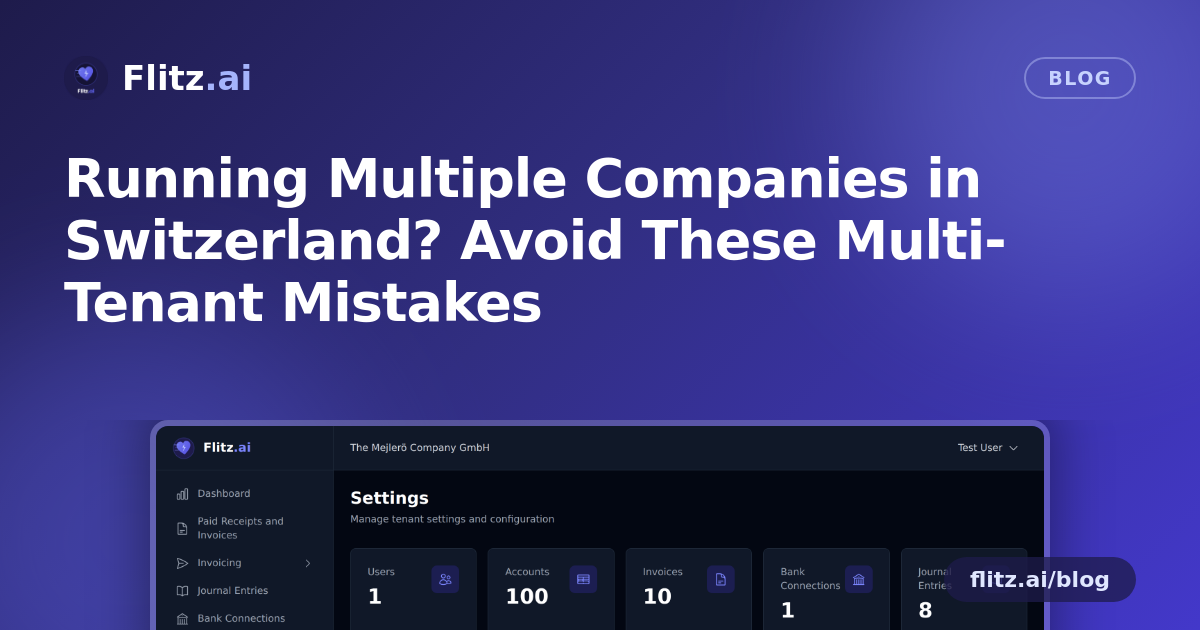
If you run more than one company, operate a holding structure, or manage accounting for multiple clients as a fiduciary, you already know the pain of juggling separate logins, separate spreadsheets, and separate tools that were never designed to talk to each other. Over time, this patchwork approach creates risks that most businesses only discover when something goes wrong: a client sees another client's invoice, a former employee still has access to financial data, or a bookkeeper spends half a day reconciling numbers across three disconnected systems.
Below are the most common mistakes Swiss SMEs and fiduciaries make when managing multiple entities or offering services under their own brand, why they happen, what they actually cost, and how proper multi-tenant infrastructure prevents each one.
Mistake 1: Mixing Data Between Companies
It is surprisingly common for growing businesses to manage two or three legal entities inside a single account of a tool that was never built for multi-tenancy. Invoices get tagged with the wrong company by mistake, MWST figures get blended, and at year-end the accountant has to manually untangle which transaction belongs to which entity.
This happens because most software treats "a second company" as an afterthought — a label or a filter, not a genuinely separate environment. The cost is real: hours of manual reconciliation, higher risk of filing errors with the Swiss tax authorities, and a loss of trust if a client ever notices commingled data.
The fix is complete data isolation between companies from the ground up, not as a bolt-on filter. Each company operates in its own environment, with its own invoices, accounting records, banking data, and documents, even when all companies are managed from a single account.
Mistake 2: Giving Everyone the Same Level of Access
Many small businesses default to an all-or-nothing approach: either someone has full access to everything, or they get no access at all and have to ask for every report manually. This usually happens because setting up granular permissions in traditional software is tedious, so owners skip it under time pressure.
The cost shows up later — an external accountant who only needed read access to one company's books suddenly has visibility into payroll for every entity you manage, or a part-time employee can edit invoices they should only be viewing. These are exactly the kinds of gaps that create compliance headaches and uncomfortable conversations.
The solution is role-based access control with clearly defined roles — Owner, Admin, Accountant, Viewer — so each person only sees and does what their role requires. Combined with the ability to invite team members with granular permissions per company, you can bring in external bookkeepers or auditors for exactly the entities and functions they need, nothing more.
Mistake 3: Treating Branding as an Afterthought
Fiduciaries and consultants who resell software to their clients often do so under a generic, unbranded interface. Clients log into a tool that clearly belongs to someone else, which undercuts the fiduciary's own brand and makes the relationship feel transactional rather than personal.
This happens because white-labeling is usually expensive or technically out of reach for smaller firms. The cost is a missed opportunity: clients associate the convenience with the software vendor instead of with the fiduciary who recommended and set it up, weakening client retention and referral potential.
With white-label branding — your own logo, colors, and domain — plus a custom subdomain per company, a fiduciary or consultancy can offer the platform as if it were their own product. Clients get a consistent, professional experience under your brand, while you still benefit from a fully maintained, modern platform underneath.
Mistake 4: Underestimating the Admin Overhead of Separate Tools
When each company runs on its own instance of different software, switching between them means logging in and out repeatedly, remembering different credentials, and losing the overview of what is happening across the whole portfolio. This mistake is less about security and more about wasted time — but the cumulative cost over a year of daily context-switching is significant.
A proper multi-tenant setup lets you manage multiple companies from a single account, switching between fully isolated environments without re-authenticating or losing context. For a fiduciary managing a dozen clients, or a holding structure with several subsidiaries, this alone can save hours every week.
Mistake 5: Assuming Isolation and Convenience Are a Trade-Off
Perhaps the biggest misconception is that you have to choose between strict data separation and operational convenience — that keeping companies isolated necessarily means more friction. In reality, this trade-off only exists when the underlying architecture was not designed for multi-tenancy from day one.
Platforms built with multi-tenant architecture as a core design principle, rather than a retrofit, deliver both: complete isolation of financial and client data, and a single, convenient place to manage access, branding, and operations across every company you oversee.
Getting It Right From the Start
Whether you are a growing business with multiple legal entities, a holding company, or a fiduciary serving several clients, the underlying need is the same: strict separation where it matters, and simplicity where it counts. Fixing these mistakes after the fact — migrating data, rebuilding permissions, renegotiating branding — is far more disruptive than setting things up correctly from the beginning.
Flitz.ai was built around this principle, offering complete data isolation, role-based access, custom subdomains, and white-label branding as standard capabilities rather than add-ons, so Swiss SMEs and fiduciaries can scale across multiple companies without compromising on security or control.