
The MWST Deadline Is Approaching and Your Books Are a Mess: Here's the Fix
Every quarter, the same scramble: sorting invoices, checking VAT rates, hoping the numbers add up. Here's how automated VAT reports end that ritual for good.
It's the last week of the quarter. You know the Steuerverwaltung deadline is coming, but somewhere between client invoices, payroll, and the usual daily fires, your VAT paperwork has been quietly piling up. Now you're sitting with a stack of receipts and invoices, trying to remember which transactions carried the 8.1% standard rate, which ones fell under the reduced 2.6%, and whether that one hotel booking should have been taxed at 3.8%.
If this sounds familiar, you're not alone. For most Swiss SME owners and office managers, MWST reporting isn't complicated because the concept is hard — it's complicated because it's manual. Pulling numbers from different systems, double-checking rate assignments, and formatting everything correctly for filing takes hours that nobody budgeted for. And one misclassified transaction can mean a report that doesn't match your actual books, which is the last thing you want when the tax office is involved.
The real cost of manual VAT compilation
The problem isn't just the time it takes — though that alone adds up to a predictable quarterly or monthly headache. It's the risk that comes with doing it by hand. Swiss VAT isn't a single flat rate. Businesses need to track four different rates: 8.1% standard, 2.6% reduced, 3.8% for accommodation services, and 0% for exempt transactions. Every invoice, every expense, every transaction needs the right code attached to it. Miss one, mix up a rate, or forget to include a transaction, and your report is wrong before you've even submitted it.
For businesses that file quarterly, this happens four times a year. For those on monthly filing, it's a recurring task that never really goes away — just when you've closed one period, the next one starts.
What automatic VAT reporting actually changes
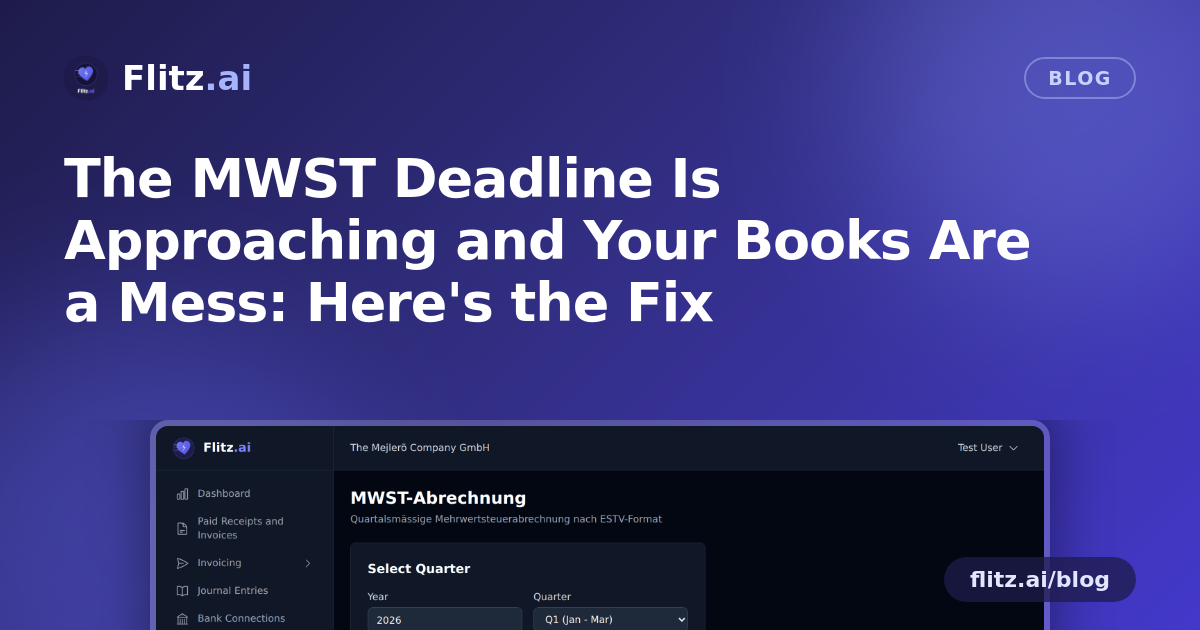
Flitz's VAT reports feature is built to remove exactly this kind of manual work. Instead of compiling numbers after the fact, your VAT report is generated directly from your existing bookkeeping data — the same data that's already in the system from your invoicing and accounting activity.
Here's what that means in practice:
- Automatic VAT code assignment. Every transaction gets the correct VAT code applied as it's recorded, across all four Swiss rates — 8.1%, 2.6%, 3.8%, and 0%. You don't have to remember which rate applies to which transaction type; the system handles it based on your bookkeeping entries.
- Your filing rhythm, your choice. Whether your business reports monthly or quarterly, Flitz generates the report for the period you need, matching your actual filing schedule with the Steuerverwaltung.
- Filing-ready formatting. The report isn't just a summary — it's formatted exactly as required for submission to the Swiss tax authorities, so there's no reformatting or re-entering numbers into another template.
- One-click generation. When it's time to file, you don't assemble anything manually. The report is generated in a single click, pulling directly from the bookkeeping data that's already accurate because it was coded correctly from the start.
Why this matters beyond saving time
The time savings are real — turning a multi-hour compilation task into a single click frees up capacity that's better spent running the business. But the bigger benefit is accuracy and peace of mind. When VAT codes are assigned automatically and consistently at the point of transaction, there's no end-of-quarter scramble to reconstruct what happened three months ago. The report reflects what's actually in your books, because it's generated from them directly rather than built separately alongside them.
This also matters for fiduciaries and accountants working with multiple SME clients. Instead of chasing down documentation and manually checking rate classifications for each business, they get a report that's already structured and ready for review or filing, built on bookkeeping that was handled correctly throughout the period — not patched together at the deadline.
A quieter, less stressful quarter-end
MWST reporting will always be a recurring obligation for Swiss businesses. What doesn't have to stay the same is the stress and manual effort around it. When VAT rates are tracked automatically, transactions are coded correctly from day one, and the report itself is just one click away, quarter-end — or month-end — stops being a fire drill and becomes just another routine task.
If your current process still involves spreadsheets, manual rate-checking, or reformatting numbers before filing, it's worth looking at how much of that work could simply disappear.