
MWST Reports and Swiss Compliance: Why Manual VAT Filing Is a Risk You Don't Need
Swiss VAT law leaves little room for error. Here's what the Steuerverwaltung expects from your MWST filings, where manual processes break down, and how automated reports keep you audit-ready.
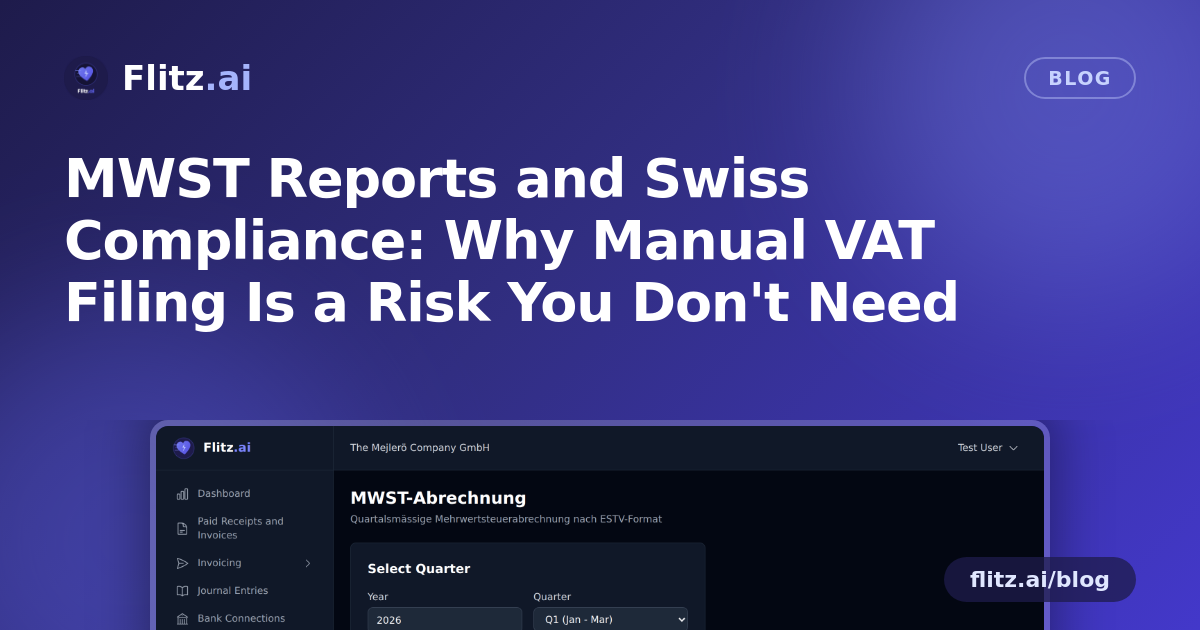
Every VAT-registered business in Switzerland has the same quiet obligation running in the background: correctly classifying every transaction, applying the right rate, and filing a clean report with the Steuerverwaltung on time. Get it wrong, and the consequences aren't hypothetical — they range from late-filing penalties to a full audit that digs through months of bookkeeping.
Yet MWST reporting is still, for a large share of Swiss SMEs, a manual exercise: exporting figures from accounting software, sorting them into rate categories, double-checking totals in a spreadsheet, and hoping nothing was missed. This is precisely the kind of process where compliance risk quietly accumulates.
What Swiss VAT law actually expects
The Swiss MWST system is built around correct rate application and timely, accurate reporting. Businesses need to track transactions across the current rate structure — 8.1% standard rate, 3.8% for accommodation, 2.6% for reduced-rate goods and services, and 0% for exempt or excluded transactions. Each transaction needs the correct VAT code assigned at the point of booking, not reconstructed weeks later during report preparation.
Depending on turnover and registration, businesses report either quarterly or monthly. Either way, the report has to be formatted precisely as the Steuerverwaltung requires — this isn't a "close enough" document. A misclassified rate, a missing code, or a rounding inconsistency can trigger queries or corrections that cost time and, in some cases, money.
Where manual VAT processes create risk
Manual compilation introduces risk at almost every step:
- Rate misclassification: Applying 8.1% where 2.6% applies (or vice versa) is an easy mistake when transactions are coded by hand, especially across a mix of goods and services.
- Inconsistent coding over time: Different staff, or the same person on a different day, may code similar transactions differently — creating discrepancies that surface only during an audit.
- Last-minute compilation: When reports are built by pulling numbers together right before the filing deadline, there's little time to catch errors before submission.
- Weak audit trail: If the Steuerverwaltung asks how a figure was derived, a spreadsheet built after the fact offers little traceability back to the original transaction.
None of this stems from carelessness. It's simply what happens when a regulatory requirement is handled as a periodic manual task rather than something built into daily bookkeeping.
Building compliance into the bookkeeping itself
The more reliable approach is to make VAT correctness a property of the bookkeeping system, not a separate step performed afterward. That means every transaction gets the right VAT code automatically, at the moment it's recorded — based on the nature of the transaction, not a manual judgment call applied later.
Flitz's MWST / VAT reporting feature works this way. It covers all current Swiss MWST rates — 8.1%, 3.8%, 2.6%, and 0% — and assigns the correct VAT code to each transaction automatically as part of normal bookkeeping. There's no separate reclassification exercise before filing, because the classification already happened correctly the first time.
Reports that match what the Steuerverwaltung expects
When it's time to file, the report itself is generated in the format required for Swiss tax filing — no manual reformatting, no reconciling exported figures against a template. Because the underlying transaction data is already correctly coded, the report reflects the books exactly, which matters if a filing is ever reviewed or questioned.
Monthly or quarterly, without extra overhead
Businesses filing monthly and those filing quarterly have different rhythms, but the same underlying need: a report that's ready when the period closes. The reporting period is a setting, not a workaround — switch between monthly and quarterly cadence according to your registration, and the report generation logic adapts accordingly.
One click instead of one afternoon
Perhaps the most tangible difference is time. Instead of compiling a VAT report from multiple exports and cross-checks, the report is generated in one click, directly from the bookkeeping data that's already accurate. For an office manager or a fiduciary managing filings across several clients, that difference compounds every reporting period.
Audit-readiness as a byproduct, not a project
The real advantage of automated, correctly-coded VAT reporting isn't just faster filing — it's that the business stays audit-ready by default. Every transaction carries its VAT code from the moment it's booked, every report ties back cleanly to the underlying data, and there's no reconstruction needed if the Steuerverwaltung asks questions later. Compliance stops being a quarterly scramble and becomes a natural output of how the books are kept day to day.
For Swiss SMEs and the fiduciaries who support them, that shift — from manual compilation to built-in correctness — is where real risk reduction happens.