
Payroll Without the Panic: Onboarding a New Hire Without Breaking Your Books
A new hire should be exciting news, not a payroll headache. Here's how a Swiss SME can onboard, calculate contributions, and stay audit-ready without manual spreadsheets.
Picture a small Swiss engineering office with six employees. Business is picking up, and the team finally gets approval to hire a seventh person — a junior technician starting on the first of next month. Good news for the workload. Less good news for whoever handles payroll, because Swiss payroll is never just "add a name to the list."
This is a scenario many Swiss SMEs recognize: a new hire triggers a chain of calculations, registrations, and bookkeeping entries that have to be correct from day one — not fixed retroactively three months later when the SVA (Sozialversicherungsanstalt) sends a query.
The Moment a New Hire Joins
The office manager enters the new employee's details: salary, start date, pension fund (BVG) enrollment, and insurance category. From here, several things need to happen correctly and simultaneously:
- AHV/IV/EO contributions need to be calculated at the current statutory rate
- ALV (unemployment insurance) contributions apply up to the relevant salary threshold
- BVG (occupational pension) coordination deduction and contribution rate must match the fund's plan and the employee's age bracket
- UVG (accident insurance) split between occupational and non-occupational coverage depending on working hours
- KTG (daily sickness benefits insurance), if the company carries it, needs to be factored into the gross-to-net calculation
Manually, this means checking rate tables, cross-referencing the pension fund's contribution schedule, and hoping nothing changed since the last update. One misapplied percentage and the payslip is wrong — and so is every downstream report.
Running the First Payroll
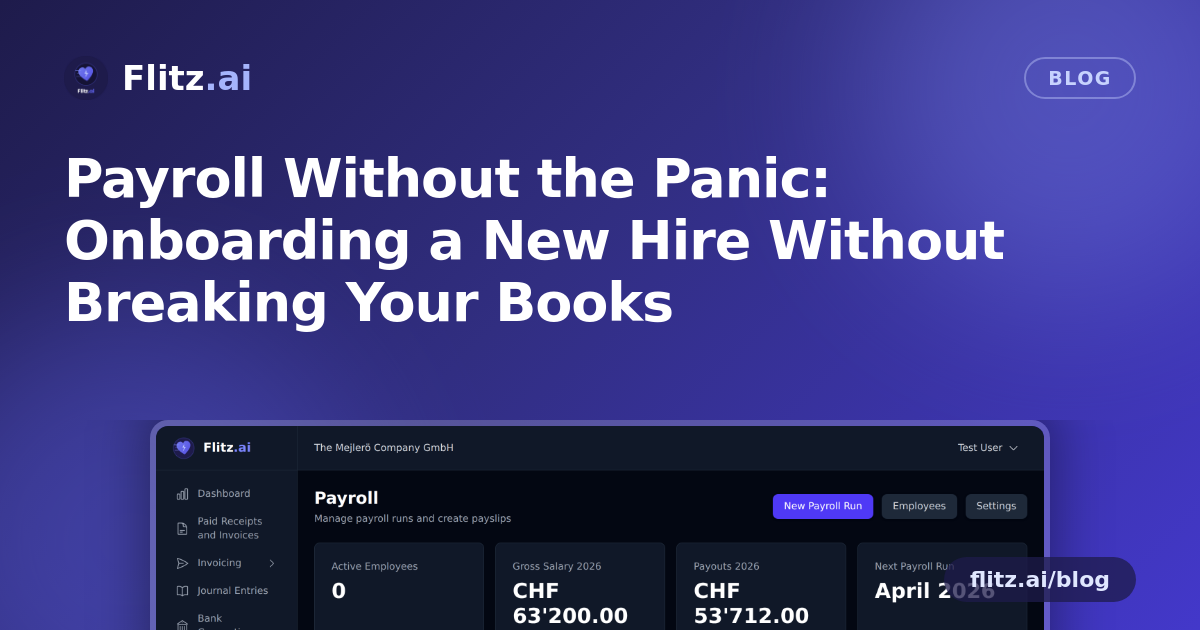
With Flitz payroll, the new employee's profile is set up once, and the system applies AHV/IV/EO, ALV, BVG, UVG, and KTG calculations automatically based on current rates and the employee's specific parameters. There's no separate lookup table to maintain and no manual percentage entry for each contribution type.
When the payroll run happens at month-end, the technician's first payslip is generated alongside the other six employees in the same run. Multi-employee management means the office manager isn't repeating the same process seven times — the whole team's payroll processes together, with each person's individual calculations handled correctly in parallel.
Where the Numbers Actually Land
Here's where many small businesses lose time: after payroll is calculated, someone still has to translate it into accounting entries — gross salary, employer contributions, employee deductions, net payment — and post all of that correctly to the general ledger.
Flitz creates the journal entries for each payroll run automatically. The salary expense, the social insurance liabilities, and the net payment obligation are posted without anyone re-typing figures from a payslip PDF into the accounting module. For the engineering office, this means the books reflect the new hire's cost accurately from month one, with no reconciliation surprises at quarter-end.
Fast Forward to Quarter-End Reporting
Three months later, it's time for SVA reporting. In many small businesses, this is where things get stressful — pulling together contribution data for every employee, checking it matches what was actually paid, and submitting on time.
Because every payroll run throughout the quarter was calculated and recorded consistently, the SVA annual reporting data is already there, structured and ready. There's no scramble to reconstruct three months of manual calculations or reconcile discrepancies between what was paid and what was booked.
Year-End and the Lohnausweis
Come January, the same office needs to issue a Lohnausweis (salary certificate) for every employee, including the technician hired mid-year. This document has to be precise — it's used for the employee's tax filing and any inaccuracy becomes their problem, not just an internal one.
With Flitz, Lohnausweis generation happens per employee directly from the payroll data already processed throughout the year. There's no separate year-end project to compile twelve months of payslips into a certificate; the figures are already consistent because they came from the same automated calculations all year long.
What This Means in Practice
The value isn't just "less manual work," though that matters. It's that a new hire, a routine month-end run, and a year-end audit-style review all draw from the same consistent, automatically calculated source. For a small business without a dedicated payroll specialist, this consistency is what prevents small errors from becoming quarter-end fire drills or year-end corrections.
Swiss payroll compliance has a lot of moving parts — AHV, ALV, BVG, UVG, KTG, SVA, Lohnausweis — and each one has its own rules and deadlines. Automating the calculations and the bookkeeping doesn't remove the responsibility of getting payroll right, but it does remove most of the manual risk of getting it wrong.