
Quarter-End Without the Spreadsheet Panic: A Swiss SME's Bank Reconciliation Story
A look at how a typical Swiss SME can turn a dreaded quarter-end reconciliation marathon into a 20-minute review, using automated bank matching.
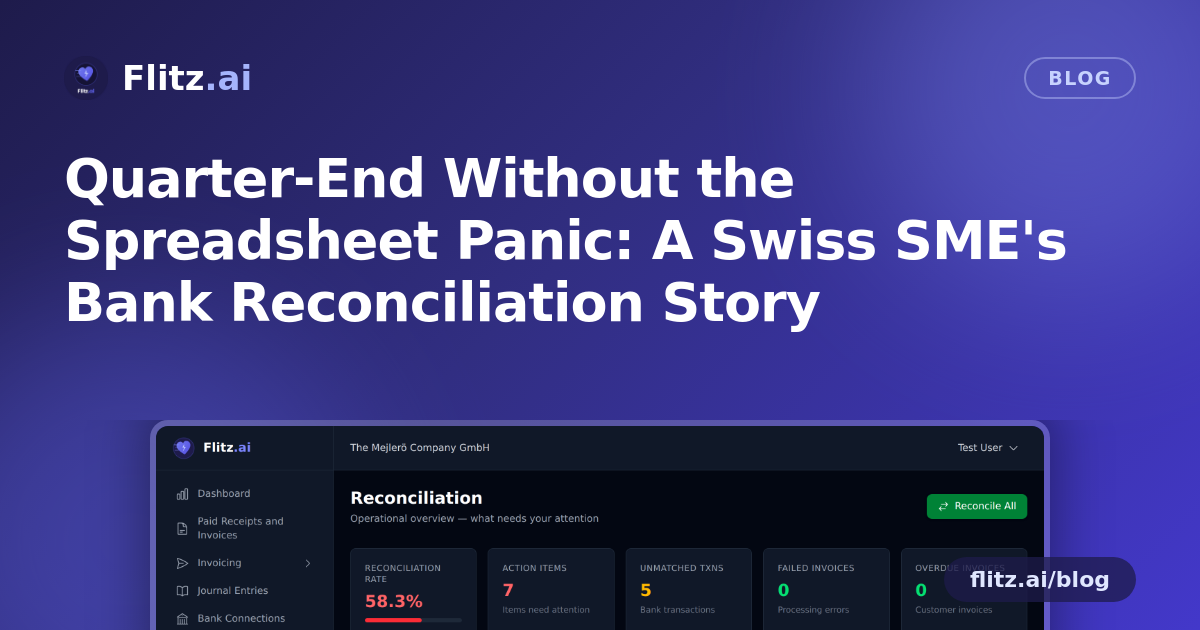
Picture a small Swiss engineering firm, five employees, steady project work, and a bookkeeper who also handles HR and the occasional client call. It is the last week of the quarter, and the MWST return is due in a few weeks. The task on top of the pile: reconcile three months of bank transactions against outstanding invoices before the fiduciary can close the books.
This scenario plays out in thousands of Swiss SMEs every quarter. It is rarely glamorous, but it is exactly the kind of repetitive, detail-heavy work that is ripe for automation — and it is a good lens for understanding what bank reconciliation actually looks like when it is done well.
The Old Way: Three Browser Tabs and a Headache
Traditionally, this work means logging into e-banking, exporting a statement, opening the accounting software in another tab, and manually matching each line item to an invoice or bill. A QR-bill payment with a slightly different reference format, a client who typed the wrong amount, a direct debit that does not mention an invoice number — each of these turns into a side investigation. Multiply that by a full quarter of transactions and it easily becomes a full day of work, often done under time pressure right before a deadline or, worse, right before an audit.
Connecting the Bank: Two Ways In
For a business using PostFinance, the first step is simple: connect the account directly through the PostFinance Open Banking API. Transactions flow in automatically, with no manual export or upload required. For SMEs banking elsewhere, the process is just as workable — a CSV import works with statements from any Swiss bank, and full support for the ISO 20022 (camt.053) standard means structured, detailed statement files can be brought in without reformatting or guesswork.
In our example firm, the bookkeeper exports a camt.053 file from the house bank and uploads it. Within moments, every transaction from the quarter is sitting next to the firm's open invoices and bills, ready to be matched.
Three Ways to Match, So Nothing Falls Through the Cracks
This is where the real time savings happen. Rather than relying on a single matching rule that breaks the moment a client fat-fingers a reference number, the system applies three strategies in sequence:
- QR reference matching — the gold standard for Swiss payments, linking a payment directly to its invoice via the QR reference number.
- IBAN plus amount matching — useful when a reference is missing but the payer's IBAN and the exact amount line up with an open invoice.
- Fuzzy matching — catching the messier cases, such as slightly rounded amounts, partial payments, or references with typos, by weighing multiple data points together.
Any transaction matched with 90%+ confidence is reconciled automatically. For our engineering firm, that means the dozens of straightforward client payments and recurring supplier debits are cleared instantly, with no manual touch at all.
What Is Left for a Human
What remains is a short list: a handful of ambiguous transactions where confidence sits below the threshold. Maybe a client paid two invoices in one transfer, or a refund came through without a clear reference. The bookkeeper reviews this shortlist, confirms or corrects the suggested matches, and moves on. Instead of a full day combing through statements line by line, the entire quarter-end reconciliation is handled in well under an hour.
Why This Matters Beyond Quarter-End
The same workflow pays off in other moments too. When a new hire joins the finance team, they inherit a system where reconciliation logic is consistent and documented, rather than a patchwork of personal habits. When an auditor asks for evidence that bank activity ties out to the books, the matched transactions and audit trail are already there, rather than being reconstructed under time pressure. And because reconciliation can happen continuously rather than being saved up for quarter-end, outstanding invoices get flagged and chased sooner, which is good for cash flow all year round.
Built for How Swiss Businesses Actually Bank
None of this requires changing banks or adopting a new payment standard. Whether a business banks with PostFinance directly or works with any other Swiss institution via CSV or camt.053 export, the matching logic is the same. That consistency is what turns bank reconciliation from a dreaded, error-prone chore into a background process that simply works — freeing up time for the parts of running a business that actually need a human's judgment.
You can see the full feature set on the bank reconciliation page.
The goal is not to replace the bookkeeper's judgment — it is to make sure that judgment is only needed where it genuinely matters.