
The Real Cost of Tribal Knowledge: What Undocumented Processes Cost Swiss SMEs
Swiss SMEs lose hours every week re-explaining what's already been figured out — because writing it down was always too much friction. Here's how that changes.
Ask any Swiss SME owner where the company's know-how actually lives, and the honest answer is rarely "in a document." It lives in someone's head. The bookkeeper knows which supplier needs a reminder call every quarter. The office manager knows why a client gets a special discount code. The person who onboarded three apprentices knows the checklist by heart — because they wrote it once, in an email, three years ago, and never again.
This works fine until it doesn't. Someone goes on parental leave, changes jobs, or simply gets sick for two weeks, and suddenly the team is re-learning a lesson that was already paid for once. According to IDC, 42% of process knowledge in SMEs exists only in employees' heads. That's not a training problem. It's a structural one — and it costs real money.
The hidden hourly cost of "just ask someone"
Most small teams don't track this cost because it's spread across dozens of small interruptions rather than one big line item. But add it up over a typical week for a team of eight to twelve people, and the picture is stark:
- Repeated questions: "How do we handle MWST for this type of invoice again?" or "What's our process for a new hire's IT setup?" — asked and answered informally, often more than once a month, per person.
- Search time: Digging through old emails, chat threads, or a half-abandoned Notion page to find a decision that was made months ago.
- Onboarding drag: New employees spending their first two weeks shadowing colleagues instead of reading a checklist, because no checklist exists — or the one that does is outdated.
- Knowledge walking out the door: When someone leaves, the team loses not just a person but an undocumented playbook, and has to reconstruct it through trial and error.
Even a conservative estimate — say, 30 to 45 minutes per person per week spent asking, searching, or re-explaining things that should already be written down — adds up to roughly 4 to 6 lost hours per week across a ten-person team. At a blended cost of CHF 60–80 per hour, that's CHF 1,000 to CHF 2,000 a month quietly disappearing into re-explaining the same things, not into growing the business.
Why most intranets never get used
Every company has tried to fix this at some point. A wiki gets set up. A Notion workspace gets created. For the first two weeks, people are enthusiastic. Then the friction sets in: writing a proper entry takes 20 minutes, formatting it takes another 10, and nobody has that kind of slack time on a Tuesday afternoon. So the wiki goes stale, search returns nothing useful, and everyone quietly goes back to asking in the group chat.
The problem was never that people don't value documentation. It's that the cost of writing an entry has always been higher than the perceived benefit — until someone actually needs it and it's not there.
How the Flitz Intranet Knowledge Bank removes the friction
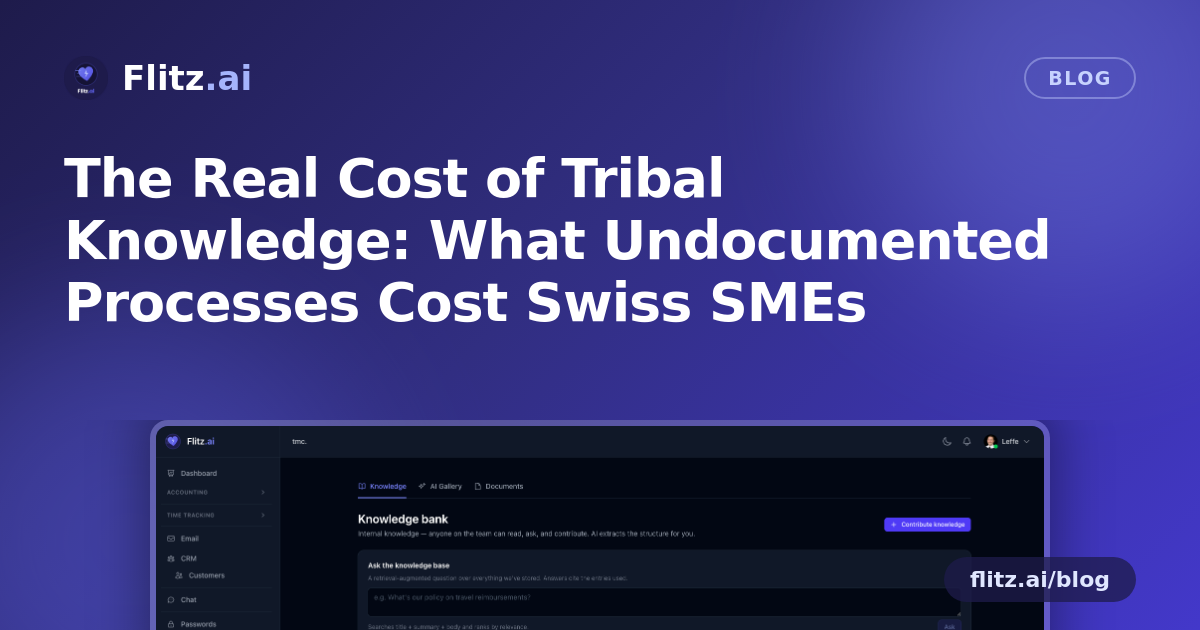
Flitz's knowledge bank is built around one idea: writing an entry should take less time than asking a colleague. Paste a URL or describe a topic in a single sentence, and the AI drafts a polished entry — title, summary, body, tags and category — ready for a quick review before posting. What used to take 20 to 30 minutes of writing and formatting now takes under a minute of reading and approving.
That single change flips the economics of documentation. If it costs almost nothing to capture a decision, a vendor note, or an onboarding step the moment it happens, teams actually do it — and the knowledge base stays alive instead of decaying into a graveyard of outdated pages.
Finding answers is just as fast as creating them
Once entries exist, anyone on the team can ask the knowledge base a question in plain language and get a direct answer with citations back to the source entries, thanks to retrieval-augmented search. No more scrolling through folders or guessing which tag someone used. That alone can cut search time from minutes to seconds, and it means the answer is always traceable to who wrote it and when.
- Categories, tags and full-text search make it easy to browse by topic, author or keyword.
- Author attribution and view counts show who contributed knowledge and how much it's actually being used — turning documentation into visible, credited work rather than invisible overhead.
- Versioned editing means anyone can update an entry as processes change, without erasing the history of how a decision evolved.
Why it belongs next to your real data, not in a separate app
Tools like Notion or Confluence keep knowledge in a silo, disconnected from the actual business. Flitz's knowledge bank sits inside the same workspace as your accounting, customers and deals — so a process note about a client can sit right next to that client's record, and a vendor note can live where the vendor's invoices already are. There's no second login, no separate tool to remember to check, and no risk of the knowledge base quietly becoming "that other thing we forgot to update."
The real return: hours back, and insurance against turnover
For a small team, the time-savings case is straightforward: fewer repeated questions, faster search, quicker onboarding, and a documentation habit that survives beyond any one person's memory. Even recovering three to four hours a week across a small team translates into CHF 800–1,500 a month freed up for actual work — not to mention the far larger, harder-to-measure cost avoided when a key employee leaves and takes their undocumented knowledge with them.
A knowledge base that people actually use isn't a nice-to-have. It's the cheapest insurance policy a small business can buy against the one certainty every company faces: people eventually move on, but the company should keep what they knew.