
The Hidden Cost of Hiring the Spreadsheet Way (And How to Get Those Hours Back)
Hiring without proper tooling quietly eats hours every week in a small team. Here's what it actually costs, and how Flitz's Recruitment module gives that time back.
Ask any Swiss SME owner how long hiring takes and you'll usually get a shrug followed by: "it's not that bad." Then you look at the actual steps — posting the job on three different boards, copying CVs into a shared folder, replying to "did you get my application" emails, scheduling interviews over back-and-forth messages, and eventually writing (or avoiding writing) rejection emails to the people who didn't make it. None of it feels like a full-time job. All of it adds up to one.
Where the hours actually go
For a small team without dedicated recruiting software, a single open role typically pulls time from four separate places:
- Sourcing and posting — manually publishing to job boards, copying the same text into different formats, and fielding applications that land in three different inboxes.
- Screening — opening every CV, skimming it against the job description, and deciding who's worth a call. For a role that attracts 60–100 applications, that's easily several hours of reading, much of it on candidates who were never a realistic fit.
- Coordination — emailing back and forth to find an interview slot, then doing it again when something gets rescheduled, then updating a spreadsheet so nobody gets double-booked.
- Closing the loop — writing rejection emails, or more often, not writing them, which quietly damages your employer brand every time a candidate is left wondering.
Multiply a conservative 4–6 hours of this per open role, per week, across a few concurrent vacancies, and a small HR or office-management function can lose the better part of a working day every week to pure process — before any actual interviewing happens. At a loaded cost of CHF 60–90 per hour for the person doing this work, that's CHF 250–500 a week spent on administration that produces no hires on its own, just the conditions for a hire to eventually happen.
What changes when the process is built for a small team
Flitz's Recruitment module doesn't try to be an enterprise ATS with a hundred settings you'll never use. It's built for a team that needs to hire well without hiring a recruiter to run the recruiting.
One job posting, one careers page, done
Every tenant gets a branded public careers page. You post the role once — with an opt-in salary range, a remote flag if relevant, and a stable JOB-XXXXXX reference code candidates can quote in any follow-up — and that's the only place it needs to exist. No copying the same text across four boards.
No more manually checking if an application is real
Candidates confirm their application via an emailed link before anything reaches your pipeline. That double opt-in quietly removes the time you'd otherwise spend chasing bounced addresses or filtering bot submissions — the pipeline only ever sees people who actually want to be considered.
AI reads every CV so you don't have to read all of them
The moment an application is confirmed, AI screens and scores it against the job description. If a scoring call fails, that application is flagged for manual review instead of being silently shown as a fake zero — so you're not misled by a technical hiccup, and you're not reading sixty CVs to find the five worth your time. Need to search your existing candidate pool for a specific profile? Describe it in plain language and get a ranked list back, run asynchronously so it never freezes the page you're working on.
A pipeline that matches the role, not a vendor's template
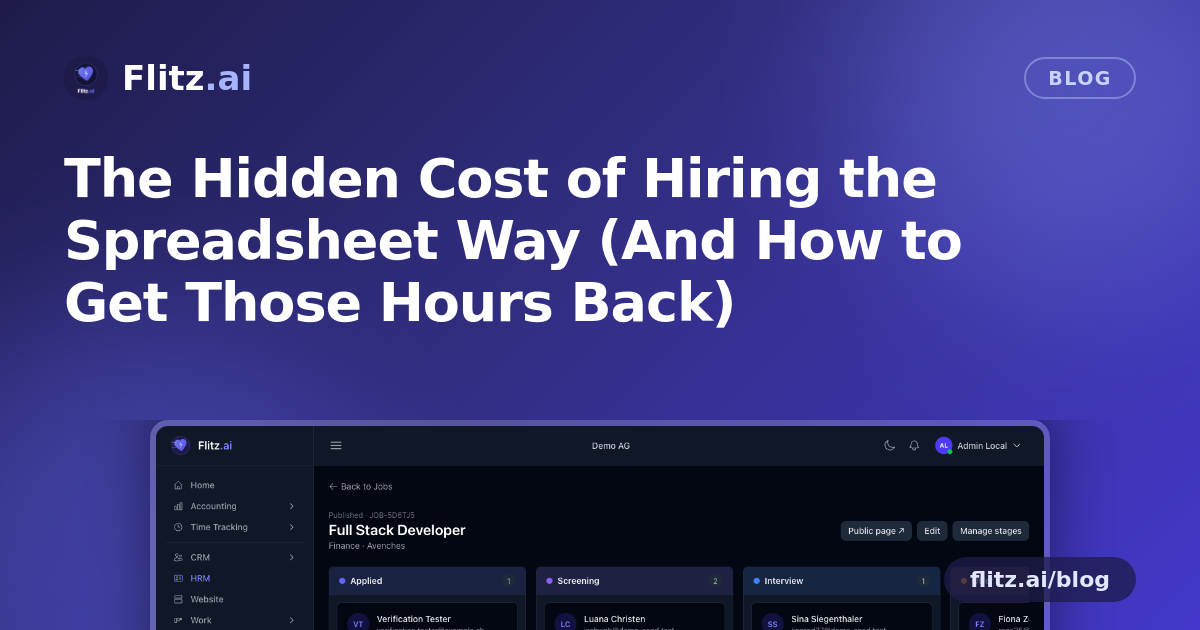
Stages are configurable per job — add, rename, reorder as the role demands. Drag-and-drop moves are conflict-checked, so two people managing the same pipeline never silently overwrite each other's work. Interview scheduling, rescheduling and cancellation are tied to the same application record as the CV and AI score, so nothing lives in a separate calendar thread.
Rejections that actually get sent
AI drafts rejection emails for every candidate who doesn't move forward. You choose, per tenant, whether they auto-send or wait for a recruiter to edit and approve. Either way, the step that most small teams skip because there's no time for it now happens by default.
Compliance without a reminder in your calendar
Rejected or withdrawn candidates are automatically anonymized after six months; hired candidates stay in your normal HR records. The GDPR data lifecycle runs on its own — one fewer policy you have to remember to enforce manually.
What that's actually worth
If the module removes even half of the sourcing-copy, manual-screening and chase-up time described above, a team filling two or three roles a year gets back several working days — time that goes back into actual interviewing, onboarding, or simply running the business. And unlike Personio, Recruitee or Workable, none of it requires exporting candidate data to yet another vendor: it's the same tenant that already runs your accounting, invoicing and HR.
Hiring well shouldn't cost you a full day a week in administration. The goal isn't to automate the judgment calls — it's to stop losing hours to the parts that were never judgment calls to begin with.