
Swiss Compliance Training Doesn't Have to Live in a Slide Deck
Compliance knowledge that lives in one person's head is a liability. Here's how structured, trackable training keeps Swiss SMEs audit-ready under OR, DSG and beyond.
Ask most Swiss SME owners where their compliance knowledge lives, and you'll get an honest but uncomfortable answer: in someone's head, in a PDF nobody opens, or in a slide deck from the last onboarding that's three reorganizations out of date. That's fine until the day it isn't — a data protection inquiry, a new hire who never received proper instruction, or an internal audit asking "can you show me that staff were trained on this?"
Swiss law doesn't demand a formal learning management system. But it does create real expectations around documented processes, data handling and accountability — and manual, undocumented training is where a lot of that accountability quietly breaks down.
Where the legal expectations actually come from
Several threads of Swiss and cross-border law touch training indirectly but firmly:
- The revised Data Protection Act (DSG), aligned closely with GDPR principles, expects organizations to demonstrate that staff handling personal data understand their obligations — not just that a policy exists on paper.
- The Code of Obligations (OR) places duties of care and diligent business conduct on management (Art. 717a and related provisions for larger entities, but the spirit applies broadly). If an employee causes harm through an error that proper instruction would have prevented, the absence of documented training becomes relevant.
- Correct bookkeeping under the Kontenrahmen KMU and MWST rules depends on staff actually knowing the current chart of accounts, VAT rates and invoicing requirements — not assuming they picked it up by osmosis.
- Sector-specific obligations — anti-money-laundering refreshers, workplace safety, data processing agreements with third parties — often come with explicit "staff must be trained" language, even if the format is left open.
None of this requires a certified LMS. But it does require something most small businesses don't have: a record. Who was trained, on what, when, and did they actually demonstrate understanding — not just click "mark as complete."
The manual process is where the risk hides
A typical small business "training process" looks like this: a new hire gets a PDF by email, maybe a verbal walkthrough, and is trusted to have absorbed it. There's no record of what was covered, no check that anything was understood, and no way to prove it months later when it matters. If the person who delivered the training leaves the company, the knowledge — and any informal record of it — leaves with them.
This isn't a willful compliance gap. It's just what happens when training isn't built into the operational fabric of the business. The fix isn't more paperwork; it's structure.
What structured training changes
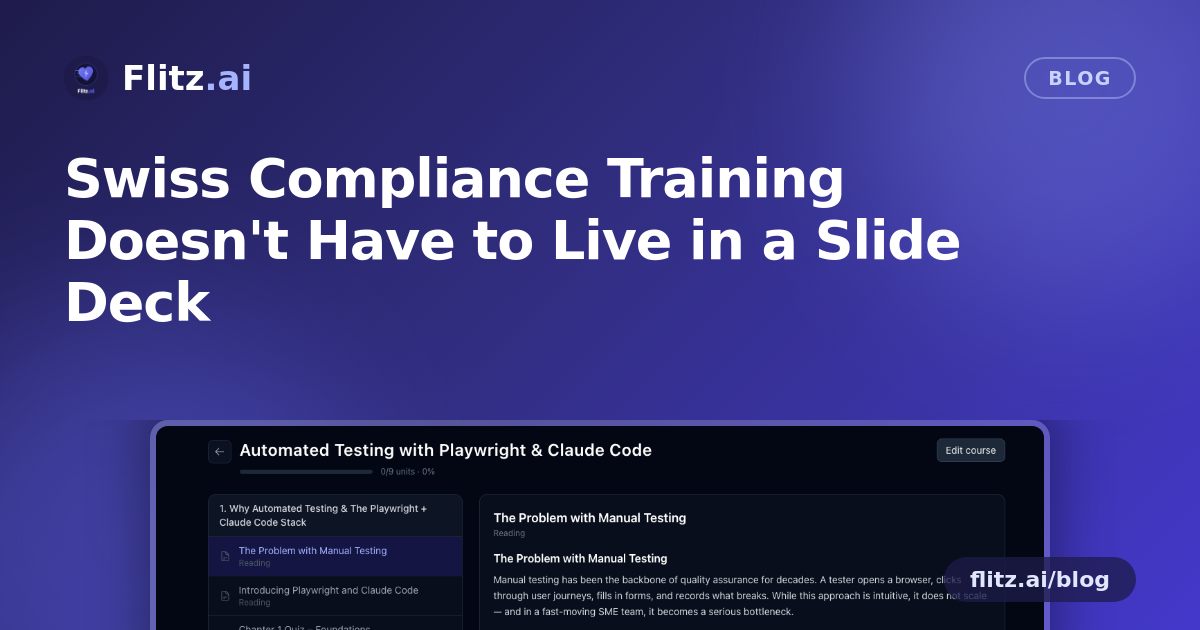
The Training module in Flitz turns scattered know-how into courses built from chapters of video, reading, PDF and multiple-choice quiz units, authored directly inside the platform your team already works in. A few design choices matter specifically for compliance:
- No click-through completions. Videos must be watched to the end and readings carry a minimum reading time, so "completed" actually means something if it's ever questioned.
- Server-side grading. Multiple-choice quizzes are graded on the server with an optional passing score, and correct answers never reach the browser — so results reflect genuine understanding, not guesswork or inspection of page source.
- Assignment with due dates. Courses can be assigned to specific people with a deadline, and invitees are notified by email, chat and the in-app notification bell, so nothing relies on someone remembering to chase it up.
- Permanent per-person training records. Completion badges and training history persist even if the underlying course is later deleted or revised — exactly the kind of durable evidence an auditor or data protection inquiry would ask for.
- Retakes keep the best result, so a bad day on a quiz doesn't permanently mislabel someone as untrained, while still requiring the passing score to be met.
Getting started without becoming a course designer
Writing a full course from scratch is the usual reason training projects stall. Flitz's AI course generation addresses that directly: describe the field that needs to be learned — MWST invoicing basics, DSG data handling rules for customer records, a new product line — and get a draft course back with chapters, readings and quizzes already structured. From there it's edited with a rich-text course builder rather than built from zero.
Keeping training data where it belongs
Training records often contain sensitive signal: who struggled with what, who hasn't completed mandatory DSG refreshers, performance on compliance quizzes. Flitz is tenant-scoped throughout — courses, media and progress data stay inside your workspace rather than syncing out to a third-party LMS. For a business already reasoning carefully about DSG obligations, that's one less data flow to document and justify.
One workspace, one less subscription
Most SMEs reaching for Thinkific, TalentLMS or Teachable are solving a narrow problem — "we need to track who finished onboarding" — with a tool built for selling courses to the public. Building training directly into the platform that already runs invoicing, accounting, CRM and HR means the training record sits next to the employee record it's actually about, with no extra subscription and no extra login.
Compliance training will never be the most exciting item on an SME's to-do list. But when the question "can you prove staff were trained?" comes up — from an auditor, a client's due diligence questionnaire, or your own legal counsel — having a structured, timestamped answer beats a shrug and a search through old emails every time.