
Hiring in Switzerland: How to Stay nDSG/GDPR-Compliant Without Drowning in Spreadsheets
Recruitment creates personal data risk from the first CV to the final rejection. Here's what Swiss data protection law expects from SME hiring — and how to meet it without a 500-seat ATS.
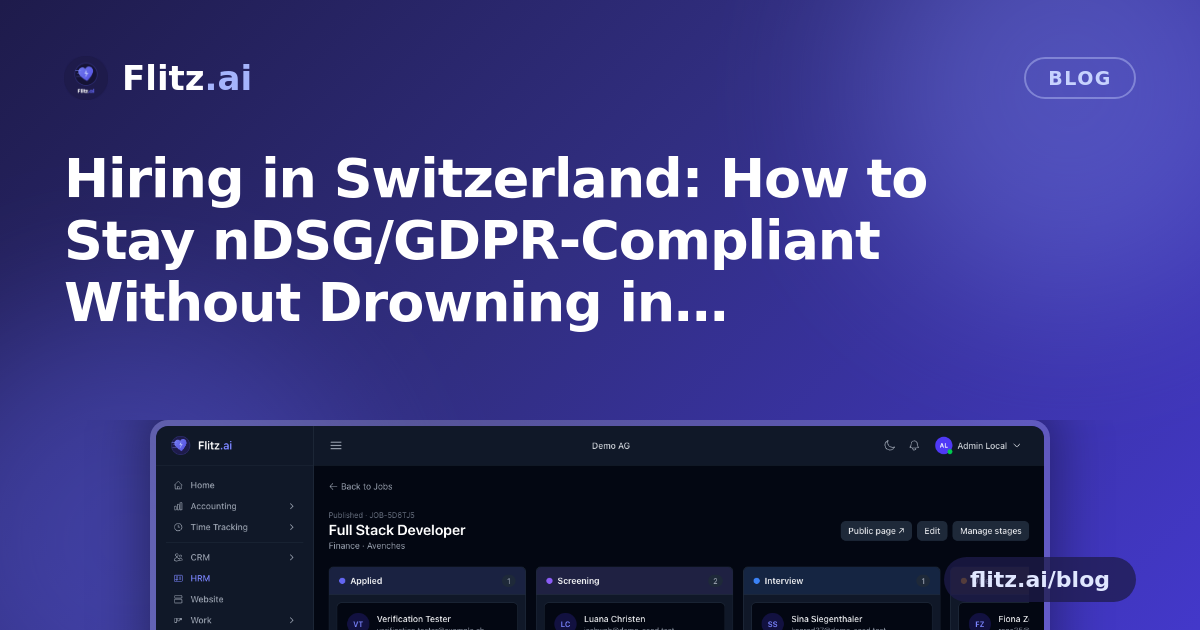
Recruitment is one of the few business processes where a Swiss SME handles sensitive personal data about people who are not yet employees, not yet customers, and not yet bound by any contract with the company. Every CV, every cover letter, every interview note is personal data under the revised Swiss Data Protection Act (nDSG) — and if the candidate is based in the EU or EEA, GDPR applies too. Yet in many small businesses, the entire hiring process still lives in a shared inbox, a spreadsheet, and a folder of PDFs that nobody ever cleans up.
That gap between what the law expects and how hiring actually happens is where the risk sits. Here is what matters, and how a proper recruitment workflow closes the gap.
What Swiss law actually expects from recruitment data
The nDSG requires that personal data be collected for a clear purpose, kept no longer than necessary, and protected against unauthorized access. For recruitment specifically, this means:
- Consent and transparency — candidates should know what happens with their application and be able to confirm it was genuinely them who applied.
- Data minimization and retention limits — CVs and cover letters from rejected candidates cannot sit in a mailbox indefinitely "just in case."
- Accountability — if a rejected candidate asks what data you hold and why, you need an answer, not a shrug.
- Fair, explainable decisions — if you use any automated scoring or ranking, you should be able to show how it worked and catch it when it fails, rather than silently treating a technical error as a rejection.
None of this is exotic. It is the same logic that applies to customer data under the DSG — it just rarely gets applied to recruitment, because recruitment feels informal even when it legally isn't.
Where manual hiring processes create risk
A spreadsheet-and-email approach to hiring tends to fail in predictable ways:
- Applications arrive from typos or bots, and nobody can verify the email address actually belongs to a real candidate before their data enters the pipeline.
- CVs and personal details are forwarded between recruiters and hiring managers, multiplying the number of places sensitive data lives.
- Rejected candidates' files are never deleted or anonymized — not out of bad intent, but because nobody owns that task.
- Two people editing the same pipeline in parallel overwrite each other's notes, creating confusion about who was told what.
- If scoring or shortlisting is done informally, there's no record of why a candidate was or wasn't moved forward.
Individually these look like small inefficiencies. Collectively, they are exactly the pattern a data protection audit or a candidate's access request would expose.
How the Flitz Recruitment module is built around compliance, not despite it
Flitz treats recruitment as a regulated data process from the first click, not an afterthought bolted onto a Kanban board.
Double opt-in applications
Every candidate must confirm their application via an emailed link before it ever reaches the pipeline or the AI screening step. This filters out mistyped addresses and bot submissions before their data is processed at all — a practical application of data minimization.
Transparent, honest AI screening
Confirmed applications are automatically scored against the job description. Critically, if the AI call fails for any reason, the application is flagged for manual review — it is never silently shown as a fake zero score. This matters for fairness and explainability: an applicant should never be disadvantaged by a system error that looks like a rejection.
Conflict-checked pipeline, one source of truth
The Kanban pipeline is configurable per job and every drag-and-drop move is conflict-checked, so two recruiters can't silently overwrite each other's work. Interview scheduling, CV, and AI score all live on the same application record — no scattered copies across inboxes and spreadsheets.
Rejections, your way
AI-drafted rejection emails can auto-send by default or be held for a recruiter to review and edit before anything goes out — configurable per tenant. Either way, every rejected candidate receives a timely, documented response instead of silence.
Built-in data lifecycle
This is the piece most SMEs are missing entirely: rejected or withdrawn candidates are automatically anonymized after six months. Hired candidates' data simply transitions into normal HR recordkeeping. Nobody has to remember to clean up a folder — the retention rule is enforced by the system itself, which is precisely what an audit-ready process looks like.
A public careers page without a vendor sprawl problem
Each tenant gets its own branded careers page with job postings — including optional salary range, remote flag, and a stable JOB-XXXXXX reference code candidates can quote when they follow up. This replaces tools like Personio, Recruitee or Workable without exporting candidate data to yet another third-party vendor, which itself reduces your data protection surface: fewer processors, fewer data transfer agreements, fewer places something can go wrong.
Compliance as a side effect of good process
None of this requires a compliance officer or a legal review of every hire. It requires a hiring workflow where consent, retention, fairness and auditability are built into the default path — so doing the right thing is also the easiest thing. For a Swiss SME that doesn't have the headcount for a dedicated recruiting or legal team, that is the only kind of compliance that actually sticks.