
Swiss OR Compliance Made Simple: Year-End Financial Statements Without the Risk
Every Swiss company must produce a compliant Jahresabschluss under OR Art. 957ff. Here's where manual processes create audit risk — and how to close the books cleanly.
Every company registered in the Swiss commercial register has a legal duty to close its books properly each year. Article 957 et seq. of the Swiss Code of Obligations (OR) sets out exactly what counts as a compliant Jahresabschluss: a balance sheet (Bilanz), a profit & loss statement (Erfolgsrechnung), and — depending on company size — notes. Smaller entities below the thresholds in OR Art. 957a can use simplified accounting, but the core obligation to deliver a true, complete, and traceable picture of the business never disappears.
For many Swiss SMEs, this is where things get stressful. Not because the law is unclear, but because the underlying process — pulling numbers from invoicing tools, bank statements, payroll, and MWST filings into one coherent set of statements — is where errors creep in.
What Swiss Law Actually Expects
OR Art. 957a requires bookkeeping to be complete, truthful, and systematically documented, following generally accepted principles (the "Grundsätze ordnungsmässiger Rechnungslegung"). This means every transaction needs a clear paper trail back to a document, and the figures in your Bilanz and Erfolgsrechnung must reconcile with your underlying ledgers — your Kontenrahmen KMU structure — down to the last centime.
On top of that, OR Art. 958f obliges companies to retain accounting records and supporting documents for ten years, in a form that remains accessible and unaltered. Combine this with ongoing MWST reporting obligations to the Federal Tax Administration and data protection duties under the revised DSG, and it becomes clear: a "good enough" spreadsheet approach to year-end closing is a real liability, not just an inconvenience.
Where Manual Processes Create Risk
Most compliance gaps don't come from bad intentions — they come from fragmented workflows:
- Disconnected data sources. When invoicing, banking, and payroll each live in separate tools, someone has to manually consolidate figures into the Bilanz and Erfolgsrechnung. Every manual transfer is a chance for a transcription error or a missed transaction.
- No locked fiscal periods. If prior periods can still be edited after statements are filed, you lose the "systematically documented" integrity that OR Art. 957a demands — and you can't prove your year-end figures weren't changed afterward.
- Weak audit trail. Auditors and tax authorities expect to trace every balance back to source bookkeeping entries. Without a live trial balance (Saldenliste), reconciling discrepancies at closing time becomes a slow, manual hunt.
- Last-minute scrambling. When financial statements are assembled only once a year, under deadline pressure, mistakes multiply — exactly when accuracy matters most.
Staying Audit-Ready by Design
The most reliable way to meet OR requirements isn't to work harder at year-end — it's to generate statements directly from the same bookkeeping data you use all year round, with no manual re-entry.
Flitz's Annual Financial Statements module does exactly this. Because Flitz centralizes accounting, invoicing, banking, and HR data in one system, your Jahresabschluss isn't a separate project — it's a direct output of your day-to-day bookkeeping:
- Balance sheet (Bilanz) generated automatically from your live ledger, structured according to Kontenrahmen KMU conventions.
- Profit & loss statement (Erfolgsrechnung) reflecting actual recorded income and expenses — no manual reconciliation step.
- Trial balance (Saldenliste) available at any time, so you can spot imbalances before they become year-end surprises.
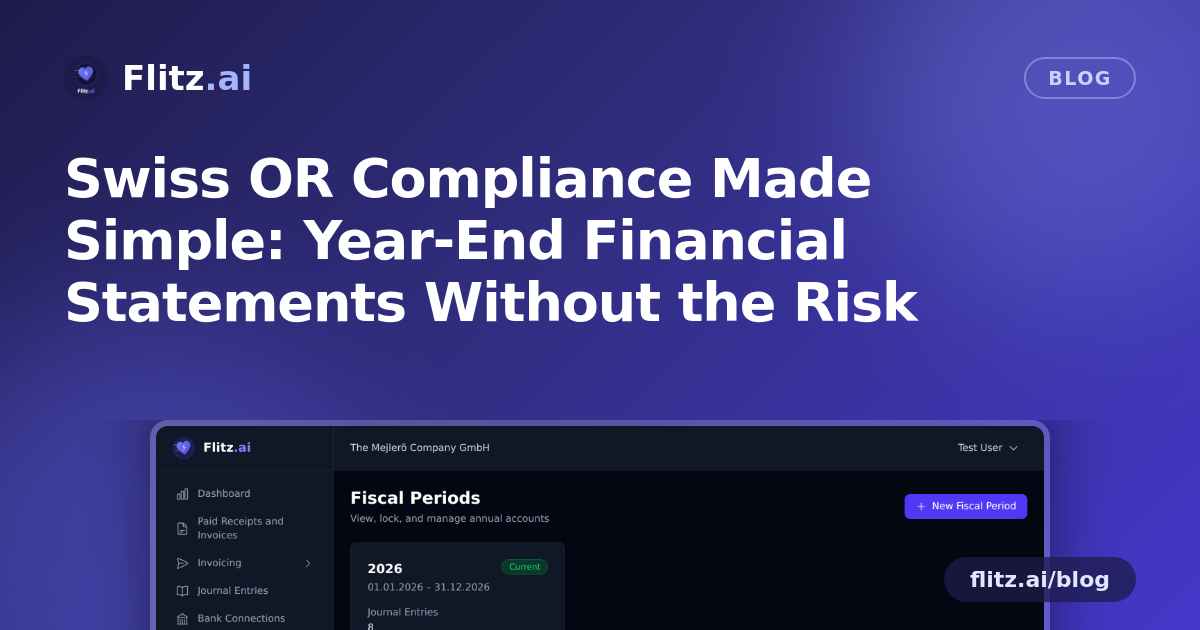
- Fiscal period management with locking, ensuring that once a period is closed, entries can't be silently altered — exactly the kind of documentation integrity OR Art. 957a expects.
- Built from the ground up to align with Swiss OR Art. 957ff requirements, rather than adapted from a generic accounting template.
Why This Matters Beyond the Legal Minimum
Compliance isn't only about avoiding penalties. A clean, lockable, OR-aligned Jahresabschluss is also what your fiduciary, your bank, or potential investors will ask for. If you ever face a tax audit or need to apply for financing, being able to produce an accurate Bilanz, Erfolgsrechnung, and Saldenliste within minutes — rather than days — is a genuine operational advantage.
Audit-readiness shouldn't be a once-a-year scramble. It should be a byproduct of how you run your books every single day.
For Swiss SMEs and the fiduciaries who support them, that shift — from reactive year-end assembly to continuous, locked, traceable bookkeeping — is what actually reduces compliance risk under OR, not just paperwork volume.