
Payroll Compliance in Switzerland: Where Manual Processes Put Your SME at Risk
Swiss payroll involves AHV, ALV, BVG, UVG, KTG, Lohnausweis, and SVA reporting — all with strict deadlines. Here's where manual payroll creates compliance risk and how automation closes the gap.
Running payroll in Switzerland is not just about paying salaries on time. It is a compliance exercise with multiple regulators, strict deadlines, and real financial consequences if something goes wrong. Social insurance contributions, the Lohnausweis, and SVA reporting are all legally mandated — and the obligation to get them right sits squarely with the employer, not an external office.
What Swiss law actually expects from payroll
Every employer in Switzerland carries obligations under multiple frameworks at once:
- AHV/IV/EO (old-age, disability, and loss-of-earnings compensation) must be calculated correctly on every payslip and reported to the competent Ausgleichskasse (SVA).
- ALV (unemployment insurance) contributions follow defined wage ceilings that change periodically and must be applied precisely.
- BVG (occupational pension) contributions depend on age brackets and coordination deductions, which differ from one pension plan to another.
- UVG (accident insurance) and KTG (daily sickness benefits) have employer and employee cost-sharing rules that must be documented correctly.
- A Lohnausweis must be issued to every employee annually, following the exact format required by Swiss tax authorities.
- An SVA annual report reconciling declared versus actual wages is mandatory, and discrepancies trigger follow-up corrections or back payments.
None of this is optional, and none of it forgives rounding errors. The Swiss Code of Obligations (OR) also requires that wage records be kept in a traceable, auditable form — which means your bookkeeping and your payroll cannot live in separate, disconnected systems.
Where manual payroll processes create risk
Many Swiss SMEs still run payroll through spreadsheets, standalone payroll tools, or outsourced providers who are not tightly connected to the company's accounting. This creates several recurring risk points:
- Calculation drift. AHV, ALV, and BVG rates and thresholds are updated periodically. A spreadsheet formula that was correct last year can silently produce wrong deductions this year.
- Manual journal entries. Translating a payroll run into correct bookings against your Kontenrahmen KMU chart of accounts is time-consuming and error-prone when done by hand, and mistakes here distort your financial statements, not just your payroll.
- Inconsistent Lohnausweis generation. When the Lohnausweis is produced separately from the payroll run, figures can drift apart — a mismatch that surfaces exactly when a tax authority or auditor compares documents.
- SVA reporting gaps. If monthly or periodic wage data is not consistently tracked, the annual SVA reconciliation becomes a scramble, increasing the chance of missed deadlines or underreported wages.
- Weak audit trail. Spreadsheets get overwritten, emails get lost, and versions multiply. When an auditor or SVA official asks "show me how this figure was calculated," a fragmented process struggles to answer quickly.
Individually, these look like small inefficiencies. Collectively, they are exactly what turns a routine SVA audit or year-end closing into a stressful, costly exercise — and in the worst case, into back payments with interest.
What an audit-ready payroll process looks like
Compliance is fundamentally about consistency and traceability: the same correct numbers, calculated the same way, every time, flowing automatically into your books. That is the design principle behind Flitz's payroll module.
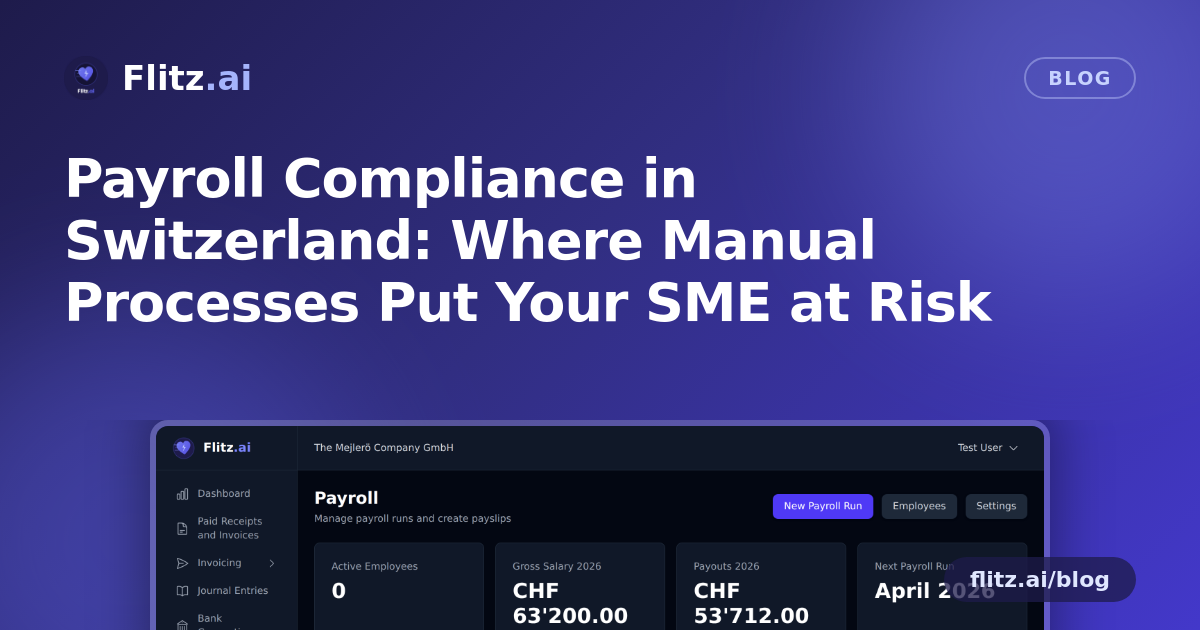
- Automatic social insurance calculations for AHV/IV/EO, ALV, BVG, UVG, and KTG remove the need to track rate changes manually or rebuild formulas every January.
- Lohnausweis generation per employee is produced directly from the same payroll data used for contributions, so there is no separate process that can drift out of sync.
- SVA annual reporting is built on consistent, period-by-period wage data rather than a year-end reconstruction effort.
- Automatic journal entries post each payroll run directly into the books, aligned with your chart of accounts, eliminating manual re-entry and the errors that come with it.
- Multi-employee management keeps every employee's contributions, deductions, and documents organized in one place, regardless of whether you employ three people or thirty.
Why this matters beyond avoiding fines
Audit-readiness is not just about defending against penalties. It is about being able to answer, at any moment, exactly what was paid, what was withheld, and why — to an employee, a new fiduciary, a bank, or a Swiss tax or insurance authority. Under the DSG (Swiss data protection act), payroll data also counts as sensitive personal information, which means it needs to be stored securely and accessed in a controlled way, not scattered across local spreadsheets and email attachments.
When payroll, social insurance calculations, and bookkeeping are connected in a single system, every payroll run becomes a documented, reconcilable event rather than a manual task you hope was done correctly. That is the difference between reacting to a compliance problem and never having one in the first place.
Swiss payroll compliance is less about knowing every rule and more about having a process that applies those rules the same way, every single month.
Getting started
If your current payroll process relies on spreadsheets, manual journal entries, or a disconnected tool, it is worth asking a simple question: if an SVA auditor called tomorrow, how long would it take to produce a clean, reconciled answer? If the answer is "longer than it should," automating the calculation, documentation, and bookkeeping side of payroll is one of the highest-leverage compliance improvements a Swiss SME can make.