
From Tribal Knowledge to Tracked Training: A Step-by-Step Guide for Swiss SMEs
Stop relying on PDFs buried in shared drives and hallway explanations. Here's a practical, step-by-step way to turn scattered know-how into trackable courses your whole team can complete.
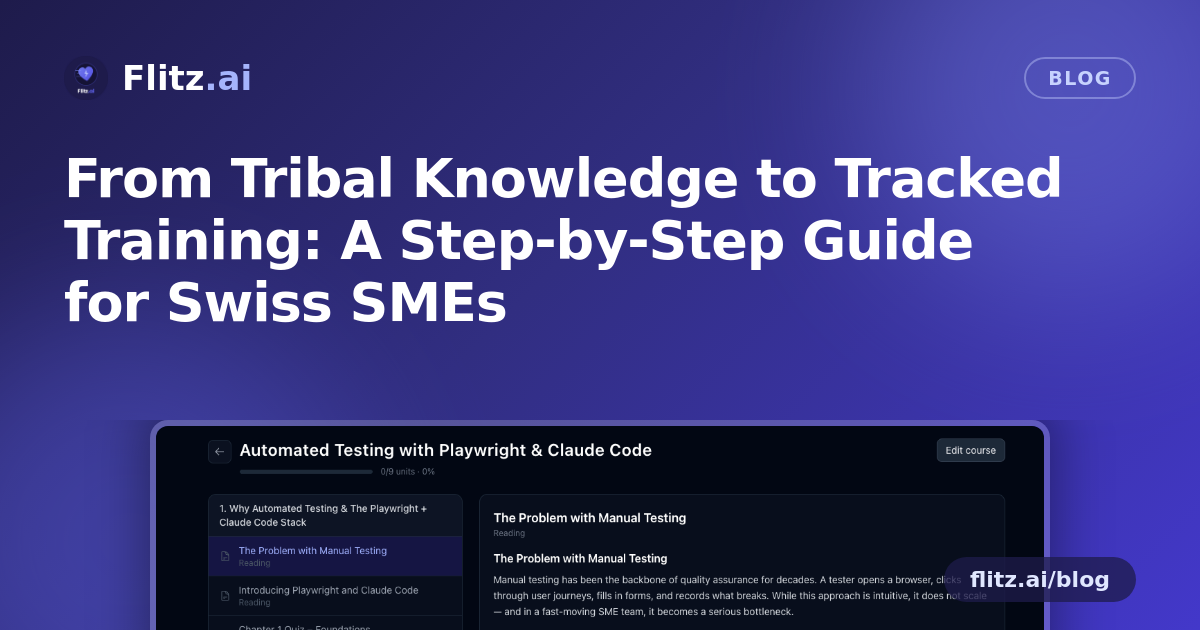
Ask most Swiss SME owners how new hires learn the ropes, and the honest answer is usually some mix of "they shadow someone for a week," "there's a slide deck from 2021 somewhere," and "they ask whoever's free." It works, sort of — until the person with the knowledge is on holiday, leaves the company, or simply forgets to mention the one compliance detail that actually matters.
The problem isn't a lack of knowledge. It's that the knowledge has never been turned into something structured, repeatable, and provable. Here's how to fix that without buying yet another SaaS subscription or spending a month building courses from scratch.
Step 1: Audit what already exists in people's heads and inboxes
Before building anything, list what currently counts as "training" at your company: onboarding checklists, safety briefings, product walkthroughs, MWST or data-protection refreshers, the email you send every January reminding staff about expense rules. Most SMEs are surprised how much already exists — it's just scattered across PDFs, email threads, and verbal habit. This list becomes your course backlog.
Step 2: Let AI draft the first version of each course
Instead of starting from a blank page, describe the subject area to Flitz's Training module — for example "onboarding for a retail cashier" or "annual data protection refresher" — and let the AI course generation feature produce a full draft: chapters, reading units, and multiple-choice quizzes. You're not writing from scratch anymore; you're editing. This alone usually cuts course-building time from days to an afternoon.
Step 3: Refine the course with the builder
Open the draft in the course builder and adjust it to match reality. Add chapters and units — video, reading, PDF, or quiz — using the rich-text editor. Swap in your own product videos, replace generic examples with your actual procedures, and tighten the quiz questions so they test what genuinely matters for the role. This is also the point to decide whether a passing score should be required before someone is considered trained.
Step 4: Publish and assign with a due date
Once a course is ready, assign it to the relevant team members with a due date. Invitees are notified automatically by email, in chat, and via the notification bell — no manual follow-up emails, no forgotten reminders. Everyone sees the course in their own workspace with their personal progress tracked unit by unit.
Step 5: Let the system enforce real completion
This is where structured training beats a shared PDF: videos must be watched to the end and readings have a minimum reading time, so there's no click-through-and-forget. Quizzes are graded server-side, and correct answers never reach the browser, which means results are trustworthy, not guessable. If a passing score is set, team members can retake the quiz — Flitz keeps their best result, so one bad day doesn't define the record.
Step 6: Review completion badges and the training record
When someone finishes the last unit, they automatically earn a completion badge. More importantly, every completion is logged in a permanent per-person training record — one that survives even if the course itself is later deleted or revised. For compliance refreshers, audits, or simply answering "when was this person last trained on X," you now have a clean, searchable answer instead of a guess.
Step 7: Set a refresh cadence
Training isn't a one-time project. Pick a sensible interval for compliance-sensitive courses — annually for data protection, every two years for safety basics, whenever a product changes for product know-how — and re-assign the course with a new due date. Because the course already exists, re-running it takes minutes, not a rebuild.
What changes once this is in place
- New hires get a consistent onboarding experience regardless of who happens to be free that week
- Compliance refreshers become a scheduled task instead of an afterthought someone remembers in Q4
- Managers can see who's trained and who isn't, without chasing anyone for confirmation
- Training data, videos, and progress records stay inside your own workspace — tenant-scoped like everything else in Flitz, with nothing shared across companies
You also don't need a separate LMS subscription to get there. Flitz Training is built to replace tools like Thinkific, TalentLMS, and Teachable for internal company training — same structured courses and tracking, one less invoice, and no training content leaving your Swiss workspace.
The goal isn't more training. It's training that actually gets completed, actually gets verified, and actually leaves a record behind.
Getting started this week
Pick one course from your audit list — ideally your onboarding checklist, since it's used most often — and run it through the AI draft, a quick edit pass, and an assignment to your next new hire. One working course is enough to prove the process; the rest of your backlog follows naturally once the first one is live.