
5 Costly Mistakes Swiss SMEs Make When Searching for Business Data (And How an AI Assistant Fixes Them)
Hunting for an invoice, a chat message, or last month's hours shouldn't eat up your afternoon. Here are the most common data-search mistakes Swiss SMEs make — and how to avoid them.
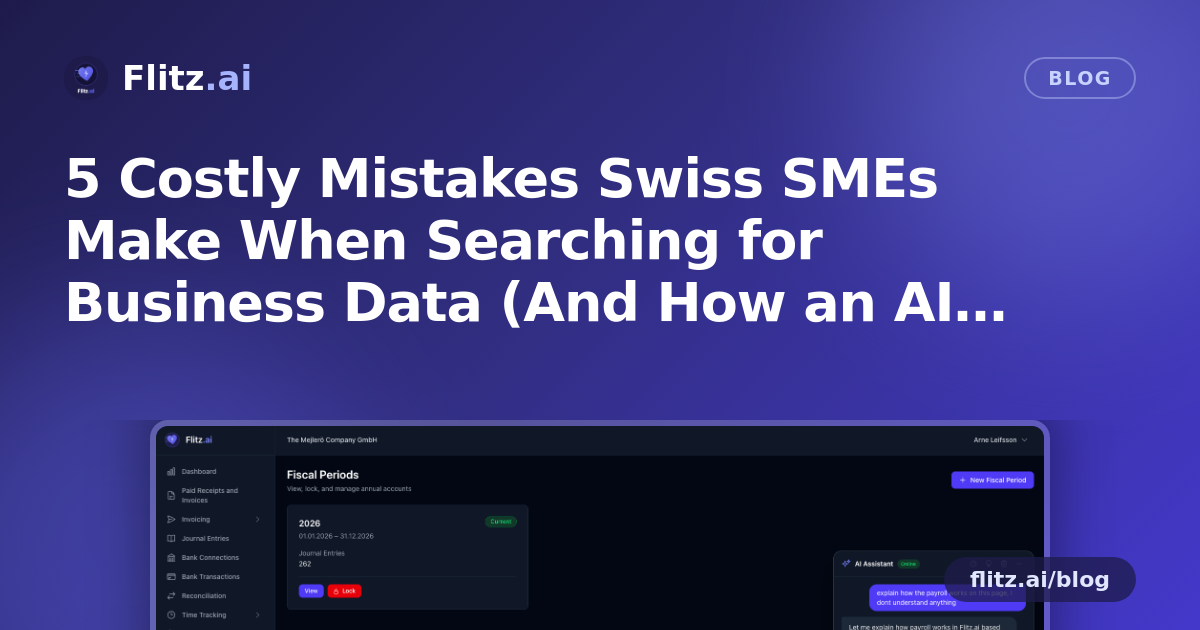
Running a small business in Switzerland means constantly switching hats — and constantly switching tools. Your accounting lives in one system, your team chat in another, your project hours in a spreadsheet or a third app. When you need an answer fast, you often don't get one fast at all. You get a scavenger hunt.
Below are the five mistakes we see most often when Swiss SMEs try to find and use their own business data — and what they cost in time, money, and peace of mind.
Mistake 1: Treating "checking the numbers" as a once-a-month task
Many business owners only look closely at account balances or outstanding invoices when it's time to close the books or prepare the MWST return. In between, decisions get made on gut feeling: Can we afford this purchase? Has that client finally paid? Is a supplier invoice overdue?
This happens because digging through accounting software takes effort — you need to open the right module, apply filters, and interpret the report. So people simply postpone it.
The cost: cash flow surprises, late payment reminders sent (or not sent) at the wrong time, and decisions made without real numbers behind them.
The fix: With a conversational AI assistant connected directly to your accounting data, you can simply ask "What's our current balance?" or "Which invoices are overdue?" in plain language and get an instant answer — no reports to build, no modules to navigate. Checking the numbers becomes a 10-second habit instead of a monthly chore.
Mistake 2: Losing important decisions in chat history
Agreements with clients, pricing changes, or internal approvals often happen in chat — and then disappear into an endless scroll. Weeks later, nobody remembers who confirmed what, or the conversation is buried across different channels and threads.
This mistake happens because chat is designed for speed, not retrieval. Nobody labels a message "important decision" in the moment.
The cost: disputes over verbal or written agreements, repeated questions to colleagues, and time wasted scrolling instead of working.
The fix: An assistant that can search chat messages and conversations across all channels turns your entire communication history into something you can actually query — "What did we agree with that supplier last month?" — instead of something you have to remember.
Mistake 3: Flying blind on project hours and absences
Many teams track time diligently but rarely look at it until invoicing day or payroll run. That means overruns on fixed-price projects go unnoticed, and absence patterns (sick days, vacation balances) only get reviewed reactively.
This happens because time-tracking data usually lives in a separate tab or tool that nobody opens unless they have to.
The cost: underbilled projects, unexpected vacation-balance disputes, and payroll corrections after the fact.
The fix: Ask directly — "How many hours were logged on this project this month?" or "Who's absent next week?" — and get the answer instantly, because time entries, project hours, and absences are part of the same connected system the assistant can query.
Mistake 4: Assuming generic tools understand Swiss accounting
A general-purpose chatbot or spreadsheet formula doesn't know the difference between the Swiss Kontenrahmen KMU and a generic chart of accounts. It doesn't know how MWST rates apply, or what the Swiss Code of Obligations (OR) requires for bookkeeping. Business owners end up translating their own questions into generic terms, then translating the answers back — or worse, getting answers that are simply wrong for Switzerland.
This happens because most AI tools are built for a global audience, not for Swiss fiduciary and tax rules.
The cost: misinterpreted MWST figures, compliance risks, and extra review time from your fiduciary to catch errors.
The fix: An assistant that understands Swiss accounting rules — OR, MWST, and the Kontenrahmen KMU — out of the box means you can ask questions in normal business language and trust that the answer is framed correctly for Swiss requirements.
Mistake 5: Switching tools so often that questions never get asked
Perhaps the most common mistake is simply giving up. If getting an answer means logging into a separate dashboard, waiting for a report, or pinging your bookkeeper, many small but important questions never get asked at all. "Is this expense normal?" "Did we invoice that client yet?" These questions pile up unanswered.
This happens because friction kills curiosity. The more steps between a question and an answer, the less likely the question gets asked.
The cost: missed red flags, duplicated invoices, and a general sense of not being in control of the business.
The fix: An assistant available everywhere — as a floating panel on every page — removes the friction entirely. You don't need to open a new tab or remember where a report lives. You ask, right where you are, and move on.
Bringing it together
None of these mistakes happen because business owners are careless. They happen because the tools in use create distance between a question and its answer — across accounting, chat, and time tracking. The fix isn't more discipline; it's less friction.
Flitz's AI Assistant is built as a copilot across your entire platform: one conversational layer over your accounting data, chat history, and time entries, fluent in Swiss accounting rules, and available wherever you're working. Instead of hunting for answers, you simply ask.