
The Swiss SME Website Checklist: How Many Boxes Can You Actually Tick?
A practical self-assessment for your company website — and why most Swiss SMEs fail half the checklist without even knowing it.
Every Swiss SME has a website. Far fewer have one that actually works for the business. It sits on a separate platform, updated by whoever last remembered the WordPress password, disconnected from the CRM, the invoices, and the rest of the company's data. If you've ever hesitated before asking "can someone update the homepage," this checklist is for you.
Go through the list below and be honest. Then see how a website that lives inside your business platform — not next to it — changes the answers.
The Self-Assessment
1. Can you publish a new page without calling a developer?
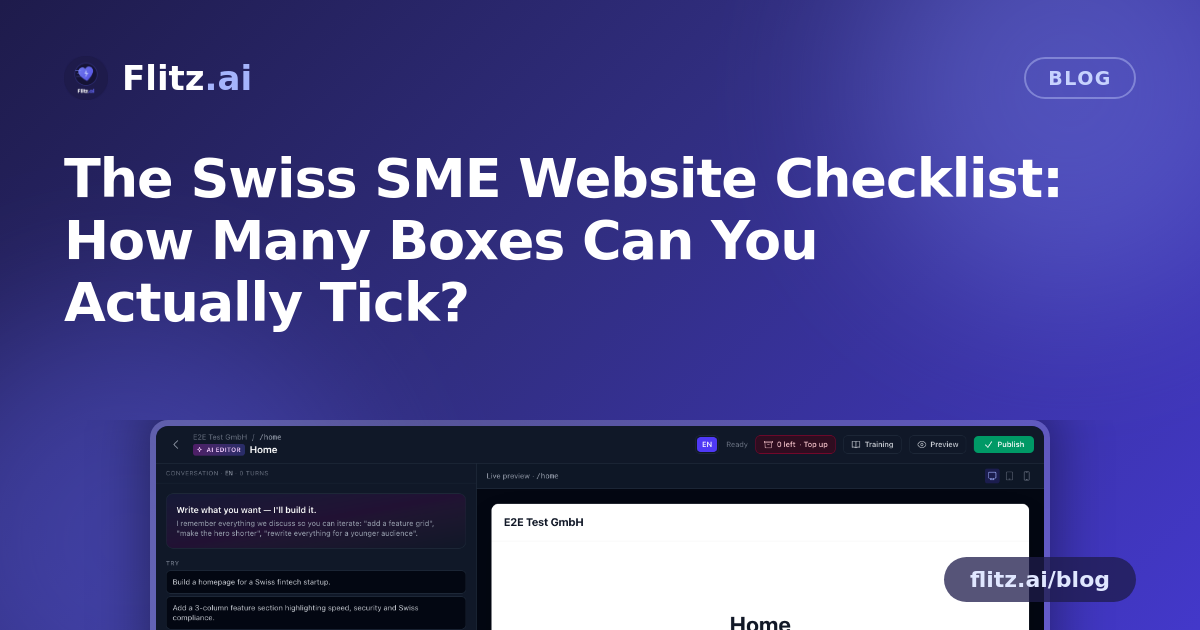
If updating a service page or adding a landing page requires a freelancer, a support ticket, or a drag-and-drop builder nobody enjoys using, that's a bottleneck. An AI page editor that turns a plain-language description into ready content blocks removes the dependency entirely — you describe the page, review the draft, and publish.
2. Do you actually publish blog posts, or just mean to?
Most SMEs know content marketing helps SEO and trust, and most SMEs don't do it, because writing takes time nobody has. An AI blog writer that drafts a full post from a topic — and translates it into every language you operate in with one click — turns "we should really write more" into something that happens on a Tuesday afternoon.
3. Is your site on your own domain, with HTTPS, without a support ticket?
A custom domain with automatic HTTPS is table stakes for credibility. It should take adding a domain and verifying by DNS — not a multi-day back-and-forth with a hosting provider.
4. If you serve German, French, Italian, or English customers, is every page actually translated?
Switzerland runs on multiple languages, and a site that's only in German quietly turns away Romandie or Ticino customers. Multi-language support out of the box — every page and post translatable per locale, with navigation that adapts automatically — should not be a separate project with a separate agency.
5. Do you have a sitemap.xml, robots.txt, and sensible meta defaults — without knowing what those are?
SEO fundamentals shouldn't require a specialist. Site-wide meta defaults plus an automatically generated sitemap.xml, robots.txt, and even an llms.txt file mean the technical groundwork is done the moment you publish, not months later during an audit.
6. When someone fills out your contact form, does it land in your CRM — or in an inbox nobody checks?
A lead form that just sends an email is a lead that's one deleted message away from disappearing. Forms wired directly to your CRM turn every website visitor into a tracked lead automatically, with no manual copy-pasting between tools.
7. Does your site load fast and stay online, without you thinking about hosting?
A server-side rendered, HTML-cached public site loads quickly and stays reliable without separate hosting to manage or a plugin update to dread.
8. Are you GDPR-compliant with cookie consent, without a compliance consultant?
Cookieless page-view analytics paired with a built-in cookie-consent banner should be the default, not an add-on plugin you had to research and install yourself.
9. Is your website actually connected to the rest of your business?
This is the box almost nobody ticks. Your marketing site, your CRM, your invoicing, your accounting — if they all live in different tools with different logins and different bills, your website is an island. Every lead it generates, every page it publishes, sits disconnected from the customer and financial data it should reflect.
Scoring Yourself
If you ticked seven or more boxes, you're ahead of most SMEs. If you're somewhere in the middle — a domain here, a half-finished blog there — you're not alone, and it's usually not a strategy problem. It's a tooling problem: too many separate subscriptions, each solving one piece, none talking to the others.
The point of a company website isn't to exist. It's to bring in leads, represent the business accurately, and cost as little ongoing effort as possible.
Where Flitz Fits
Flitz brings the website and CMS into the same workspace as your books, customers, and deals. The AI page editor and AI blog writer handle the content work. Your own custom domain, automatic multi-language versions, SEO defaults, sitemaps, and a privacy-first cookie banner handle the technical work. Lead forms drop straight into your CRM, so a filled-out form becomes a tracked lead, not an email that sits unread.
No drag-and-drop builder to wrestle with. No extra subscription bill unrelated to the rest of your business. One less login, and a website that finally lives next to the data it should reflect.
Run the checklist again in six months. See how many more boxes are ticked — and how little effort it took.