
The Swiss Year-End Checklist: Is Your Jahresabschluss Really OR-Compliant?
A practical self-assessment for Swiss SMEs to check whether their annual financial statements actually meet OR Art. 957ff requirements — and how to tick every box automatically.
Every Swiss company, no matter how small, has to close its books once a year. The Jahresabschluss (annual financial statement) is not optional — it's a legal obligation under the Swiss Code of Obligations, and it's the document your bank, your tax authority, and potentially your auditor will scrutinize. Yet for many SME owners, year-end closing is still a scramble of spreadsheets, half-reconciled accounts, and last-minute calls to the fiduciary.
Before you hand anything over — or submit anything to the tax office — run through this self-assessment. If you can't confidently tick every box, your closing process has a gap.
The Self-Assessment: 8 Questions Every Swiss SME Should Answer
1. Do you have a complete balance sheet (Bilanz)?
Your balance sheet must show assets, liabilities, and equity as of the closing date, structured according to OR requirements. If you're still manually copying totals from different ledgers into a spreadsheet, there's a high risk of transcription errors or missing accounts.
2. Does your profit & loss statement (Erfolgsrechnung) actually reconcile with your bookkeeping?
The P&L has to reflect every booked transaction for the fiscal year — no gaps, no manual adjustments that aren't traceable back to source entries. If your P&L is built separately from your day-to-day bookkeeping, you're duplicating work and introducing risk.
3. Can you produce a trial balance (Saldenliste) on demand?
A trial balance listing all account balances is the backbone of any audit or review. If generating one means exporting data and rebuilding it in Excel every time, you're losing hours you don't have during closing season.
4. Is your fiscal period properly locked after closing?
Once a financial year is closed and the statements are filed, can anyone still go back and edit a booking from that period? If yes, that's a compliance and audit-trail problem. Locked periods are essential for data integrity.
5. Are your statements generated directly from existing bookkeeping data — or rebuilt from scratch?
Rebuilding financial statements manually each year invites inconsistency. The numbers in your Bilanz and Erfolgsrechnung should be a direct, automatic reflection of what's already in your books — not a separate exercise.
6. Do your statements meet the structural requirements of OR Art. 957ff?
Swiss law is specific about minimum structure and disclosure for balance sheets and P&L statements, depending on company size. Many smaller businesses unknowingly use outdated or incomplete templates.
7. Can you trace every figure in your statements back to its source transaction?
If a tax authority or auditor asks "where does this number come from," can you answer in seconds? Full traceability isn't just good practice — it's what makes a review or audit painless instead of painful.
8. Are you confident your statements are ready before the deadline — without weekend overtime?
If closing the books means several evenings of manual reconciliation every single year, the process itself is the problem, not your bookkeeping discipline.
Why Most SMEs Struggle With This
None of these requirements are exotic. They're standard obligations under Swiss law. The difficulty is almost never understanding what is required — it's the manual work of pulling data from bookkeeping systems, reformatting it correctly, keeping prior periods untouched, and making sure every number still ties out after adjustments. That manual bridge between "bookkeeping" and "financial statement" is where errors, delays, and stress creep in.
Ticking the Hard Boxes Automatically
This is exactly the gap Flitz's Annual Financial Statements feature closes. Because it works directly from your existing bookkeeping data rather than a separate export, your balance sheet, profit & loss statement, and trial balance are generated automatically and stay consistent with every booked transaction.
- Balance sheet and P&L are built to Swiss OR Art. 957ff structure, so you're not guessing at formatting requirements.
- Trial balance is available on demand, giving your fiduciary or auditor exactly what they need without a separate export job.
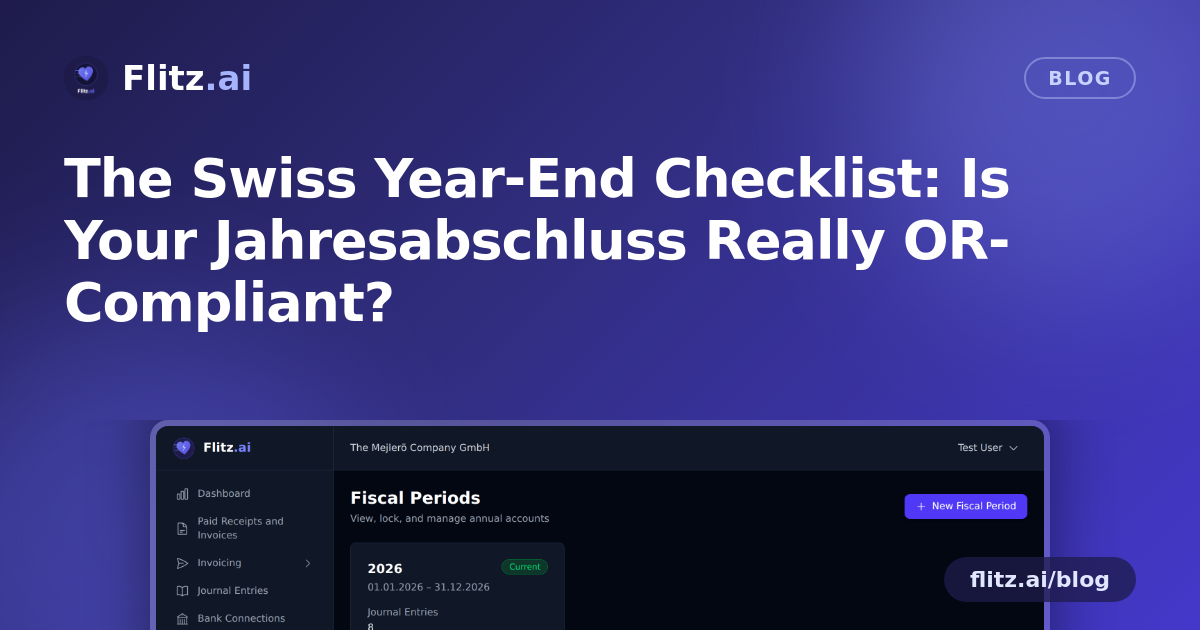
- Fiscal period locking means once a year is closed, the underlying bookings are protected — no accidental edits, no compliance headaches.
- Full traceability back to source entries means every figure in your statements can be explained, not just calculated.
Instead of treating year-end closing as a separate, dreaded project, it becomes a natural extension of the bookkeeping you're already doing throughout the year.
Run the Checklist Now
Go through the eight questions above with this year's books in front of you. If you hit even one gap — a balance sheet that doesn't quite reconcile, a trial balance you have to rebuild by hand, a prior period that's still technically editable — that's a sign your closing process needs automation, not more effort.
Swiss compliance doesn't have to mean more manual work. It means having the right structure in place before the deadline arrives.