
Team Chat and Swiss Compliance: Why Where You Talk Business Matters
Consumer chat apps feel convenient, but they quietly create DSG and record-keeping risks for Swiss SMEs. Here's how a built-in Team Chat keeps business communication compliant and audit-ready.
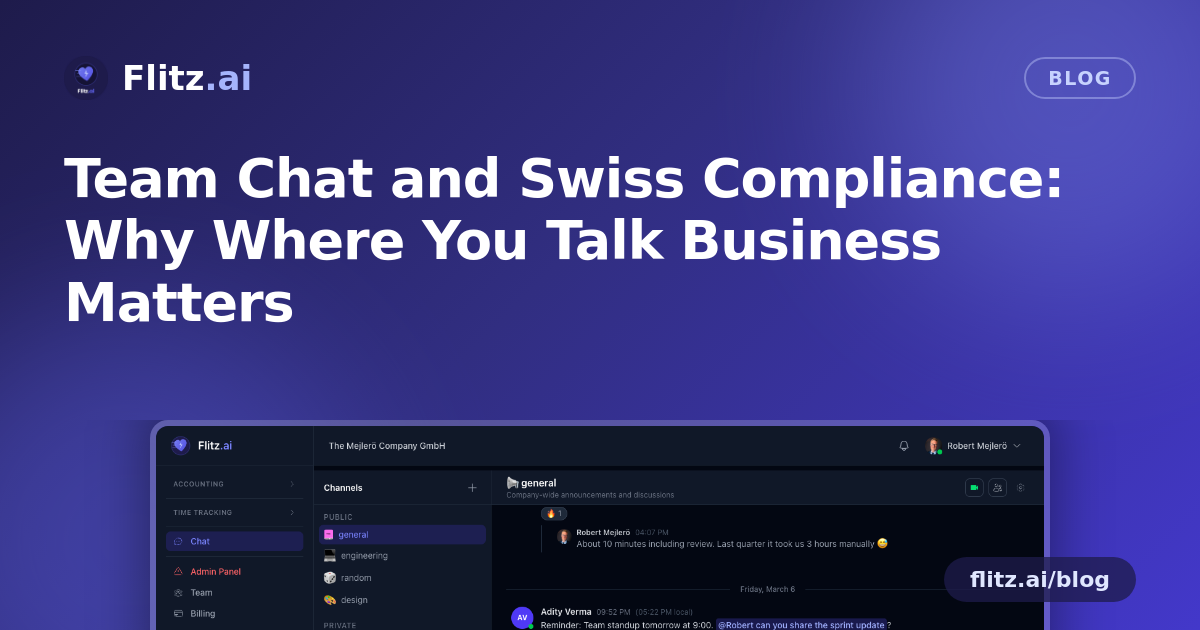
Ask any Swiss SME owner where their team actually communicates day to day, and the honest answer is often "WhatsApp" or a patchwork of personal messaging apps. It's fast, familiar, and free. It is also, from a compliance standpoint, one of the quieter risks sitting inside many small businesses today.
Swiss data protection law (revDSG), combined with GDPR obligations for any business dealing with EU customers or staff, and the general documentation expectations under the Code of Obligations (OR), all point in the same direction: business communication involving personal data, contracts, financial figures, or HR matters needs to happen on infrastructure the company actually controls — not on an employee's personal phone app tied to a foreign server and a foreign privacy policy.
Where consumer chat apps create risk
Consumer messaging tools weren't built for corporate governance, and that gap shows up in several concrete ways for Swiss businesses:
- Data location and processor control. Under revDSG, a company remains responsible for personal data it processes, even when that processing happens inside a third-party app. If client names, salary details, or invoice references travel through a consumer chat app, the business has little visibility into where that data lives or how it's secured.
- No retrievable business record. When a decision, an approval, or a client instruction lives only in a personal chat thread, it disappears the moment an employee changes phones, deletes the app, or leaves the company. That's a problem if the same information is later relevant to a contract dispute, an audit, or a Mehrwertsteuer (MWST) review.
- Mixed personal and business use. Personal chat apps blend private conversations with work ones. That makes it nearly impossible to apply consistent access rights, retention rules, or deletion policies — all things a DSG-conscious business should be able to demonstrate if asked.
- Uncontrolled file sharing. Sending a client contract or a payroll spreadsheet through a personal messaging app means that file now sits on a server and in a backup chain the business never agreed to.
None of this means Swiss SMEs are doing anything malicious. It's simply what happens when convenience tools fill a gap that proper business infrastructure should be covering.
What good practice looks like
Compliance-minded communication doesn't require locking employees into something slow or clunky. It requires a system where:
- Business conversations stay within a platform the company controls and can audit
- Access can be scoped by team, project, or topic rather than an open free-for-all
- Conversations and shared files remain retrievable, rather than vanishing with a deleted app
- Meetings and file sharing happen through the same governed environment, not a dozen disconnected tools
This is exactly the gap that Team Chat in Flitz is built to close.
How Team Chat keeps things audit-ready
Because Team Chat sits inside the same platform as your accounting, invoicing, banking, and HR modules, business conversations stay in the same governed environment as the financial and personal data they often reference — rather than scattered across personal devices and foreign apps.
Public and private channels with threaded replies mean conversations are organized by topic or project, not buried in a single endless feed. If a fiduciary or auditor later needs to trace how an invoice discrepancy was resolved or which employee approved a client change, the thread is still there — searchable and attributable, not deleted along with someone's WhatsApp history.
Private channels give you the access control that consumer apps can't: HR discussions, salary questions, or sensitive client matters can be restricted to exactly the people who need them, supporting the data minimization principle at the heart of revDSG.
File attachments shared inside Team Chat stay within the same infrastructure as the rest of your business data, instead of spreading contracts and spreadsheets across yet another third-party server with its own retention and privacy terms.
The ability to integrate any online meeting provider per channel means video calls tied to a specific client or project are logged and organized in context — useful when reconstructing a timeline of decisions is ever necessary.
And with a native desktop app, OS notifications, and dock badges, employees have no practical reason to fall back on personal apps just to stay responsive — the compliant option is also the convenient one.
Compliance without extra admin work
The point isn't to turn every chat message into a legal document. It's to make sure that when business communication matters — because it touches personal data, a client agreement, or a financial decision — it lives somewhere your business actually owns and can account for.
For Swiss SMEs already juggling OR record-keeping duties, MWST documentation, and revDSG obligations, moving team communication out of personal apps and into a governed, built-in Team Chat isn't extra bureaucracy. It's one less blind spot to explain if a data protection authority, auditor, or client ever asks the question: "Where does that conversation live, and who can see it?"
A compliant chat tool isn't the one with the most features. It's the one where your business still has the record when it needs it.