
5 Training Mistakes Swiss SMEs Make (And How to Fix Them)
Onboarding stuck in someone's head, compliance training nobody can prove, quizzes nobody grades. Here are the training mistakes costing Swiss SMEs time and risk — and how to avoid them.
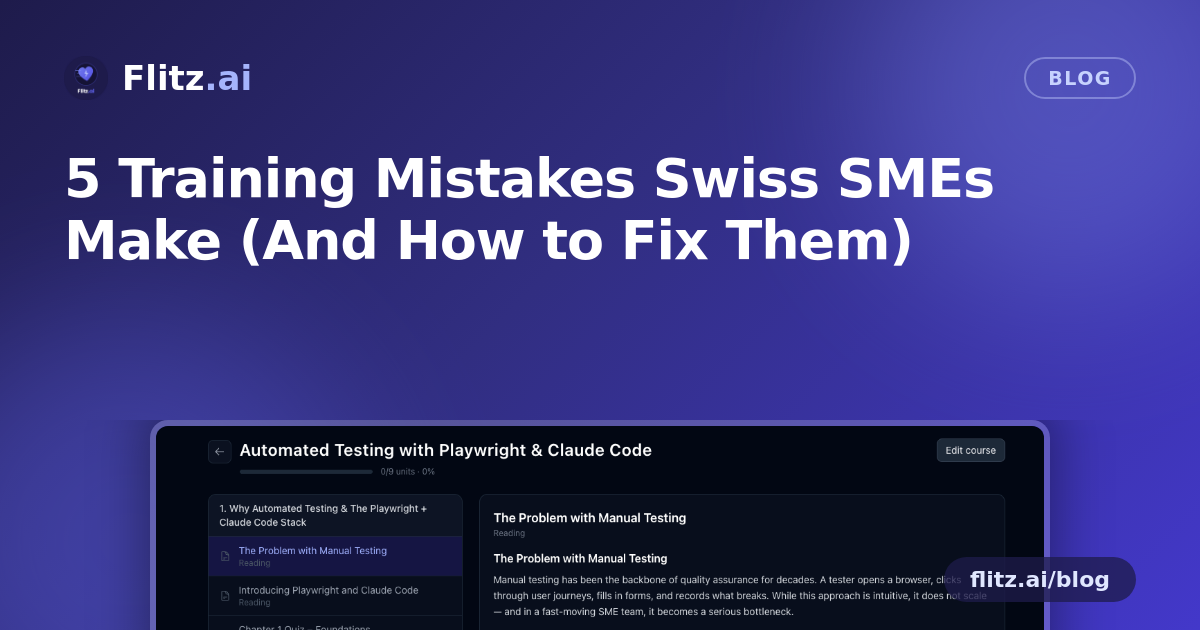
Ask most Swiss SME owners where their training material lives, and the honest answer is: in someone's head, in a folder of old slide decks, or in a WhatsApp message from three years ago that nobody can find anymore. It's not that businesses don't value training — it's that building and maintaining it properly has always felt like a project too big to start. That gap creates real, recurring costs. Here are the mistakes we see most often, and how to close them.
Mistake 1: Onboarding lives in one person's head
New hires typically learn "how we do things here" by shadowing a colleague for a few days. It works, until that colleague is on holiday, leaves the company, or simply forgets to mention something important. The cost shows up later — as inconsistent processes, repeated mistakes, and new employees who feel unsure for weeks longer than they should.
The fix isn't a 40-page PDF nobody reads. It's structured, bite-sized content that every new hire goes through the same way: chapters of video, reading, and quiz units that capture what's currently only spoken knowledge. Flitz's Training module even offers AI course generation — describe the field to be learned and get a full draft course with chapters, readings and quizzes, which you then refine instead of starting from a blank page.
Mistake 2: Compliance refreshers happen once, then never again
Data protection basics, workplace safety, anti-harassment policies — these need refreshing, not a one-time mention during week one. Many SMEs run a single verbal briefing and never revisit it. When an audit or an incident happens, there's no record that anyone was ever trained, let alone retrained.
Assigning a course with a due date solves the recurrence problem: invitees are notified by email, chat and the notification bell, so refreshers actually get scheduled and completed instead of quietly slipping. And because every course produces a permanent per-person training record that survives even if the course itself is later deleted or rebuilt, you have proof of who completed what and when — without digging through old email threads.
Mistake 3: "Completion" means someone clicked next
A common shortcut: send a PDF or a video link and mark someone as "trained" once they've opened it. But opening a file and actually absorbing it are two different things. This mistake is invisible until it matters — a mishandled customer request, a safety incident, a compliance gap — and then it's too expensive to ignore.
Flitz closes this loophole structurally: videos must be watched to the end and readings have a minimum reading time, so there are no click-through completions. Combined with multiple-choice quizzes that carry an optional passing score, genuine understanding — not just presence — is what earns a badge.
Mistake 4: Quiz results can be gamed or lost
If quizzes are run through a shared spreadsheet or a generic form tool, answers circulate, scoring is manual, and results get overwritten or lost. That undermines the entire point of testing knowledge in the first place.
In Flitz, quizzes are graded server-side — correct answers never reach the browser, so they can't be inspected or shared ahead of time. Retakes keep the best result, which encourages genuine learning rather than punishing a bad day, without opening the door to answer-sharing.
Mistake 5: Paying for three tools that don't talk to each other
It's common to see SMEs stitch together a course platform like Thinkific, TalentLMS or Teachable alongside their HR system and their internal chat — three subscriptions, three logins, and training data sitting on servers outside the business entirely. For a Swiss SME already managing accounting, invoicing, banking, CRM and HR in separate places, one more disconnected tool is one more thing to maintain and one more vendor holding your data.
The Training module is built directly into Flitz, tenant-scoped like every other module: courses, media and progress stay inside your workspace, alongside HR records and the rest of the business. No extra subscription, no data leaving Switzerland's business logic behind for someone else's cloud.
What good training actually looks like
Fixing these five mistakes doesn't require a training department. It requires:
- Course content that's actually built from what your team already knows, drafted quickly with AI assistance
- Assignments with due dates and real notifications, so refreshers happen on schedule
- Completion criteria that require real attention, not a click
- Quiz scoring that's tamper-proof and fair on retakes
- A permanent record you can produce if anyone ever asks "was this person trained?"
None of this needs to live in a separate system with its own login and its own subscription. When training sits next to HR, onboarding, and the rest of day-to-day operations, it stops being a project that gets postponed and starts being part of how the business runs.