
VAT Reports in Switzerland: Spreadsheets vs. an Integrated Approach
Every Swiss SME eventually asks: why does filing MWST still feel like a part-time job? We compare the old spreadsheet-and-email way with an integrated approach.
Ask any Swiss business owner or office manager what they dread most on a quarterly basis, and "MWST filing" comes up a lot. Not because the Swiss VAT system is unusually complex compared to other countries, but because the process of getting numbers from your books into a filing-ready report is often more manual than it needs to be.
Let's look honestly at how most SMEs handle this today, where the friction actually comes from, and what changes when VAT reporting is built directly into your bookkeeping rather than bolted on afterward.
The old way: spreadsheets, email chains, and point tools
For many small and mid-sized Swiss companies, the VAT filing routine looks something like this: export transactions from the accounting system, paste them into a spreadsheet, manually tag each line with the correct VAT rate (8.1%, 2.6%, 3.8%, or 0%), double-check for miscategorized entries, then reformat everything to match what the Steuerverwaltung expects. If a bookkeeper or fiduciary is involved, add an email chain — sending files back and forth, waiting for confirmation, fixing a typo, resending.
This approach isn't irrational. Spreadsheets are flexible, familiar, and cheap. For a very small operation with few transactions, manual tagging might genuinely be fast enough. And some point tools do a decent job of one specific step, like rate calculation.
Where the friction actually shows up
- Manual VAT code assignment is error-prone. Assigning the right rate to every transaction by hand — especially when a business deals with multiple rates across different products or services — is exactly the kind of repetitive task where mistakes creep in.
- Disconnected tools mean double entry. If your bookkeeping lives in one system and your VAT calculation happens in a separate spreadsheet or tool, someone has to keep them in sync. That's extra time, and extra risk every time a number changes.
- Formatting for filing is its own task. Even after the numbers are right, they still need to be structured the way the Steuerverwaltung expects. That reformatting step adds no real value — it's pure overhead.
- Email chains create version confusion. When a report bounces between an office manager and a fiduciary multiple times, it's easy to lose track of which version is final.
None of this is catastrophic on its own. But multiply it by every monthly or quarterly filing deadline, year after year, and the cumulative time cost is significant — time that could go toward running the business instead.
The integrated approach: VAT reports generated from your actual bookkeeping
The alternative is to stop treating VAT reporting as a separate project and instead generate it directly from the bookkeeping data you already have. That's the idea behind Flitz's MWST / VAT reports feature: your transactions are automatically assigned the correct VAT code as they're recorded, covering all current Swiss rates — 8.1%, 2.6%, 3.8%, and 0%. No manual tagging, no spreadsheet formulas to maintain.
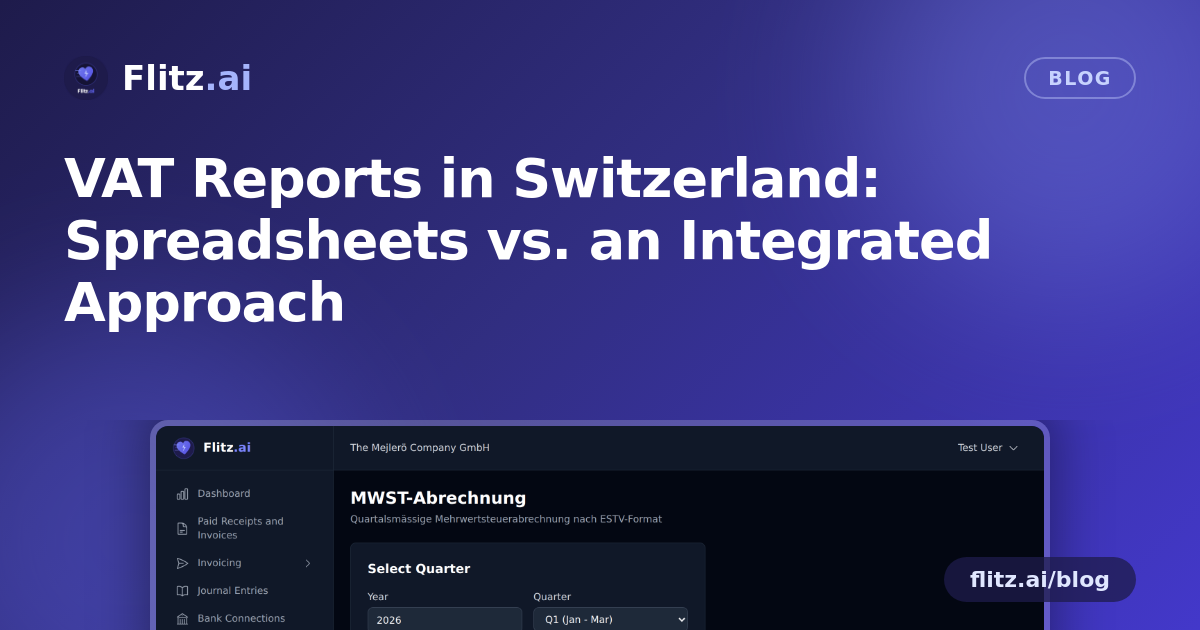
When it's time to file, you choose your reporting period — monthly or quarterly, whichever matches your business — and generate the report in one click. It's already formatted exactly as required for filing with the Steuerverwaltung, so there's no separate reformatting step and nothing to reassemble from multiple sources.
What this trades off, honestly
Consolidation isn't free of trade-offs. Moving your bookkeeping and VAT reporting into one platform means committing to that system's structure rather than the infinite flexibility of a blank spreadsheet. If your business has a genuinely unusual VAT situation, you'll want to confirm the automated code assignment still matches your specific case — automation handles the standard patterns well, but any accountant will tell you to review the output before filing, same as with any method.
That said, for the vast majority of SMEs, the trade-off favors consolidation. You're not giving up control — you're removing the manual steps that didn't require judgment in the first place: copying numbers, applying known rates, reformatting for a known template.
Why this matters more as a business grows
A sole proprietor with a handful of invoices a month might not feel the pain of manual VAT tracking. But as transaction volume grows, as a business starts dealing with multiple VAT rates in the same month, or as a fiduciary takes over filing on behalf of several clients, the manual approach scales badly. Every additional transaction is another chance for a misapplied rate or a missed entry.
An integrated system scales the opposite way: the one-click report takes the same effort whether you have fifty transactions or five thousand, because the rate assignment already happened automatically when the transaction was recorded, not at filing time.
The bottom line
Spreadsheets and disconnected tools got many Swiss SMEs through years of MWST filings, and there's nothing wrong with having used them. But the amount of manual, low-value work they require — tagging rates, reformatting, chasing confirmations by email — is exactly the kind of overhead that automated, correctly formatted VAT reporting is built to remove. If your bookkeeping already knows what happened in each transaction, your VAT report should be a byproduct of that data, not a separate project you start from scratch every month or quarter.