
The Real Cost of "Can Someone Build Me a Dashboard?"
Every "quick dashboard request" costs a Swiss SME hours of back-and-forth. Here's what that actually adds up to in CHF — and how Flitz's AI Gallery removes the bottleneck entirely.
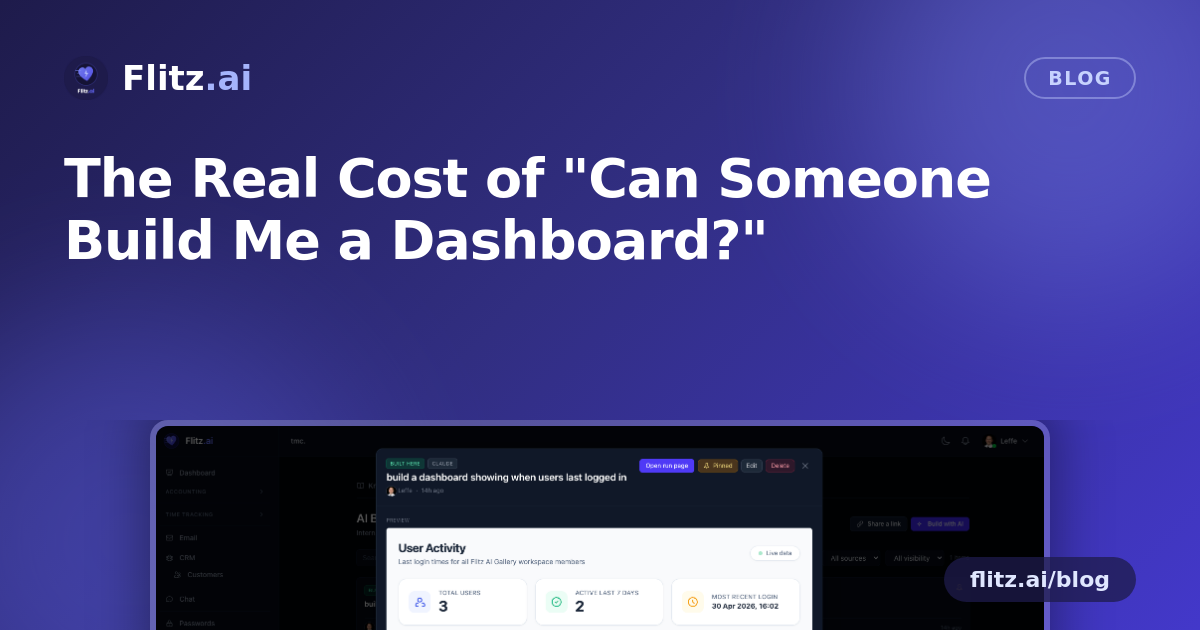
Ask around any Swiss SME office and you'll hear a version of the same story: someone needs a simple internal tool — an absence calendar, a client onboarding tracker, a login-activity view — and instead of getting it in minutes, it takes days. Not because the tool is hard to build. Because of everything that happens before the building starts.
Where the hours actually go
Picture a typical small team of eight to fifteen people. Someone in operations wants to see, at a glance, who's behind on onboarding steps for new clients. There's no dedicated data or IT person, so the request goes to whoever is "good with Excel" — often the office manager or a fiduciary partner who already has a full plate.
- Thirty minutes explaining what's needed, usually over chat or in a meeting
- An hour or two exporting data from three different systems into CSVs
- Another hour or two wrestling with pivot tables, VLOOKUPs, or a half-remembered Power BI login
- A round of "actually, can you also show status per stage" — repeat the export-and-rebuild cycle
- The result lives in someone's Downloads folder and is stale within a week
Conservatively, that's three to five hours per request. A small team generates a handful of these asks every month — new hires need an absence view, a partner wants a login-activity check for security, someone wants a quarterly capacity overview. Multiply it out and you're easily looking at 10-15 hours a month spent on internal tooling that isn't billable, isn't strategic, and isn't even particularly satisfying work.
What that costs in francs
At a loaded cost of CHF 80-120 per hour for the person usually stuck doing this — often your most senior generalist, not a junior — 12 hours a month is roughly CHF 1,000-1,400 a month, or somewhere north of CHF 12,000 a year, spent recreating dashboards that should take five minutes to produce. That's before counting the cost of decisions delayed because the data wasn't ready in time, or the frustration of a team member who gave up asking and just guessed instead.
And this is the optimistic scenario — one where you don't also pay for a BI tool license, or a Lovable/Bolt/Replit subscription for someone to prototype internal apps on the side, disconnected from your real business data and requiring API keys and auth setup before anything even runs.
The fix: let the person with the question build the answer
The AI Gallery in Flitz removes the bottleneck by removing the middleman. Any employee can describe what they need in plain English — "absence calendar for the next quarter," "client onboarding checklist with status per stage," "dashboard showing when each team member last logged in" — and the AI builds a working HTML/JavaScript tool right in the browser, using the same SQL toolkit and row-level security as the Flitz AI Assistant.
There's no CSV export, because it's already connected to your live tenant data. There's no separate coding subscription, because Alpine.js and Tailwind run the whole thing in-browser. And there's no waiting on the one person who understands pivot tables, because the person asking the question is the one building the tool.
Iterate in seconds, not another meeting
Once the first version exists, refining it is a chat message, not a new project: "make the avatars bigger," "add a filter by role," "sort by last active." The AI rebuilds the artifact on the spot. Compare that to the old cycle of re-explaining requirements and waiting for the next available slot on someone's calendar.
Built once, useful forever
Unlike a one-off AI Assistant chat that answers a question and disappears, gallery items are persistent. Pin one to the team dashboard and it becomes a permanent, shareable mini-app — anyone with access can re-run it, and author avatars plus visibility controls mean private drafts stay private until you're ready to share.
Time saved is focus regained
The real return isn't just the CHF 12,000-plus in avoided rebuild cycles. It's what your team does with the hours that come back: a fiduciary partner spends that time on advisory work instead of pivot tables; an office manager gets a real lunch break; a founder stops being the informal BI department for a company that was never supposed to need one. In a small team, freeing up even one afternoon a week per person compounds fast — into faster decisions, less second-guessing, and a team that trusts the numbers because they built the view themselves.