
Endpoint Security and Swiss Data Law: Why Every Laptop Is a Compliance Risk
A single infected laptop can trigger breach-notification duties under the revised Swiss DSG. Here's what the law expects from SMEs — and how to stay audit-ready without hiring a security team.
Every Swiss SME now runs on laptops, phones, and a patchwork of cloud apps — and every one of those devices is a potential doorway into company and customer data. Since the revised Federal Act on Data Protection (DSG) came into force, and with GDPR obligations still applying to many Swiss businesses serving EU customers, the question is no longer "should we have antivirus software?" It's "can we prove, in writing, when we detected a breach and what we did about it?"
That second question is where most small and medium-sized businesses run into trouble.
What the law actually expects
The revised DSG and GDPR both build on the same principle: data controllers must detect breaches quickly and, in many cases, report them within a strict timeframe once they become aware of a risk to data subjects. The clock doesn't start when you decide to investigate — it starts when the breach reasonably should have been noticed. If your business has no continuous monitoring, "should have been noticed" can be argued to mean much earlier than the day someone finally spots something odd.
For a bakery chain, a fiduciary office, or a ten-person engineering firm, this creates a real gap. Nobody has a security operations centre. Antivirus is often whatever came preinstalled, updates are inconsistent across Mac and PC, and nobody is actively watching for indicators of compromise. If a breach happens, there's no log, no timestamp, no documented response — just a vague sense that "something seemed slow last Tuesday."
Where manual processes create risk
Three gaps show up again and again in Swiss SMEs:
- No continuous scanning. Antivirus that only runs when someone remembers to click "scan" leaves weeks of blind spots.
- No posture visibility. Is disk encryption actually on? Is the firewall enabled? Is the screen lock configured? Most owners genuinely don't know, device by device.
- No documented response. Even when something is caught, there's rarely a record linking the detection to an asset, a timestamp, and an action — which is exactly what a regulator or cyber insurer will ask for after an incident.
Buying a dedicated endpoint-protection suite like CrowdStrike or SentinelOne solves the technical problem but adds another subscription, another dashboard, and another vendor contract to manage — often sized for enterprises, not a 15-person KMU.
How built-in endpoint protection closes the gap
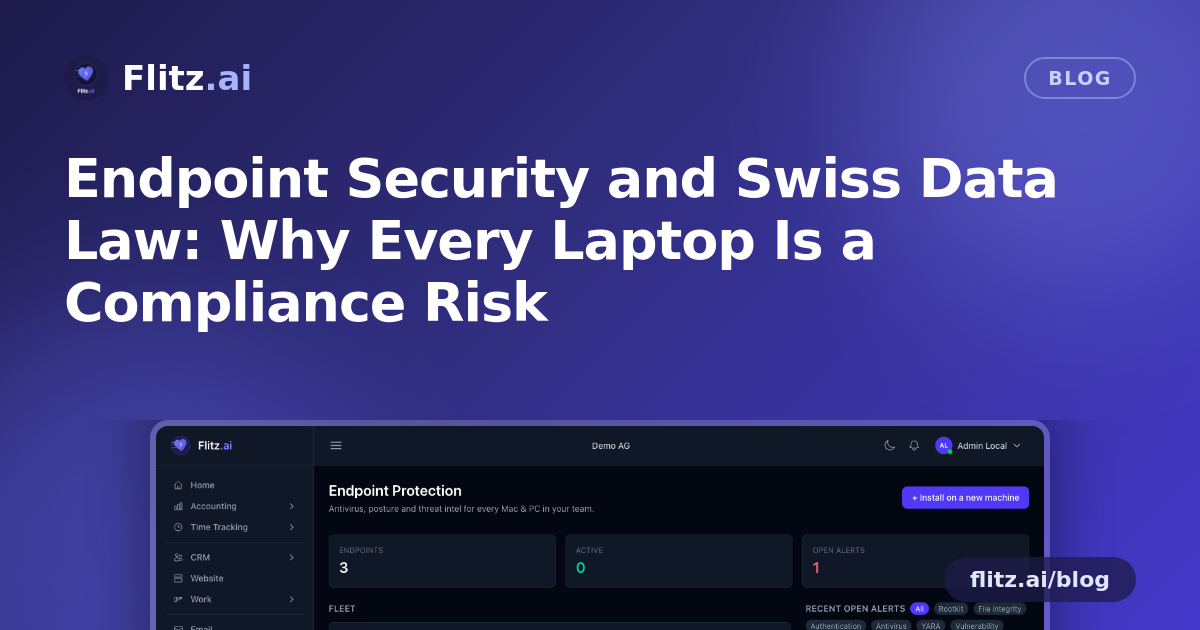
Flitz's Antivirus & Endpoint Protection module is designed to give Swiss SMEs the same continuous monitoring that larger companies rely on, without a separate security stack. A lightweight agent on every company Mac and PC runs ClamAV and YARA antivirus scanning on-demand or on a schedule, so there's no reliance on someone remembering to click a button.
Every endpoint is also checked against abuse.ch threat-intelligence indicators of compromise, catching known-malicious activity that signature-only antivirus can miss. On top of that, a CIS-benchmark posture score evaluates each device for disk encryption, firewall status, screen lock, and signature freshness — turning "we think our laptops are secure" into a documented score per device.
When a high-severity detection occurs, Flitz doesn't wait for someone to notice. It automatically opens an alert and, where the law requires it, starts the GDPR breach clock — creating the timestamped record that proves when the organisation became aware and what happened next. From the fleet dashboard, a single click can isolate a compromised machine from the network, or release it once it's clean, without needing to walk to someone's desk.
Audit-readiness without extra tooling
Every endpoint automatically links to its corresponding IT-Inventory asset by MAC address or serial number, so when an auditor, insurer, or fiduciary asks "which device, which user, which date," the answer is already connected — no spreadsheet reconciliation required. And because Flitz is tenant-scoped, every device, alert, and scan belongs exclusively to your company; there is never any cross-tenant visibility or leakage, which matters as much for client confidentiality as it does for DSG compliance itself.
For businesses that currently cobble together separate tools — Bitdefender GravityZone for scanning, Jamf Protect for Mac fleets, a spreadsheet for inventory, and a mental note for breach timing — consolidating into one module means one less vendor relationship, one less login, and one coherent audit trail instead of four disconnected ones.
The real benefit: fewer surprises, better documentation
Compliance isn't really about having the right software installed — it's about being able to demonstrate, after the fact, that reasonable measures were in place and that you acted promptly. Continuous scanning, automatic posture scoring, instant isolation, and an automatically-started breach record together turn a reactive scramble into a documented process. That's the difference between a stressful phone call to a lawyer and a calm, evidence-backed conversation with the Federal Data Protection and Information Commissioner (FDPIC) or an auditor.
For Swiss SMEs without a dedicated IT security function, that's not a luxury — it's what the law now effectively expects of any business handling personal data.