
Endpoint Security Without an IT Department: A Swiss SME's Quarter-End Wake-Up Call
A illustrative quarter-end scenario shows how Swiss SMEs without an IT team can detect, contain, and document a security incident in minutes — not weeks.
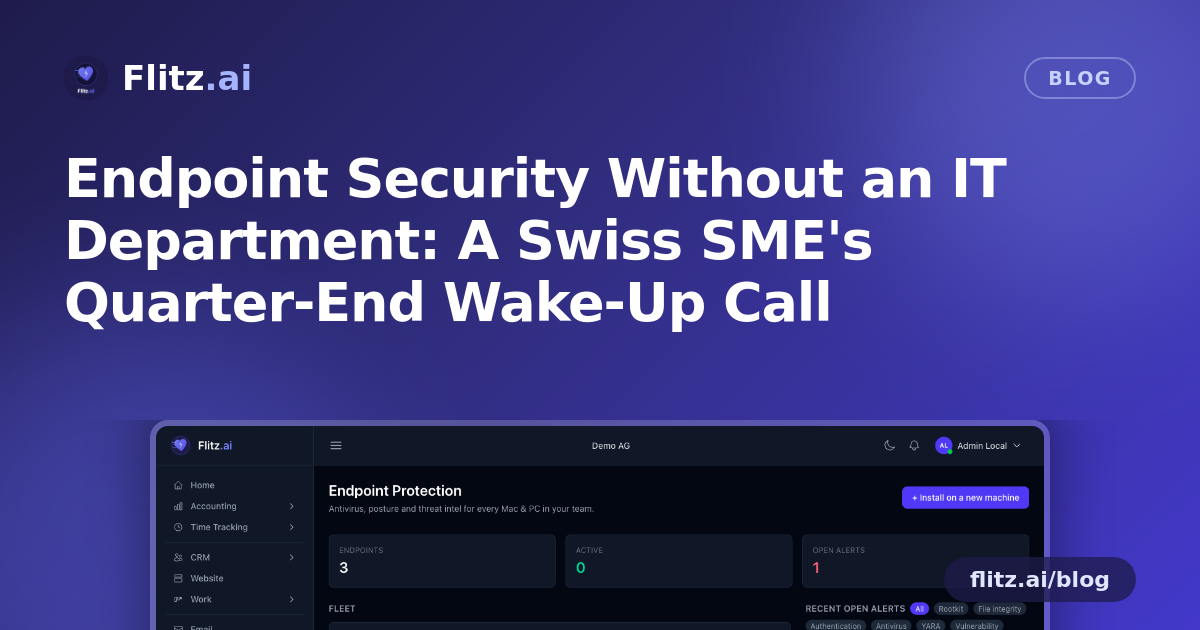
Picture a fictional but familiar scenario: a Swiss engineering firm with fourteen employees is closing the books for quarter-end. The finance lead is finalizing MWST figures, the office manager is onboarding a new hire, and someone in the workshop just plugged a USB drive from a client site into their work laptop. None of this looks unusual. But this is exactly the moment when small businesses are most exposed — everyone is busy, attention is on deadlines, and nobody is watching the endpoints.
This is the reality for most Swiss SMEs: there is no dedicated security team, no 24/7 monitoring, and no budget for an enterprise-grade tool like CrowdStrike or SentinelOne. Yet the risk is identical to that of a large company — ransomware, malware, and data breaches do not check headcount before striking.
The Quarter-End Scenario, Step by Step
In our illustrative example, the new hire's laptop was set up two days earlier. Because Flitz's lightweight agent is part of the standard onboarding checklist, it was installed alongside the usual accounting and CRM access — no separate IT project required. The moment the device joined the network, it auto-linked to its IT-Inventory asset record by MAC address and serial number, so the office manager never had to manually track which laptop belongs to whom.
When the USB drive was inserted, the scheduled ClamAV and YARA antivirus scan on that machine happened to run shortly after. It flagged a suspicious file pattern. At the same time, Flitz's abuse.ch threat-intelligence IOC matching cross-referenced the file against known indicators of compromise circulating in the wild. The combination triggered a high-severity detection.
What Happens Next — Automatically
This is where the workflow stops depending on someone noticing an email buried in an inbox. Because the detection was high-severity, Flitz automatically opened an alert on the fleet dashboard. In parallel, since the situation met the threshold the law requires, it also started the GDPR breach clock — the countdown that determines notification deadlines — without anyone having to remember the regulatory obligation exists.
The office manager, who has no formal security training, opened the dashboard and saw a single flagged device with a clear severity indicator. Rather than calling an external consultant and waiting hours, she clicked once to isolate the machine from the network. The laptop stayed physically usable for the employee to continue other tasks, but it could no longer reach the file server, the CRM, or the internet — containing the threat before it could spread to the finance workstation next to it.
Checking the Rest of the Fleet
With the immediate threat contained, the natural next question is: what about everyone else's laptop? Instead of guessing, the office manager triggered an on-demand scan across the fleet directly from the dashboard. While that ran, she reviewed the CIS-benchmark security-posture score for each device — a simple per-machine rating covering disk encryption, firewall status, screen lock settings, and signature freshness. Two older laptops showed outdated antivirus signatures; both were flagged for update before quarter-end reporting continued.
This is the kind of visibility that normally requires a separate endpoint protection platform, a Jamf-style device manager for the Mac users, and someone to reconcile the two. In this scenario, it was one dashboard, one login, and one tenant-scoped view — every device, alert, and scan isolated strictly to this company's own data, with no risk of visibility bleeding across clients or tenants.
Audit Season, Simplified
A few weeks later, when the firm's fiduciary asked for evidence of IT security controls as part of an annual review, the answer wasn't a scramble through email threads and sticky notes. The incident record — detection, isolation, GDPR breach timestamp, and resolution — was already there, tied to the specific device in IT-Inventory. That is the difference between hoping your security process would hold up under scrutiny and being able to show it did.
Why This Matters for Small Teams
Most SMEs don't lack the awareness that endpoint security matters — they lack the staff and budget to run a dedicated stack of antivirus, threat intelligence, device compliance, and incident response tools separately. Flitz folds all of that into the same platform already running payroll, invoicing, and CRM, replacing tools like CrowdStrike, SentinelOne, Bitdefender GravityZone, and Jamf Protect with one built-in system.
Every Mac and PC in the company gets the same continuous protection: scanning, threat-intel matching, posture scoring, one-click isolation, and automatic compliance documentation — without hiring a security specialist or juggling four vendor dashboards. You can see how this fits alongside the rest of the platform on the Flitz endpoint protection feature page.
Note: the scenario above is illustrative and intended to demonstrate the workflow, not a real company or event.